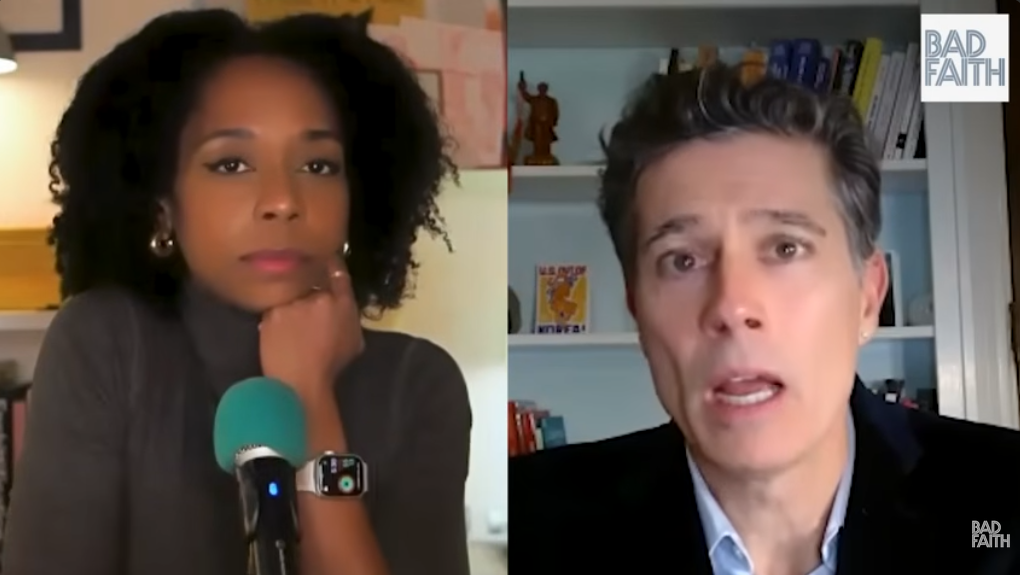
Briahna Joy Gray, former spokesperson for the Bernie Sanders primary campaign of 2020 and host of the popular podcast Bad Faith, did her listeners a real service recently by having on as a guest Villanova professor of philosophy Gabriel Rockhill to talk about his new book Who Paid the Pipers of Western Marxism? and how the CIA constructed what Rockhill calls “compatible leftism.”
According to Rockhill, an unabashed revolutionary Marxist, during the Cold War the CIA groomed anti-Soviet, self-identified “Marxists” from the Frankfurt School (including Max Horkheimer, Theodore Adorno, and Herbert Marcuse), funding their scholarship and bringing some of them to the US to teach at elite American universities. The point was to influence a movement in Western European and North American Marxism that would shift its focus from class conflict to culture and turn it into a theory and criticism factory, thereby draining it of its anti-capitalist power and removing it as a threat to the capitalist imperialist political order that created the CIA for exactly such purposes. Rockhill classifies these scholars and more recent ones like Michel Foucault and Slavoj Zizek into the “compatible” left because it has no interest in altering the power structure. Rather, it fits comfortably into it. (Horkheimer, considered one of the founders of the Frankfurt School, for example, would eventually shock lefties by defending the Vietnam War as a bulwark against Red China!)
The Democratic Party, meanwhile, has never been part of the left. It has always been a party of capital. Any “left” impulse the party has ever had (and probably will ever have) has come only from popular movements outside its infrastructure, which mirrors the national political structure: money on top, people below.
Gray does a superb job of supporting Rockhill as he explains these foundational facts of capitalist empire to her listening audience, sharpening the focus with illustrations from her own experience as a Harvard-trained lawyer and political player/influencer of the left. Rockhill’s book seems clearly to have resonated with her, even excited a sense of hope in her.
But then, nearly a third of the way through the three-hour podcast, Gray reveals a knee-jerk tendency in her approach to conversation that can sometimes undermine the intended irony of her show’s title.
It begins to go off the rails a bit when she asks Rockhill–who had just described Slavoj Zizek as a classic liberal doing “commie cosplay” to lure half-formed lefties away from anti-imperialism–for his opinion on another professional leftist, Noam Chomsky. Is Chomsky a member of the compatible left, Gray wonders? The reason she’s so interested is not because of Chomsky’s recently revealed friendship with Jeffrey Epstein, which has suddenly rendered him persona non grata in many parts of the chattering left. No, Gray harkens back to some friction she got from Chomsky in the prelude to the 2020 presidential election, when, much to her frustration, he insisted that the correct response for a person of the left was to vote for the less fascist of the two major candidates, i.e., Democrat Joe Biden.
There’s some sticky history between Gray and the Democrats. After the 2020 primary was quickly settled following Biden’s win in the South Carolina primary, when, allegedly, Barack Obama orchestrated exits from Beto O’Rourke, Amy Klobuchar and Pete Buttigieg to prevent Bernie Sanders from winning the nomination, Gray infuriated “blue no matter who” voters for refusing (unlike her boss, Bernie Sanders) to toe the line behind Biden and publicly switching her support to those notorious Democratic bugbears, the Greens. Chomsky infuriated Gray for sounding like one of those die-hard Democrats chasing her around social media.
Full disclosure: In 2020 I was already planning to vote for the Greens, as I’d been voting for them in presidential elections since 2012. I live in New York, a solidly blue state that makes it very hard to vote third party because Democrats in particular have raised the bar for other parties to get a place on the ballot. I’ve been reasoning that my vote means next to nothing no matter how I vote since the Democrat is virtually guaranteed to win in New York. I think of my third party support (in 2024, I wrote in Claudia De la Cruz of the Party for Socialism and Liberation) as harmless votes of No Confidence in the status quo. I’m sympathetic to Gray’s argument that, for many marginalized people, the threat to withhold support from Democrats as a bloc to shift the party left is the only political power that feels available to them. That was the strategy opponents of the genocide in Palestine were following in 2024 with the ploy to write in “uncommitted” in opposition to Biden in the primaries. Unfortunately, it didn’t work as hoped or intended. The eventual nominee, Kamala Harris, dug in on her stance, evidently lacking the will, courage, or imagination to give a clear sign of support for the Palestinian American community by, for example, making space at the Democratic convention for one Palestinian speaker.
Listening to Rockhill’s response to Gray’s Chomsky query—indeed, listening to Rockhill’s sharp analysis of politics as essentially and always a struggle between capital and labor or, if you prefer, between bosses/owners/authorities and workers/renters/democrats—I realized that Chomsky and Rockhill actually make perfect sense: For working people and believers in leftist ideals like equality and freedom for all, American elections, especially at the national level and most especially in swing states, can only be about harm reduction, about choosing between more entrenched fascism and less entrenched fascism. It’s a choice between giving the billionaires who believe they own the country more power or moving the needle a little in the other direction. Someone like Gray might reply, then you’re still voting for fascism or political and economic inequality. But I was more persuaded by Rockhill’s analysis. “If you’re serious about changing the political spectrum in the United States,” he says, “you can’t just do it around election time,” and he continues:
Everything [in the U.S. electoral system] is so fundamentally anti-democratic. What you need is to develop real people’s power in organized institutional form so that when you come to an election you actually have the power necessary to fight and win….
I am of the position that given the current state of US American politics, genocide was never on the ballot. It’s never been on the ballot. Genocide is constant under US imperialism. The Democrats do it, the Republicans do it. What you see different under the current administration is an increasing turn towards fascism that is, at certain levels, more intense than what you saw under Biden and then the Harris campaign….
Would I prefer Harris to be in office as opposed to Trump? Would I think that that would be incrementally—incrementally— better? Yes. Do I think it would get us further to abolishing imperialism? No. Further to abolishing capitalism? No. Further to dismantling the structures that maintain that two-party system? No. But in order to do that, you need strategic thinking and you need strategic political action….
Voting is a tactical political decision that takes about five seconds and relates to what the overall field of forces is and where you want to go strategically in the future. And in the United States today, going in the fascist direction is not going to allow us to develop more political power on the left…. I mean, as far as I’m concerned, incremental differences matter in politics, but they have nothing to do with my strategic horizon of struggle, which are ultimately in the long term.”
Gray admits that Rockhill “triggered” her (her term) by echoing the very words Chomsky used, talking about voting as a small, brief matter in the polling booth—probably also by stating simply that, yes, Harris in the White House would be better than Trump, something far too many on the left have trouble admitting. Unfortunately, it seems to have triggered her to shut her ears to what Rockhill was really saying about the key differences between political strategy (toward end points) and the tactics used to get there. Her wheels got stuck in the angry muck of the duopoly vs. democracy debate and it’s unclear to me whether she took in the more fertile ground Rockhill was trying to move the discussion to. She does eventually move the conversation in a more interesting and extremely helpful direction, allowing Rockhill plenty of time for his trenchant analysis of the current crisis from a global and historical perspective.
“There’s a great distinction that [Antonio] Gramsci makes,” Rockhill says at one point, “between … a war of maneuver, when you move forces in, of course, and then a war of position, when you’re actually digging the trenches and doing the hard work of building power. I think that we’re in a war of position in the United States [between left and right]. We need to build left power, left political education, left party structures, a left culture, because it’s been decimated for decades and decades.”
I do think it’s extremely helpful, even urgent, to listen to the entire conversation. So many on the left are still stuck in that fruitless conversation over who among us on the left is more responsible for the mess we’re in. We don’t need to be there. We all need to take a step back and try to see the big picture, understand the long-term history of how we got here (hint: history did not begin in 2016) and what must be done to end catastrophic capitalism and forge a more democratic, equitable world in which everybody is free and prosperity is accessible to all, not just a tiny sliver of the population .
Elections in the U.S. never have and never will bring greater democracy or the full revolution toward socialism that could remake the world. They just give the electorate an opportunity to vote for more entrenched capitalist inequality and imperialism or less. A constitutionally built-in inequality gives some of us who live in red or blue states the privilege of attempting the tactic of third-party voting. It’s more urgent to build a political infrastructure, like a Congress organized to reflect proportional representation, that can accommodate and empower third parties. But as my identical twin brother has pointed out to me in our rare but intense disagreements about Democratic politics and voting, it may be more ethical and politically mature for blue or red state leftists to show solidarity with their less-privileged comrades in the swing states and consistently vote for incrementally less fascism. I’m coming around to agree with him. But in the long run, it’s always better to keep the focus on the needs, wants and desires of the people. And on the long-term strategy to elevate and empower them..
 Tragic Farce