A Statement From the 90 5th Avenue #Occupation

Here’s a fascinating and encouraging development from yesterday’s second-month celebration of the occupation of Zuccotti Park, something to indicate that the movement is far from being a flash in the pan and far from being defanged. A group of students and other protesters have taken over a space at 90 Fifth Avenue in preparation for creating a free “people’s university.” It may also provide an alternative space for at least some of #OWS’s displaced denizens during the winter months, provided the city and the owners  of the building (which happens to be one of the nation’s largest banks, according to the protesters) don’t try to Bloomberg/Brookfield them out.

A Statement From the 90 5th Avenue Occupation follows the jump: Continue reading

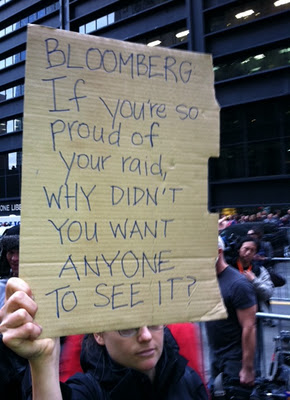
#OWS Signage: Question for Bloomberg

h/t Charles Bivona

UPDATE: State of Seized Library

From the blog of #OccupyWallStreet’s People’s Library:

UPDATE: State of Seized Library.

The movement will no doubt survive, even if its flagship camp is forced to move elsewhere. But its flagship library is not as easily replaced.  More than any other aspect of Bloomberg/Kelly’s Monday night raid on Zuccotti Park, the thoughtless destruction of the People’s Library symbolizes the soullessness of the authorities threatened by our wonderfully rebellious American Fall.

May the embers of this shameful moment be kept alive in our hearts and minds to kindle an even more wonderful American Spring.

#OWS: Sometimes the Good Guys Don’t Wear White

Don Emmert/Agence France-Presse — Getty Images


The Standells – Sometimes Good Guys Don’t Wear White

#OWS Economics: Ron Paul on Wealth and Privileges

4. Government may not redistribute private wealth or grant special privileges to any individual or group.

–from The Ten Principles of a Free Society

Continuing my gradual critique of Ron Paul’s Ten Principles, the next in line is relevant to what I’ve been talking a lot about these past few weeks, the great impetus behind #OccupyWallStreet: income inequality.

It’s significant that the godfather of the Tea Party movement (the original form of it, anyway) includes wealth redistribution in his principles of liberty. It points up an area where these two movements can either come together or get driven apart.  There’s no question about where #ows stands on this point. Income inequality is a key symptom of the disease #0ws arose in response to, and one of its goals, I would argue,  is to force a correction of what it views this to be: a moral wrong. If Paul is any indication (and I’m sure he is), the Tea Party is not so much troubled by this gap as it is by the idea that government should try to close it. Continue reading

#TeaParty Rep. Loses Cool with Skeptical Constituents

Rep. Joe Walsh of Illinois demonstrates his concept of representative democracy at a townhall held in a bar in his district last weekend. What exercised the Congressman’s patience was the suggestion, apparently popular among the unrattled attendees, that, as I suggested yesterday,  private banks were as much at fault for the depressed or recessed economy as politicians. Walsh displays the Tea Party mindset at its most rigid worst when he asserts that consistency of ideology is more important than accuracy of fact. He doesn’t want the people of his district to forget is that he will not stray from the Tea Party (Republican) line that  private interests are more important than the public interest.

The bottom line: The people get it. Some politicians don’t and don’t want to get it.

PS: Perhaps the most astonishing moment of this video is when Walsh says, “”What has made this mess is your government­, which has demanded for many years that everybody be in a home.” Is a Tea Party Republican actually blaming the American dream of universal home ownership for the economic mess? Is he really suggesting that the American dream is the product of government rather than of individuals? Setting aside the question of whether or not this is right, this seems to be a startling position for a conservative, pro-market, pro-individualist to be taking. I wonder if this will be a new shade of conservatism: anti-American Dream libertarianism.


The Bishops and Their Pawns

Archbishop Timothy Dolan, President of the US Conference of Catholic Bishops, spreading smoke at his day job.

I’ve been focusing on monied interests in the past few weeks, but if you want a striking example of how American democracy has evolved to favor the interests of the powerful over the people, consider this article on Huffington Post by Laura Basset about another form of ungodly influence over the body politic:

A group of men with no real background in law or medicine, but blessed with a strong personal interest in women’s bodies, have quietly influenced all of the major anti-abortion legislation over the past several years. The U.S. Conference of Catholic Bishops may be one of the quietest, yet most powerful lobbies on Capitol Hill, with political allies that have enabled them to roll back decades of law and precedent. Continue reading

Through a Glass Darkly: Catherine Austin Fitts and the Capitalism of Crisis

In The Shock Doctrine, Naomi Klein brought to light the neoliberal tactic of crisis capitalism, unleashed in circumstances (as in Chile, Argentina, Poland, Russia, South Africa) where political powers have exploited (or even created) extreme conditions–such as coups, natural disasters, or economic crises–during which the local population is disoriented and their defenses are down, to instigate corporation- and “investment”-friendly policies like lowered taxes and the  cutting  and privatization of government services.  The justification given for such maneuvers is to bring the target economy in line with the global economy, but, of course, very few people (only a tiny few) in the world actually benefit from these capitalistic incursions. One of the most obscene instances of the Shock Doctrine in action resulted in the rape of the former Soviet Union”s assets by the oligarchs in the name of Boris Yelstin’s economic “reforms.” But that’s only one of the most obvious and well known cases.

Catherine Austin Fitts

Catherine Austin Fitts

During the Clinton years, as former communist apparatchiks were helping themselves to radically discounted oil fields and other rich resources in Russia, Catherine Austin Fitts says she witnessed a similar feeding frenzy much closer to home. A former managing director and board member at the Wall Street firm Dillon Read who served as Assistant Secretary at HUD in the first Bush administration, Fitts started a financial company of her own, The Hamilton Securities Group of Washington, D.C., to help communities make the most of federal monies and improve their standing in what she calls the Popsicle Index,  which measures the confidence families in a community feel to send a six-year-old by herself to the corner store and back. Fitts witnessed firsthand the collusion between Washington and Wall Street insiders (often the same people on opposite sides of a revolving door) to employ crisis capitalism techniques in the US as part of the daily repertoire of government actions (my emphasis):

Our efforts at The Hamilton Securities Group to help HUD achieve maximum return on the sale of its defaulted mortgage assets coincided with a widespread process of “privatization” in which assets were, in fact, being transferred out of governments worldwide at significantly below market value in a manner providing extraordinary windfall profits, capital gains and financial equity to private corporations and investors. In addition, government functions were being outsourced at prices way above what should have been market price or government costs — again stripping governmental and community resources in a manner that subsidized private interests. The financial equity gained by private interests was often the result of financial, human, environmental and living equity stripped and stolen from communities — often without communities being able to understand what had happened or to clearly identify their loss. This is why I now refer to privatization as “piratization.”

One of the consequences was to steadily increase the political power of companies and investors who were increasingly dependent on lucrative back door subsidies — thus lowering overall social and economic productivity. Hence, the doubling of FHA’s mortgage recovery rates from 35% to 70-90% ran counter to global trends and ruffled feathers…. Continue reading

Where Did #OccupyWallStreet Come From?

When the histories of #OWS begin to be written, two primary sources will be invaluable, and you can read them right now.

Continue reading

#OWS: The Status Quo Strikes Back

I went with my wife and daughter to Times Square on Saturday evening, October 15, to add our numbers to the #occupationWallStreet demonstration that ended up there, climaxing a day of global protest. It was invigorating to know people were there, like us,  specifically for the shared purpose of declaring to the world that this is a movement–or a revolution, I like to think– only just beginning. And on top of that, to witness the tourists and ordinary denizens of the shops, hotels, restaurants and street corners near America’s Crossroads seeming to get that they were observing history being made around them, like the diners pressed against the windows on the second story of  T.G.I.Friday’s staring down at the throng-choked sidewalk below.  It was difficult to tell how many in the crowd were existing in the gray area between tourist just happening to be on the spot and protester in the making. (Truth be told, probably not many. But among the workers, that’s another matter.)

When we got home, my wife read aloud a report from Reuters called “Wall Street protests go global, riots in Rome,” that stunned me–actually depressed me, to be more precise. The story, by Philip Pullella from Rome with additional reporting by Ray Sanchez and Ed McAllister in New York (among others elsewhere), gave the distinct impression that, besides the Roman riots, the news service’s reporters were unimpressed with the subject. Continue reading