Republicans in Congress Are Fine with Musk Power Grab

First phone lines in Kathmandu being laid in 1959 with help from the United States Agency for International Development (USAID). This photo is from an archived USAID site. At the time of this posting, the USAID site itself was dark.

There are some extraordinary admissions from powerful Congressional Republicans in a NOTUS article by Haley Byrd Wilt, Shifra Dayak and Ben T.N. Mause :

In interviews on Monday night, Republican senators — including members of the Appropriations Committee tasked with setting funding levels — dismissed Musk’s moves to consolidate his power and seize sensitive government systems to shut down spending. They say that Musk, in rejecting appropriations laws passed by Congress, is simply following Trump’s priorities.

Some, like North Carolina Sen. Thom Tillis, even acknowledged that what Musk is doing is unconstitutional — but “nobody should bellyache about that.”

“That runs afoul of the Constitution in the strictest sense,” Tillis said. But “it’s not uncommon for presidents to flex a little bit on where they can spend and where they can stop spending.”

Other Republicans argued that Musk is making the government more efficient, and they said they’re glad — if nobody on Capitol Hill is going to slash spending — that someone has finally taken charge.

“The actions that have been taken with USAID are long overdue,” Sen. Bill Hagerty said. “The agency is out of control.”

And Sen. John Hoeven said “they need to be accountable.”

Yes, a Republican says, a US agency that has been at the center of foreign aid (and secret foreign policy) for more than half a century needs to be held accountable, but the party’s choice for effecting that? The world’s wealthiest man and his team of barely legal social media minions, none of whom has been vetted by Congress or any other Constitutionally empowered entity.

Or do they want to make the case that the Constitutionally-elected and seated president picked him to wield extraordinary powers over the government, so it’s virtually Constitutional somehow? No, they don’t say that. They admit it runs “afoul” of the Constitution–but who cares?

Adios, “strict constitutionalism.” Hello, interesting times.

Reagan Spending vs. #TeaParty Austerity

Would Tea Party Republicans have voted to give Reagan his 50% spending increases and 700,000 more government jobs?

In an article from the Washington Post on “Tea Party” Congressman Mick Mulvaney of South Carolina, these paragraphs caught my attention:

Mulvaney mostly meets with voters through weekly town hall meetings. Sometimes he brings with him a 30-minute PowerPoint presentation, full of bar graphs and fever charts depicting the growing federal deficit and the surging cost of health care. In January, Mulvaney added a chart on the automatic spending cuts, known as sequestration, which next year will total about $100 billion.

To him the numbers make sense. “In the greater scheme of things, they are not that big,” Mulvaney said.

But, every once in a while, a personal anecdote punctures his certainty. Earlier this month, a friend and former campaign volunteer stood up at one of the town hall meetings to tell Mulvaney that the defense cuts had cost him his job of five years with a large defense contractor. “I just want you to know that these cuts are real and they hurt me,” said Jeffrey Betsch, a single father of three daughters, who was on the verge of being evicted from his home.

After the Rotary Club speech, Mulvaney was thinking about his friend as he drove down a narrow two-lane ribbon of worn blacktop, past strawberry farms and pine forests. He felt terrible, he said, but he also believed that the country faced problems that were bigger than the struggles of a single constituent.

“I don’t see how you wipe out 40 cents of spending on every dollar and not have someone get hurt,” Mulvaney said.

The punchline of the article, which is titled “As budget cuts hit S.C., a congressman is surprised at constituents’ reactions” is that his constituents are actually not angry with him, despite his stubborn refusal to shower the district with federal dollars, as his predecessor Rep.  John Spratt did. It was anger toward Spratt and his loose spending ways that propelled Mulvaney into office in 2010. That same anger may be the wind at his back if he runs for higher office in his state.

Yet principled though they may be, Mulvaney’s actions have had real consequences for his constituents. In addition to his former campaign volunteer, the Congressman faced the irritation of an Air Force general in his district who claimed the effects of the sequester had made the AF less ready for warfare than at any time in memory. To which charges, Mulvaney responded,  “If the cuts force us to look for better ways of saving money in the future, they will be a success. We can’t go backwards.”

How can a progressive argue with such principle? The chief pain caused in Mulvaney’s district is to the military and “independent” defense contractors–or should we say, to the people who work for either sector. Do progressives want to see that money continue to flow to those pockets, or can we use this opportunity of Tea Party intransigence to rethink our spending priorities? Continue reading

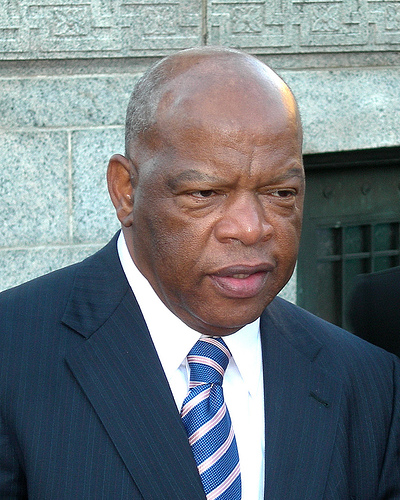
This Is What #Democracy Looks Like: John Lewis and #OccupyAtlanta

"They really didn't deny me," Lewis said.

One thing The New Republic, in its dismissal of the #OccupyWallStreet movement, misled its readers about regarding the John Lewis incident at Occupy Atlanta, and one thing anyone who doesn’t watch the video, painful as it may be, will miss: The General Assembly did not “groupthink” Lewis away, which would imply that the decision was, like the Washington crowd’s bullheaded decision to go to war in Iraq, assumed by everyone present to be a reasonable fait accompli. On the contrary, there was a strong pro-Lewis contingent among the Assembly–so strong that after the facilitator ruled that no consensus had been reached, a chant of “Let him speak!” rose up.

You can see for yourself if you watch the video below, which I recommend, especially to anyone prejudiced into a negative opinion about the Atlanta occupation’s impoliteness. You may draw the same conclusion, but it’s important to be accurate about what really happened there: An agenda had been previously agreed to, Lewis was requesting to interrupt it, and, according to the agreed upon Assembly rules, changing the agenda required “consensus,” which the Assembly was unable to reach.Therefore, the previously agreed to agenda remained in effect and Lewis was unable to interrupt. Lewis himself humbly accepted the Assembly’s decision. Continue reading