“Putin Lights up the Fire [of Revolution]!”

Pussy Riot, the Russian feminist collective and punk rock band, three of whose members (Nadezhda Tolokonnikova, Maria Alekhina and Yekaterina Samutsevic) were recently sentenced to two years in prison for “hooliganism,” have just released an answer to that sentence in the form of a blood-racing and rather catchy rocker of an anthem . Don DeLuca, music critic of the Philadelphia Inquirer, posted an informative little piece about the group and the song.

These women are serious punks!

Why Are Republicans Obsessed with Voter Fraud?

Good question with an obvious answer:

You’re more likely to be hit by lightning than you are to commit voter fraud at the polls. So why are Republicans so set on passing voter ID laws and other measures to stop this non-existent threat? According to Ari Berman, it’s all part of the GOP’s strategy to suppress the Democrat-leaning voter blocks of young people, people of color and immigrants.

On Moral Arguments for the Death Penalty: “Kant” and Retribution

Immanuel Kant: “If an offender has committed murder, he must die. In this case, no possible substitute can satisfy justice. For there is no parallel between death and even the most miserable life, so that there is no equality of crime and retribution unless the perpetrator is judicially put to death.”.

“A society that is not willing to demand a life of somebody who has taken somebody else’s life is simply immoral.”

Cited by Dudley Sharp in comments on a previous post

Continuing a conversation begun here and taken up by commenter Dudley Sharp (for whose contribution I’m grateful), I want to turn to Sharp’s “MORAL FOUNDATIONS OF THE DEATH PENALTY, Part I) (See the comment linked to above–and I hope Sharp will share Part II or more). I probably won’t spend much time addressing the religious arguments–or I may come back to them later. I will just say that I don’t believe any human is capable of speaking for the alleged ultimate authority on morality, which many name “God.” I think it’s more fruitful to assume that justice on earth is more of a political or social problem than a cosmic one. So let me focus on Sharp’s “foundations” that jibe with that view, such as the argument from “Kant” above for starters. Continue reading

Fambul Tok: The Movie

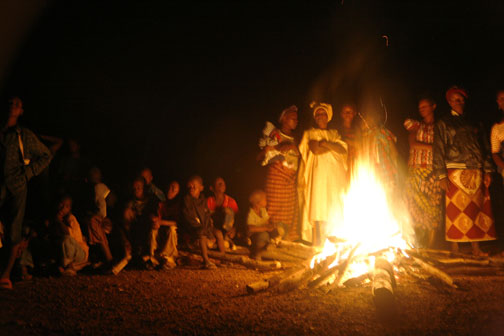
My last post on  Sierre Leone’s NGO Fambul Tok was based on my viewing several weeks ago of the 2011 film of the same name, directed by Sara Terry and co-produced by Libby Hoffman, which I highly recommend for anyone interested in questions of crime, punishment, and justice.  In brief, it concerns the NGO’s work in Sierra Leone’s communities with reconciling victims and perpetrators of the country’s civil war, which lasted from 1991-2002. It begins at a bonfire in a small village with a rape victim confronting and eventually forgiving the rapist, her uncle. In another village, former best friends are reconciled; one, as an impressed child soldier for the rebels, had killed the other’s father. A sister of a notorious rebel leader, who remains missing, begs and receives forgiveness on her brother’s behalf from the cousins and neighbors whose families he had brutalized by torture, rape and murder.

As the film explains through its central spokesperson John Caulker, Fambul Tok was developed as an alternative to the post-war commissions that had, until the film was released, prosecuted only a handful of war criminals, none of them of top rank. The cost to the nation of that nearly decade-long Western-style process was in the tens of millions of dollars. Meanwhile, Fambul Tok’s brand of justice had cost about $US 1 million  since it was founded in 2007 until the film’s release last year and had reconciled hundreds of former antagonists. Continue reading

A Radical Approach to Justice: Fambul Tok

As I was saying yesterday, we Americans carry with us a pretty basic understanding of how “justice” is officially carried out in our names, and we “law-abiding” ones don’t usually give it much thought other than to see it as a deterrent to any “criminal” urges we or our fellow citizens might have. Which is not necessarily a bad thing, if it really does deter people from injuring others in some way. I think most would agree that when a person is violent or injurious to other people, we want that person’s liberty restrained so that they aren’t able to cause harm anymore. The question becomes, however, how long should their liberty be taken from them? And beyond that, who is responsible for dispensing this justice and why them? (And, furthermore, who guards the guards?) Continue reading

Why We Need a New Approach to Justice

I’ve been absent from this blog for a while, feeling frankly too hopeless about the political situation to pick up on my usual themes and too busy reading for pay as a professional reviewer to have much time to explore other ideas. But I have been thinking about something that I’d like to begin exploring on this blog, just setting aside the question of whether it can ever become a more generally salient idea for discussion elsewhere, let alone a movement for radical change. In a word: I’d like to propose a radical rethinking of justice, crime and punishment.

Continue reading