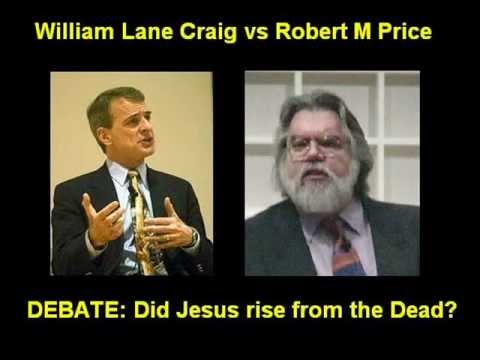
Loving Christianity Better Than Truth: The Craig-Price Debate

Craig Price

I’ve been watching and listening to numerous debates on YouTube between eminent atheists and Christian/theist apologists on subjects like “Does God Exist?”, “Does the Christian God Exist?”, “Did the Resurrection Happen?”, “What’s the Purpose of Life?” and so on. The debaters on the atheist side include Richard Dawkins, Sam Harris, the late Christopher Hitchens and Richard Carrier (whom I wrote about in my last post),  and on the theist side (among others)  Dinesh D’Souza, Rabbi David Wolpe and, most eminent of all, William Lane Craig.

If I had to score the debates he’s been in, though I disagree with him about virtually every point he makes, I’d give by far most wins to the phenomenal Dr. Craig. As atheist and debate aficionado Mark Smith notes about Craig, “He usually wins his debates. However, he wins his debates usually due not so much to being a great debater (which he is), but rather from debating people who haven’t the slightest clue how to debate.” A non-Christian rooting for one of Craig’s atheist opponents and caring about the outcome will probably wind up feeling like a Red Sox fan did last season suffering another visit from the Yankees at Fenway. Continue reading

Why You Should Doubt the Historicity of Jesus

As Richard Carrier explains in this talk given at a skeptic’s conference at the University of Wisconsin at Madison last spring, most academics who are paid to think, write and teach about Jesus will tell you that, while it’s really impossible to know for certain if Jesus was a historical figure, even the most secular of scholars in the field agree with near certainty that he probably did exist in some form or other. The key word there, of course, is the weasel word “probably.” Carrier doesn’t say so here, but these scholars are also very impatient with the alternative idea that Jesus probably wasn’t historically “real,” even though the degree of difference in certainty between their position and Carrier’s (and my) position is virtually non-existent. What the “historicists” have that Carrier and I don’t have is numbers in the academy who agree with them. That’s all they have, and when you get right down to it, that isn’t much at all.

When people who believe in a historical origin for the Jesus story find out how shaky the theoretical ground really is under their feet, they sometimes turn the conversation to less discomforting terrain, stating, for example, that it actually doesn’t matter if Jesus was real at all in the way the Bible says he was or was just made up out of thin air. The point is the wisdom in the religion and the good (or evil) that it hath wrought–or more neutrally, the impact it had on the rest of history. I disagree that this evasion is a suitable response to the challenge posed by Carrier and other mythicists. Their challenge is not aimed at the content of the religion. It’s aimed at the methods of historical research and the question of whether Christian history should be treated as a special case from other types of history,  one where it is not permitted to get too close to the central questions about its origins.

If  you think whether or not Jesus existed in history is an interesting question,  you’ll probably find Carrier’s cogent presentation on reasons not to believe in it provocative, to say the least.  Let me know what you think in the comments below.

Scrap the Constitution?

Do you consent to being governed by these people?

Do you consent to being governed by these people?

On Huffington Post’s Live channel this afternoon, Georgetown law school professor Louis Michael Seidman took up the case he made in the New York Times last weekend that the US should (as the Times piece title had it) “give up on the Constitution.” In the Times piece, Seidman wrote:

AS the nation teeters at the edge of fiscal chaos, observers are reaching the conclusion that the American system of government is broken. But almost no one blames the culprit: our insistence on obedience to the Constitution, with all its archaic, idiosyncratic and downright evil provisions….

Our obsession with the Constitution has saddled us with a dysfunctional political system, kept us from debating the merits of divisive issues and inflamed our public discourse. Instead of arguing about what is to be done, we argue about what James Madison might have wanted done 225 years ago.

As someone who has taught constitutional law for almost 40 years, I am ashamed it took me so long to see how bizarre all this is. Imagine that after careful study a government official — say, the president or one of the party leaders in Congress — reaches a considered judgment that a particular course of action is best for the country. Suddenly, someone bursts into the room with new information: a group of white propertied men who have been dead for two centuries, knew nothing of our present situation, acted illegally under existing law and thought it was fine to own slaves might have disagreed with this course of action. Is it even remotely rational that the official should change his or her mind because of this divination?

Seidman argues  that what he calls “constitutional disobedience” is not radical or new but has been applied over and over in the nation’s history. “No sooner was the Constitution in place than our leaders began ignoring it,” he wrote in the Times. He cites  several big examples, beginning with the writing of the Constitution itself, when national leaders chose expediency over fidelity to the sacred document.

On HuffPo, Seidman the non-radical was met mainly with skepticism from left and right, from defenders of civil liberties as well as from Cato Institute grandee Roger Pilon. The latter said something I actually agree with, that Seidman was getting it “exactly backwards,” suggesting a political solution when our politics is precisely what’s gone wrong. But I think Pilon’s faith in the document is misguided, as I think anyone’s faith in it is. Continue reading