Reagan’s Recovery vs Obama’s Recovery (UPDATE)

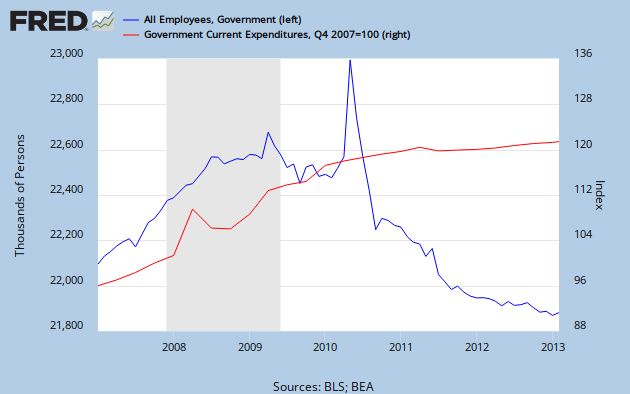
Here’s an interesting comparison by Michael at EconoPolitics.com from April of this year. In sum, Michael shows, “Had total government spending and employment followed the same trend in this recovery as the 80s recovery, spending would be $895B higher and there would be 1,250,000 more government employees.”

ecpolitics's avatarEconoPolitics

Last June, I compared the early 80s recovery under Ronald Reagan to the current recovery. I presented two graphs which compared total government spending and total government employment during the two recoveries. It turned out that government spending and employment both grew more during the Reagan recovery.

It’s been nine months since then. How have things changed?

The current recession began 62 months ago. Reagan’s recession officially began in July 1981 – so 62 months later would be September 1986.

At this point in Reagan’s Recovery (compared to start of recession):

  • Total government spending was up 51%.
  • Government employment was up 750,000.

Today (compared to start of recession):

  • Total government spending is up 22%.
  • Government employment is down 500,000.

Had total government spending and employment followed the same trend in this recovery as the 80s recovery, spending would be $895B higher and there would be 1,250,000 more government employees. Also…

View original post 54 more words

Krugman Trashes Austerity’s Phony Morality Economics

DAVOS/SWITZERLAND, 24JAN08 - Jean-Claude Trich...

DAVOS/SWITZERLAND, 24JAN08 – Jean-Claude Trichet, President, European Central Bank, Frankfurt, captured during the session ‘Systemic Financial Risk’ at the Annual Meeting 2008 of the World Economic Forum in Davos, Switzerland, January 24, 2008. (Photo credit: Wikipedia)

Apropos of a current theme of this blog, that the powerful Austrian school of economics that has supplanted Keynesianism as the go-to ideology of our government and, more and more, both political parties, is rooted in the same Nietzschean stew of pro-winner, anti-loser sentiment that appealed to the Nazis, Paul Krugman has a piece in the current New York Review of Books that devastates the “austerian” contention that Keynesianism feeds the Beast, while austerity corrects naughty economic behavior. His main support for his argument is the recent discovery of severe flaws in the methodology of two studies most often cited by austerians, one by Harvard profs Carmen Reinhart and Kenneth Rogoff and the other by Italy’s Alberto Alesina and Silvia Ardagna, purporting to show that government spending that exceeds 90% of GDP in the wake of a depression or financial meltdown is catastrophic for the economy in question.

David Stockman’s The Great Deformation … [is] an immensely long rant against excesses of various kinds, all of which, in Stockman’s vision, have culminated in our present crisis. History, to Stockman’s eyes, is a series of “sprees”: a “spree of unsustainable borrowing,” a “spree of interest rate repression,” a “spree of destructive financial engineering,” and, again and again, a “money-printing spree.” For in Stockman’s world, all economic evil stems from the original sin of leaving the gold standard. Any prosperity we may have thought we had since 1971, when Nixon abandoned the last link to gold, or maybe even since 1933, when FDR took us off gold for the first time, was an illusion doomed to end in tears. And of course, any policies aimed at alleviating the current slump will just make things worse.

In itself, Stockman’s book isn’t important. Aside from a few swipes at Republicans, it consists basically of standard goldbug bombast. But the attention the book has garnered, the ways it has struck a chord with many people, including even some liberals, suggest just how strong remains the urge to see economics as a morality play, three generations after Keynes tried to show us that it is nothing of the kind. Continue reading

The Idle Rich and the Working Stiff: Nietzche von Hayek on Capital v. Labor

Corey Robin, whose Nation piece on Nietzsche and Hayek I referred to here, posted this comparison of the two thinkers’ ideas on class on his own blog. They support his contention that Hayek was more in tune with Nietzschean philosophy than commonly supposed. Whatever you think of Robin’s thesis, it is instructive at least to see the contempt or, at least, casual dismissal of the worth of the working class in Hayek’s musings.

Corey Robin's avatarCorey Robin

Nietzsche, Human, All Too Human:

Culture and caste.—A higher culture can come into existence only when there are two different castes in society: that of the workers and that of the idle, of those capable of true leisure; or, expressed more vigorously: the caste compelled to work and the caste that works if it wants to….the caste of the idle is the more capable of suffering and suffers more, its enjoyment of existence is less, its task heavier. (§439)

My utopia.—In a better ordering of society the heavy work and exigencies of life will be apportioned to him who suffers least as a consequence of them, that is to say to the most insensible, and thus step by step up to him who is most sensitive to the most highly substantiated species of suffering and who therefore suffers even when life is alleviated to the greatest…

View original post 575 more words

Wealth Inequality in America: It’s Worse Than You Think

Hat tip to Upworthy for this astonishing and superbly well made video.

Thoughts on the Cherokee Blood-Feud, or Anthropology is Only Fun Till Someone Puts an Eye Out!

This is a fascinating piece (with an irresistible title!). It reminded me of a documentary film called Push Back (or Pushback?),  Payback by Margaret Atwood. It’s a difficult film to remember because it’s a little all over the place, but one segment concerns a blood feud in Albania of all places. The consequences of the patriarch of this little family in the Albanian mountains having killed a neighbor over a dispute involving land was that every member of the family was marked for assassination if they left the property. The entire family, in other words, was serving the murder sentence. As “northier” says, this is not an anomalous form of justice; this is the apparent human default. Are there other animals that behave this way? Or is this sense of debt unique to us?

David Graeber touches on this in his history of debt. But northier makes an interesting observation about the collective guilt shared by the customer support staff operator (who’s often half a world away from the actual perpetrators of banking chicanery) with the whole corporation, at least in the view of the irritated customer.

Really interesting food for thought here.

danielwalldammit's avatarnorthierthanthou

…and of course that is when it gets really interesting.

By poking an eye out, I am of course talking about a special sort of moment one gets from time to time in the study of anthropology, at least I do. It’s the sort of moment when some cultural practice causes the hair on the back of your neck stand up and your stomach tries to dig its way to China (or Antarctica, as would be the case here in Barrow). I’m talking about that kind of moment when you encounter something in an ethnography that just seems like too much. So, you sit there and ask yourself, “How in the Hell could that be anything but wrong?” And for a little while anyway, your mind just doesn’t want to travel down that road, the one that leads to understanding the practice in its own context. You’d rather just say ‘no’. Hell, you’d…

View original post 2,095 more words

Another blast from the past

“[M]odern democracy is at the service of global capitalism. We will not be voting our way toward a more humanist redistribution of resources, least of all if the market does not require it. Similarly, when we voted for Obama in 2008, we did not really vote for what we had the audacity to hope we were voting for, nor for change we really could believe in. We were voting, simply, for the choice the Democratic Party, through its intricate, arduous and obscenely expensive vetting process, presented to Democrats and Americans as the titular head of its party. We were not voting for any ideas other than the usual handful that get talked about endlessly in media that also owe their existence and wealth to global capitalism. We get what global capitalism pays for and wants and needs in that office to further its aims and agenda (of enriching the rich and distributing resources toward that end).”

christofpierson's avatarTragic Farce

I call myself a Democrat because that’s how I’ve been registered all of my voting life. In fact, the older I get, the more disconnected I feel from that label. I don’t want to register as an independent because, Bernie Sanders notwithstanding, I can’t get over the prejudice that American independents are all right-wing at heart. Was it George Wallace’s American Independent Party that instilled this in me? Who knows? It’s beginning to feel, however, that the correct radical stance in this disintegrating context is to not register or vote at all. A vote begins to feel like acquiescence to the corruption.

Did Democrats or any other Obama supporter vote for the fiasco of the last month, culminating in the supreme surrender by our audacious leader last night to the anti-democrats of the Republican Party, bypassing the leaders of his own party to give the (fictional) partisanship-loathing centrists of the…

View original post 1,098 more words

Blast from the past, but it seems relevant still


“It appears that the inequality gap in the US has been caused by a combination of legalized looting of public resources by the financial class and tax policies that have favored them above all other classes in the society. This is, in effect, a government underwritten redistribution of wealth away from the bottom 99% toward the top 1% and, therefore, it would seem to violate the Paulist principle that starts this article.”

christofpierson's avatarTragic Farce

4. Government may not redistribute private wealth or grant special privileges to any individual or group.

–from The Ten Principles of a Free Society

Continuing my gradual critique of Ron Paul’s Ten Principles, the next in line is relevant to what I’ve been talking a lot about these past few weeks, the great impetus behind #OccupyWallStreet: income inequality.

It’s significant that the godfather of the Tea Party movement (the original form of it, anyway) includes wealth redistribution in his principles of liberty. It points up an area where these two movements can either come together or get driven apart.  There’s no question about where #ows stands on this point. Income inequality is a key symptom of the disease #0ws arose in response to, and one of its goals, I would argue,  is to force a correction of what it views this to be: a moral wrong. If Paul is…

View original post 1,279 more words

#Frankenstorm and the Way We Talk About Climate Change

Andrew Revkin, in his Dot Earth blog for the New York Times, has been writing a lot over the past few days about the relation of global warming/climate change to the ferocious late-season appearance of #Frankenstorm Sandy, which flooded lower Manhattan, Brooklyn and Queens, tore up the Jersey shore, killed some 40 people in the US and left more than 7 million on the East Coast with no power for several days (not to mention the overlooked damage it wrought in the Caribbean before smashing into Delaware on Sunday). Many of his readers (including climate activist Dan Miller) accuse Revkin (who is a science journalist and not a professional scientist) of taking too cautious a tack on climate change generally and on human responsibility for the increase of North Atlantic storm activity in particular. Continue reading

Tax Increases or Books: A Library Fights Back

This video tells the tale of how Troy, Michigan’s public library cleverly and successfully fought back (with the help of an ad agency) against a Tea Party effort to shut it down in lieu of authorizing a 0.7% tax increase to keep it open. This story is probably a common one in the age of austerity. Although the election was almost two months ago, this is the first I heard of the campaign.

I’d like to believe that the Tea Partiers are sincere in their chagrin over the sense that they’ve lost control of their government. We on the left certainly can understand that. But they repeatedly show poor value judgment, as in this instance in Michigan. They can often seem to embody Oscar Wilde’s quip about a cynic knowing the price of everything and the value of nothing. But they’re witless cynics if they don’t know that 0.7% added to a yearly tax bill is a very small price to pay for a library.

Jill Stein on Change: Not Just Something to Believe In

If Pres. Obama and the Democrats talked this talk and walked this walk, they would be giving me something to vote for. Come to think of it, that’s exactly what Jill Stein of the Green Party is giving me.