Liberals Are Terrified of #OccupyWallStreet

TNR: Liberals should be nervous

Picking up where we left off yesterday, The New Republic has now offered its official two cents on the protests on Wall Street and, as one would expect of the stuffy self-appointed organ of the liberal power elite inside the Beltway, it disapproves.

[T]o draw on the old cliché, the enemy of my enemy is not necessarily my friend. Just because liberals are frustrated with Wall Street does not mean that we should automatically find common cause with a group of people who are protesting Wall Street. Indeed, one of the first obligations of liberalism is skepticism—of governments, of arguments, and of movements. And so it is important to look at what Occupy Wall Street actually believes and then to ask two, related questions: Is their rhetoric liberal, or at least a close cousin of liberalism? And is this movement helpful to the achievement of liberal aims?

This task is made especially difficult by the fact that there is no single leader who is speaking for the crowds, no book of demands that has been put forward by the movement. Like all such gatherings, it undoubtedly includes a broad range of views. But the volume of interviews, speeches, and online declarations associated with the protests does make it possible to arrive at some broad generalizations about what Occupy Wall Street stands for. And these, in turn, suggest a few reasons for liberals to be nervous about the movement.

The Editors responsible for the unsigned editorial then go on to outline the differences between #ows’s radicalism and TNR’s proper liberalism (the former is dreamy, “group-thinky” and utopian, the latter skeptical, pragmatic and pro-capitalist) , before urging liberals to stay the hell away. Continue reading

Jeffrey Sachs Supports #OccupyWallStreet

This is what democracy looks like when it works: media dialoguing with a rational person telling the truth about what’s wrong and what needs to change:

This is just over 22 minutes, but it’s 22 minutes well spent.

Info from the YouTube video on Sachs:

Watch Jeffrey Sachs, leading environmentalist and economist, and a respected Professor at Columbia University, speak out at the growing, inspiring Occupy Wall Street movement. Sachs is one of many professors, celebrities, community leaders, spiritual leaders and public figures who are speaking out in support of the OWS movement and what it stands for.

The Burnett Rule: If You Buy Something, Don’t Say Something

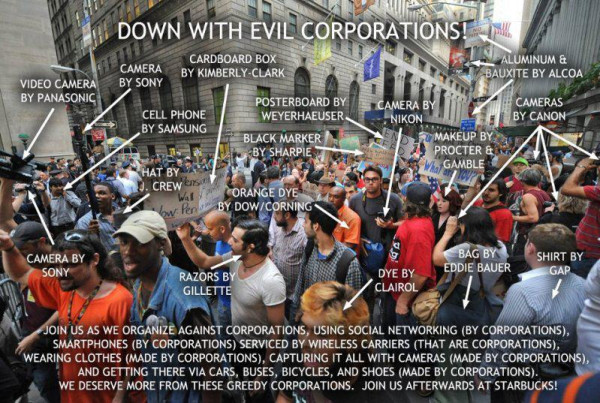
Erin Burnett’s snide putdown of #OccupationWallStreet on her new CNN platform OutFront included some sniffing over the fact that the protesters (like other Americans) drink bottled water, eat “catered lunch,” (actually slices of pizza from a local pizzeria, probably courtesy of anonymous online supporters), wear designer clothes, use Apple computers and Blackberries. The implicit “argument” in Burnett’s patrician sniffs, which we’ll no doubt be hearing over and over from the protest’s sideline critics in the days to come, is rendered explicit in this ironic photo art found on Twitter:

http://twitpic.com/6wh19u via @ForceMajeure_

So on this account, if you consume any of the products of corporate capitalism, it’s hypocritical to protest against corporate capitalism. What, then, do the Burnettists think is the correct attitude of consumers toward corporate capitalism? Obedience? Submission? Worship?

We are not only consumers–not only economic animals, but also political animals. The fact that we consume the products of the predominant economic  system doesn’t disqualify us from criticizing the political system that serves the interests of the “captains” of the system at the rest of our expense, does it? The protest is not about the economic behavior of corporations–not about capitalism per se, in other words–but about their social, political and moral behavior.

Burnett pretends to be a journalist, which of course she is not. (Seriously, Erin, a journalist?!) She is an apologist for the 1%. But anyone who is not in the role Burnett has chosen to play ought to pay closer attention to what the occupation is about, ought to use their minds to examine what the occupiers are actually saying.  I think most Americans will tend to get it if they give it a little thought, because I think most Americans can see that the system does not favor their own interests any more than it favors the protesters.

When I Heard the Learned Economist…

When I read pieces by eminent conservative economists like the Hoover Institute’s Robert J. Barro’s Keynesian Economics vs. Regular Economics, I get the sick feeling in my stomach that the rift between left and right is becoming less and less bridgeable by day. It becomes clearer and clearer to me that, while the left may be going through a prolonged crisis of self-confidence, the right is becoming more deeply mired in an ideological morass and their project is to drag the rest of us down into it whether or not we want to go.
Continue reading

NY Attorney General’s Dismissal Has “Big Banks’ Dirty Fingerprints All Over It”

Here’s a bit of outrageous news that you might not have heard today, courtesy of the Institute for Public Accuracy: Continue reading

Anarchism, Capitalism and Human Rights: A Discussion

There’s a lively little discussion going on in the comments for this post. Here’s a little sample: Continue reading

What Is Ron Paul’s Notion of Justice?

To understand Paul’s third principle for a free society (“Justly acquired property is privately owned by individuals and voluntary groups, and this ownership cannot be arbitrarily voided by governments”), it would be helpful to understand his theory of justice.

One thing seems absolutely certain: it isn’t the same as John Rawls’ theory. In fact, without being explicit about its debt, Paul’s theory, based on what I sussed out of it in the previous two posts, bears a lot of resemblance to Robert Nozick’s anti-Rawlsian theory of justice formulated in Anarchy, State and Utopia.

Full disclosure: I haven’t read Rawls or Nozick. Does this disqualify me from commenting on the ideas I’ve read about from them? I leave that up to my readers. I’m going to plow ahead because I think it’s necessary to discuss Nozick’s idea of “distributive justice” (i.e., how “justly” resources are distributed among individuals) to understand Paul’s. Continue reading

Is Private Property in America Ever Justly Acquired?

Property acquisition in the Americas begins.

Back to the critique of Ron Paul’s libertarian principles that I began with this post. We’re onto principle number 3:

3. Justly acquired property is privately owned by individuals and voluntary groups, and this ownership cannot be arbitrarily voided by governments.

–from The Ten Principles of a Free Society

[Aside: There’s that word “voluntary” with groups (associations) again! ]

As I’ve shown in my previous critiques, Paul’s principles are half-baked by-products of social contract theory. They want to assert that rights precede government (which even social contract philosophers have to take on faith) and then do away with the government that those philosophers posited as a necessary evil for preserving those rights in society with other individuals. Really? Do away with the government, you might ask? Doesn’t Paul, like Jefferson, for example, just want to keep the government to a size that isn’t able to overwhelm the individual with its potentially arbitrary and despotic power? I would argue that the way these principles are phrased–and this one in particular is a very good example–Paul seeks to postulate a society that operates according to natural rights, with or without a government. He seems to believe that rights in themselves, if we would only just respect them, are sufficient for self-government.
Continue reading

“If you put people back to work, you are cutting spending.”

Unexpected wisdom from rank and file Republicans:

“Cutting spending is important, but getting people back to work is more important,” said Diane Sherrell, 56, a Republican from Erwin, N.C. “If people are working, they are more productive. There is less crime, there is less depression, there is less divorce. There are less hospital and medical bills. If you put people back to work, you are cutting spending.”

Stanley Oland, 62, a Republican from Kalispell, Mont., said that the government needed new jobs to generate the economic activity and the revenue it requires.

“That revenue supports the basic foundation for the economy, creates more jobs and stimulates the economy,” he said. “Unless you have working people you don’t have revenue from taxes. If you cut spending, jobs will be eliminated and you won’t get any revenue. Every dollar spent creates jobs.”

Now if they would just apply this wisdom at the polls that allegedly count in November!

The Austerity of Hope

I call myself a Democrat because that’s how I’ve been registered all of my voting life. In fact, the older I get, the more disconnected I feel from that label. I don’t want to register as an independent because, Bernie Sanders notwithstanding, I can’t get over the prejudice that American independents are all right-wing at heart. Was it George Wallace’s American Independent Party that instilled this in me? Who knows? It’s beginning to feel, however, that the correct radical stance in this disintegrating context is to not register or vote at all. A vote begins to feel like acquiescence to the corruption.

Did Democrats or any other Obama supporter vote for the fiasco of the last month, culminating in the supreme surrender by our audacious leader last night to the anti-democrats of the Republican Party, bypassing the leaders of his own party to give the (fictional) partisanship-loathing centrists of the electorate  the White House is courting for 2012 the illusion of “operational bipartisanship?” Well, yes, we actually did vote for it, unfortunately, and that’s where the whole problem lies. Continue reading