Fambul Tok: The Movie

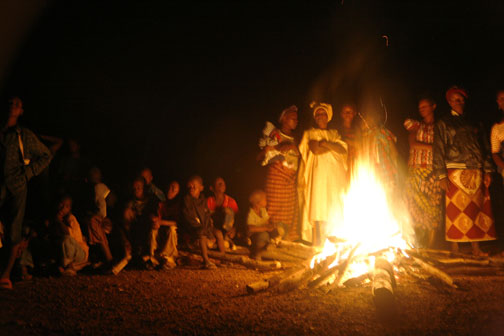
My last post on  Sierre Leone’s NGO Fambul Tok was based on my viewing several weeks ago of the 2011 film of the same name, directed by Sara Terry and co-produced by Libby Hoffman, which I highly recommend for anyone interested in questions of crime, punishment, and justice.  In brief, it concerns the NGO’s work in Sierra Leone’s communities with reconciling victims and perpetrators of the country’s civil war, which lasted from 1991-2002. It begins at a bonfire in a small village with a rape victim confronting and eventually forgiving the rapist, her uncle. In another village, former best friends are reconciled; one, as an impressed child soldier for the rebels, had killed the other’s father. A sister of a notorious rebel leader, who remains missing, begs and receives forgiveness on her brother’s behalf from the cousins and neighbors whose families he had brutalized by torture, rape and murder.

As the film explains through its central spokesperson John Caulker, Fambul Tok was developed as an alternative to the post-war commissions that had, until the film was released, prosecuted only a handful of war criminals, none of them of top rank. The cost to the nation of that nearly decade-long Western-style process was in the tens of millions of dollars. Meanwhile, Fambul Tok’s brand of justice had cost about $US 1 million  since it was founded in 2007 until the film’s release last year and had reconciled hundreds of former antagonists. Continue reading

A Radical Approach to Justice: Fambul Tok

As I was saying yesterday, we Americans carry with us a pretty basic understanding of how “justice” is officially carried out in our names, and we “law-abiding” ones don’t usually give it much thought other than to see it as a deterrent to any “criminal” urges we or our fellow citizens might have. Which is not necessarily a bad thing, if it really does deter people from injuring others in some way. I think most would agree that when a person is violent or injurious to other people, we want that person’s liberty restrained so that they aren’t able to cause harm anymore. The question becomes, however, how long should their liberty be taken from them? And beyond that, who is responsible for dispensing this justice and why them? (And, furthermore, who guards the guards?) Continue reading

Why We Need a New Approach to Justice

I’ve been absent from this blog for a while, feeling frankly too hopeless about the political situation to pick up on my usual themes and too busy reading for pay as a professional reviewer to have much time to explore other ideas. But I have been thinking about something that I’d like to begin exploring on this blog, just setting aside the question of whether it can ever become a more generally salient idea for discussion elsewhere, let alone a movement for radical change. In a word: I’d like to propose a radical rethinking of justice, crime and punishment.

Continue reading

Merrill Garbus Puts Africa In Your Earbuds

OkayAfrica invited Merrill Garbus of tUnE-yArDs (one of my current favorites) to make a mix of her own favorite African pop tunes.  It lasts about 30 minutes, delves into music going back to the 1970s and 1980s as well as more recent numbers, and ranges from the Horn of Africa down to the Cape and into the rainforests. You can read about her choices here.

TRACKLIST
Lema GebreHiwot “Wondemiye (Wedding Song)” ft. Selamawit Gebre Selassie, and Zenebech Tesfaye (Ethiopia)
Dur Dur “Goromphmca: (Somalia)
Hukwe Zawose “Safiri na Muziki” (Tanzania)
Mlimani Park Orchestra ”Tangazia Mataifa Yote” (Tanzania)
Johnny Clegg and Savuka “Moliva” (South Africa)
9Ice ”Gongo Aso” (Nigeria)
Koffi Olomide ”Loi” (DR Congo)

Spitzer, Taibbi and Kelleher on LIBOR: Breathtaking Corruption Among Biggest Banks

There’s a huge scandal going on in the banking world that most people (myself included) are probably having difficulty really grasping. You’ve probably seen the word LIBOR and the names Barclays and Bob Diamond in financial news headlines, but you would be forgiven if you didn’t take the time to wrap your mind around what those stories are about. Eliot Spitzer, former NY governor and current Current TV host, with guests Matt Taibbi of Rolling Stone and Dennis Kelleher, a former K Street lawyer now working to reform the banking system, lays out the scandal a little more clearly in this brief clip.

Continue reading

Graeber: “In America…the Entire System Is Built on Legalized Bribery”

This video interview with David Graeber of Occupy Wall Street by Italian activist, comedian and blogger Beppe Grillo covers a range of subjects this blog has also covered, focusing on debt, political power and direct democracy.  The questions appear in written Italian, but most should be fairly clear to anyone with high school-level familiarity with the romance languages, and those that aren’t Graeber answers very straightforwardly and clearly. (One thing he discusses that I’m not familiar with is the Italian 5 Star movement, of which Grillo is a leader.)

Graeber’s view of the American system is essentially captured by the quote which is the title of this post. I think it’s an accurate view. What do you think? I also greatly appreciate his proposed antidote to  the poison in the US system, which is for the people to act as though they are free and have power. That is what Occupy Wall Street is all about.

Does the Left Have a Patriotism Problem?

[I]t should not be lost on anyone that it is conservatives who typically carry around copies of our Constitution in their pockets. It is the Tea Party that refers relentlessly to the nation’s Founders. The movement’s very name invokes a key event in Revolutionary Era history to imply that there is a kind of illegitimacy to the current government in Washington akin to that of a king who once ruled the American colonies far from our shores. Representative Mike Pence of Indiana perfectly captured conservatives’ inclination to believe that their entire program is a recapitulation of the nation’s founding documents. “There’s nothing that ails this country,” Pence told a 2010 meeting of the Conservative Political Action Conference, “that couldn’t be fixed by paying more careful attention to the principles enshrined in the Declaration of Independence and the Constitution of the United States of America.”

While the right was talking about history, liberals were talking about—well, health-care coverage, insurance mandates, cap-and-trade, financial reforms, and a lot of other practical stuff. One can offer a sympathetic argument here that progressives were trying to govern in a rather difficult moment and didn’t have time to go back to the books. But the left’s default was costly, and it was noticed by an editor of this journal in the spring of last year. “Beyond the circumscribed world of academic journals and conferences,” Elbert Ventura wrote in these pages, “history is being taught—on TV and talk radio, in blogs and grassroots seminars, in high school textbooks and on Barnes & Noble bookshelves. In all those forums, conservatives have been conspicuous by their activity—and progressives by their absence.” Ventura ended with this alarming coda: “If we don’t fight for history, progressivism itself will be history.”

E.J. Dionne, “Why History Matters to Liberalism

It’s almost accepted as a truism that people on the right in the US are more patriotic–or, at least, more comfortable with expressing patriotic sentiment–than people on the left. This is not too controversial a notion on left or right, though you will certainly find many in the Democratic Party full-throatedly denying that it’s based on fact. Liberal Democrats, they say, can get just as teary-eyed over “The Star Spangled Banner” as the most politically constipated Bircher. You will also hear among a certain kind of Democrat the sort of argument you hear among liberal Christians comparing themselves to fundamentalists, about the ersatz nature of right-wing patriotism compared to “real” liberal patriotism.

But I think most people would agree that those on the right are far more comfortable wrapping themselves in the flag than those on the left. To test that, ask yourself how you think the fellow in the photo below would feel about corporate tax rates, government regulation of companies’ CO2 emissions, federal investment in renewable energy sources or subsidization of early childhood education in the barrios of our Southwestern cities.

Image Continue reading

TragicFarce.com

Note to regular readers: I’ve made TragicFarce.com the official domain name of this blog. You can still get to it as you have in the past, using my WordPress URL: christofpierson.wordpress.com; it will just be redirected to the new domain name, which you should notice in your browser’s URL address box, if not today (I’ve been told) then in the next 72 hours. You can also write to me with questions, comments, job offers, etc., at cpierson at tragicfarce.com.

Miami “Zombie”: Questions for Dade Investigators

At the risk of looking like a nut, I just sent the following e-mail to Dade County’s crime lab: Continue reading

tUnE-yArDs at Terminal 5

Last Friday night, with special guests Delicate Steve and (all the way from London) Micachu and the Shapes.

It was, as expected, an extraordinary evening of far-out African-inflected and futuristic pop/dance/rock music. Great musicianship all around, as this clip of the tUnE-yArDs’ “Bizness” (one of a long series of highlights) only hints at. (I was not the photographer. I was just somewhere between the camera and the Merrill Garbus.) Continue reading