#OWS Economics: Who’s to Blame?

Here’s an interesting video from a Texas-based libertarian, John Barksdale (my spelling may be incorrect), who calls himself order9066. I’m impressed with the research he put into this subject, and I take his point very well that it was not just Republicans who were responsible for throwing out the Glass-Steagall Act of 1933, which prohibited financial holding companies insured by the FDIC from owning other companies engaged in financial speculation such as Wall Street investment firms or insurance companies, with the Gramm-Leach Bliley Act of 1999.

While this video does serve as a corrective for the idea that Democrats share little or no blame in the gutting of New Deal protections that set-up the disaster of 2008, it goes overboard in pushing Republicans into the background of the blame picture. After all, the three authors and main sponsors of the bill were all Republicans, and both houses of Congress were, in fact, controlled by the GOP.  But it does highlight two main points: The fingerprints of “Third Way” Democrats in Clinton’s White House (including Clinton himself, of course) are as much in evidence on the financial deregulation of the late 1990s as the Republicans’ are; and Congressional Democrats were ineffective, at best, in preventing (and, at worst, complicit in bringing on) Glass-Steagall’s demise. Continue reading

Liberals Are Terrified of #OccupyWallStreet

TNR: Liberals should be nervous

Picking up where we left off yesterday, The New Republic has now offered its official two cents on the protests on Wall Street and, as one would expect of the stuffy self-appointed organ of the liberal power elite inside the Beltway, it disapproves.

[T]o draw on the old cliché, the enemy of my enemy is not necessarily my friend. Just because liberals are frustrated with Wall Street does not mean that we should automatically find common cause with a group of people who are protesting Wall Street. Indeed, one of the first obligations of liberalism is skepticism—of governments, of arguments, and of movements. And so it is important to look at what Occupy Wall Street actually believes and then to ask two, related questions: Is their rhetoric liberal, or at least a close cousin of liberalism? And is this movement helpful to the achievement of liberal aims?

This task is made especially difficult by the fact that there is no single leader who is speaking for the crowds, no book of demands that has been put forward by the movement. Like all such gatherings, it undoubtedly includes a broad range of views. But the volume of interviews, speeches, and online declarations associated with the protests does make it possible to arrive at some broad generalizations about what Occupy Wall Street stands for. And these, in turn, suggest a few reasons for liberals to be nervous about the movement.

The Editors responsible for the unsigned editorial then go on to outline the differences between #ows’s radicalism and TNR’s proper liberalism (the former is dreamy, “group-thinky” and utopian, the latter skeptical, pragmatic and pro-capitalist) , before urging liberals to stay the hell away. Continue reading

#TeaParty Terrified of #OccupyWallStreet’s New American Revolution

Dress-up rebel doing the bidding of the corporate class.

James Oliphant of the Los Angeles Times quotes prominent self-anointed leaders of the Tea Party movement on their reaction to the recent sprouting of Occupy America encampments in dozens of cities across North America from Boston and New York to Seattle and L.A. Clearly the Tea Party bosses don’t get it Continue reading

Right Wing Americans Need to Wake Up And Get Real

A blogger calling himself Mark America demonstrates the fear-sodden ideology of the right that is disabling many conservatives’ ability to think clearly about what is really going on:

On Saturday, the “Occupy DC” contingent of the greater “Occupy Wall Street” movement clashed with guards and police outside the National Air and Space Museum.  At least one was pepper-sprayed, and one was arrested.  They’re now combining with the even more radical October2011 group, the object of which is to overturn our system of government.  All of these groups have direct ties to Barack Obama from his years in the left-wing community organizing movement, and to the Democrat party structure reaching back two decades.  Let’s be honest:  These are the shock-troops of the communist movement in America.

For those of you who don’t yet understand what this is all about, it’s time to clear it up.  These people aren’t protesting for reform.  They are protesting for the absolute destruction of the United States of America of any description by which you’ve known it.  I once thought that to believe this, a person would need the tin-foil hat and the basement computer terminal and be a conspiracy kook, but this is simply not the case any longer.  These people have powerful, well-heeled backers, and they are acting in concert with Barack Obama and the extreme leftist fringe of American politics.

They  make the mistake of believing the Republican Party is the United States. Big, big mistake. It misleads them into making mistakes of thinking all around. Continue reading

Hank Williams Jr and the Sad State of American Discourse

I will try not to spend a lot of time on the latest overblown media spectacle to distract from what really matters. It probably won’t last long anyway. But the Hank Williams Jr. incident does say something about what’s wrong with the way Americans talk to (or around, at, or through) each other about America. Continue reading

Disunite the States of America?

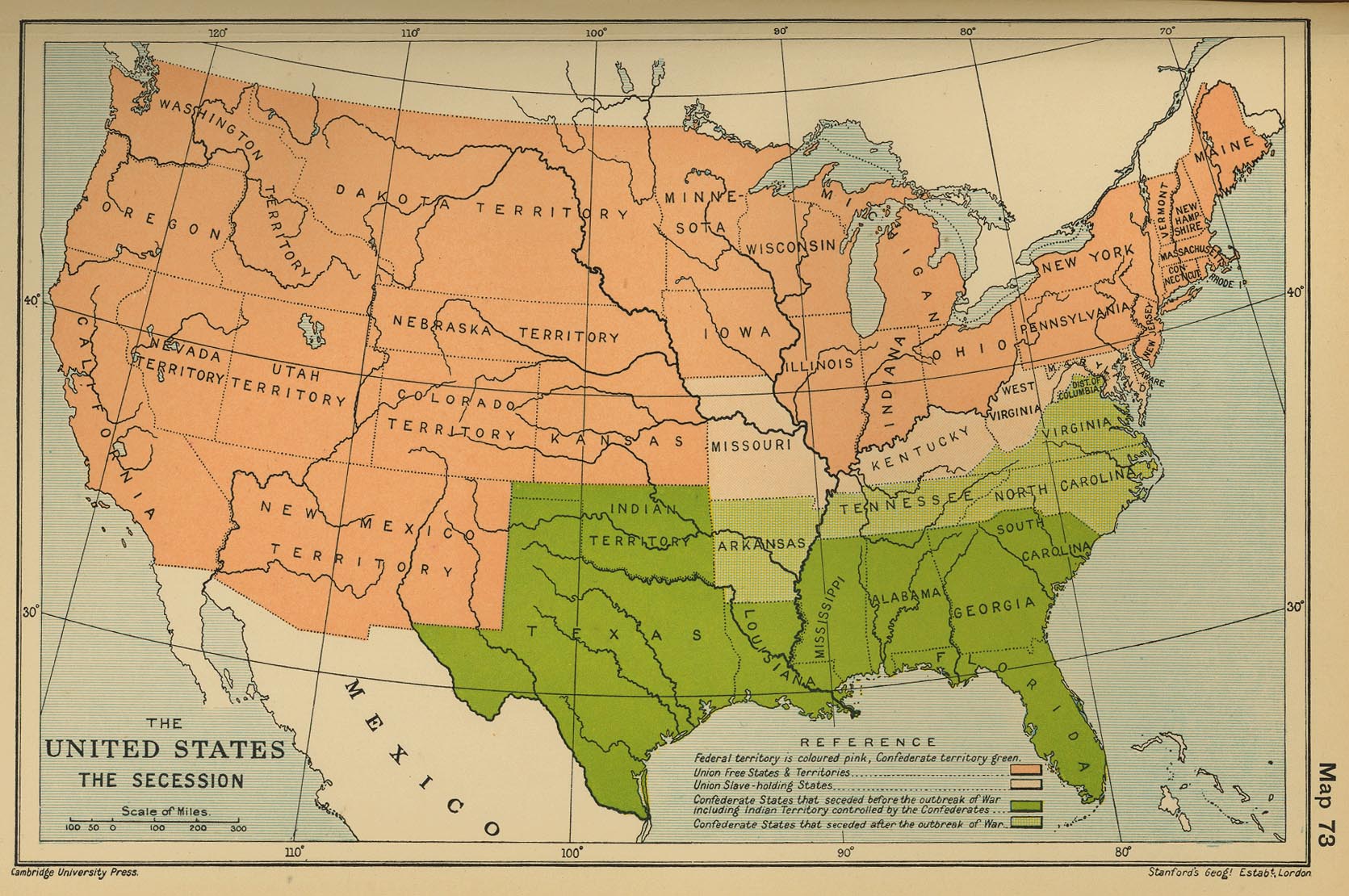
They could have everything south of the 40th parallel between the 100th and 80th latitude. And Alaska.

Eric Alterman in his Nation column this week sighs over the stupidity rampant among high-power journalists–he names Meet the Press‘s David Gregory, for one–that makes them bend over backwards to be “balanced” in their coverage of left and right. It’s a “balance” that actually lends undue gravity to right-wing idiocy. Recently, Alterman says, Gregory equated the left’s alarm over Rick Perry’s secessionist noises with the right’s over “socialist” health care reform as examples of what Gregory implied was understandable outrage over the other side’s extremism. As Alterman puts it, “To treat the potential destruction of the United States via the secession of its second most populous state and the provision of affordable healthcare to its citizens with privately provided health insurance as somehow morally and intellectually equivalent—well, ‘stupidity’ is actually too kind a word.” I couldn’t agree more.

And yet, I was reminded while reading Alterman’s essay of an idea that began to make tremendous sense to me a few weeks ago when the president delivered his jobs speech to the joint session–or actually just after, when the pundits immediately agreed that, no matter how powerful Obama’s words were, they were almost certainly all wasted, if action and not just reelection really was what was motivating him. Continue reading

A Country Doctor Diagnoses What’s Wrong with Obama

And offers a prescription for real change we can believe in.

There used to be a lot more of this wisdom among grass roots activists in America. I like the ideas of Dr. Joe Mason. You like them? You can write to him here.

The Austerity of Hope

I call myself a Democrat because that’s how I’ve been registered all of my voting life. In fact, the older I get, the more disconnected I feel from that label. I don’t want to register as an independent because, Bernie Sanders notwithstanding, I can’t get over the prejudice that American independents are all right-wing at heart. Was it George Wallace’s American Independent Party that instilled this in me? Who knows? It’s beginning to feel, however, that the correct radical stance in this disintegrating context is to not register or vote at all. A vote begins to feel like acquiescence to the corruption.

Did Democrats or any other Obama supporter vote for the fiasco of the last month, culminating in the supreme surrender by our audacious leader last night to the anti-democrats of the Republican Party, bypassing the leaders of his own party to give the (fictional) partisanship-loathing centrists of the electorate  the White House is courting for 2012 the illusion of “operational bipartisanship?” Well, yes, we actually did vote for it, unfortunately, and that’s where the whole problem lies. Continue reading

“A democracy should never be practiced outside the limits of a town.”

"It must be acknowledged that the term 'republic' is of very vague application in every language..."

Did Jefferson really say that?

On July Fourth, an essay by Nicole Swinford titled 10 Things You Might Not Know About America’s Independence that appeared on the Fox News Web site was regurgitated in full or in part on dozens of right-wing blogs, including one I commented on in a previous post. This essay is almost certain to become one of those annoying endlessly forwarded e-mails decorated with irritating gifs of flying hummingbirds and flapping flags that will be sent around next Independence Day and every one thereafter.

One should always beware of what America’s right-wing amateur historians of the revolution claim Thomas Jefferson said. Many times, when you’re given a Jefferson “quote” from one of these sources, though it’s always intended to back up their faith that the Founders were exactly in line with their own political beliefs, you can almost certainly guarantee that Jefferson meant the opposite of what they claim he meant.

Take for example Swinford’s 6th “Thing,” which reiterates the Republican talking point about what kind of government the Founders intended. (Note that this is word for word what my right-wing friend posted on his blog in that previous post): Continue reading

The “Anarcho”-Capitalist Conundrum

In the wake of September 11, 2001 and continuing through the lead-up to the Iraq War and into 2003, I was involved in an intense debate on several political Usenet groups (my involvement in political Usenet, actually, goes back to the Clinton-Lewinsky scandal of 1997-1998), in which there was a clique of rabidly right wing libertarians holding forth on what they called “anarcho-capitalism.” Many believe that the only logical conclusion to right libertarianism (and to history, actually) is capitalism completely unfettered by government. In a sense, they’re right (except for the history part): If you think government is bad for business and you think business is the best way to distribute resources, then the best government is no government at all.  Of course a lot of Libertarians believe government is necessary to provide for the defense of business interests, but the anarchos would argue that if businesses need to be defended, they should do it themselves. Abolish government, they say, abolish borders, open all the world to capitalism. Let the market determine the value of everything. Continue reading