
Bad Faith Crashes into “Noncompatible Leftism”

Briahna Joy Gray, former spokesperson for the  Bernie Sanders primary campaign of 2020 and host of the popular podcast Bad Faith, did her listeners a real service recently by having on as a guest Villanova professor of philosophy Gabriel Rockhill to talk about his new book Who Paid the Pipers of Western Marxism? and how the CIA constructed what Rockhill calls “compatible leftism.”

According to Rockhill, an unabashed revolutionary Marxist, during the Cold War the CIA groomed anti-Soviet, self-identified “Marxists” from the Frankfurt School (including Max Horkheimer, Theodore Adorno, and Herbert Marcuse), funding their scholarship and bringing some of them to the US to teach at elite American universities. The point was to influence a movement in Western European and North American Marxism that would shift its focus from class conflict to culture and turn it into a theory and criticism factory, thereby draining it of its anti-capitalist power and removing it as a threat to the capitalist imperialist political order that created the CIA for exactly such purposes. Rockhill classifies these scholars and more recent ones like Michel Foucault and Slavoj Zizek into the “compatible” left because it has no interest in altering the power structure. Rather, it fits comfortably into it. (Horkheimer, considered one of the founders of the Frankfurt School, for example, would eventually shock lefties by defending the Vietnam War as a bulwark against Red China!)

The Democratic Party, meanwhile, has never been part of the left. It has always been a party of capital. Any “left” impulse the party has ever had (and probably will ever have) has come only from popular movements outside its infrastructure, which mirrors the national political structure: money on top, people below.

Gray does a superb job of supporting Rockhill as he explains these foundational facts of capitalist empire to her listening audience, sharpening the focus with illustrations from her own experience as a Harvard-trained lawyer and political player/influencer of the left. Rockhill’s book seems clearly to have resonated with her, even excited a sense of hope in her.

But then, nearly a third of the way through the three-hour podcast, Gray reveals a knee-jerk tendency in her approach to conversation that can sometimes undermine the intended irony of her show’s title.

Continue reading
Why You Should Doubt the Historicity of Jesus

As Richard Carrier explains in this talk given at a skeptic’s conference at the University of Wisconsin at Madison last spring, most academics who are paid to think, write and teach about Jesus will tell you that, while it’s really impossible to know for certain if Jesus was a historical figure, even the most secular of scholars in the field agree with near certainty that he probably did exist in some form or other. The key word there, of course, is the weasel word “probably.” Carrier doesn’t say so here, but these scholars are also very impatient with the alternative idea that Jesus probably wasn’t historically “real,” even though the degree of difference in certainty between their position and Carrier’s (and my) position is virtually non-existent. What the “historicists” have that Carrier and I don’t have is numbers in the academy who agree with them. That’s all they have, and when you get right down to it, that isn’t much at all.

When people who believe in a historical origin for the Jesus story find out how shaky the theoretical ground really is under their feet, they sometimes turn the conversation to less discomforting terrain, stating, for example, that it actually doesn’t matter if Jesus was real at all in the way the Bible says he was or was just made up out of thin air. The point is the wisdom in the religion and the good (or evil) that it hath wrought–or more neutrally, the impact it had on the rest of history. I disagree that this evasion is a suitable response to the challenge posed by Carrier and other mythicists. Their challenge is not aimed at the content of the religion. It’s aimed at the methods of historical research and the question of whether Christian history should be treated as a special case from other types of history,  one where it is not permitted to get too close to the central questions about its origins.

If  you think whether or not Jesus existed in history is an interesting question,  you’ll probably find Carrier’s cogent presentation on reasons not to believe in it provocative, to say the least.  Let me know what you think in the comments below.

Does the Left Have a Patriotism Problem?

[I]t should not be lost on anyone that it is conservatives who typically carry around copies of our Constitution in their pockets. It is the Tea Party that refers relentlessly to the nation’s Founders. The movement’s very name invokes a key event in Revolutionary Era history to imply that there is a kind of illegitimacy to the current government in Washington akin to that of a king who once ruled the American colonies far from our shores. Representative Mike Pence of Indiana perfectly captured conservatives’ inclination to believe that their entire program is a recapitulation of the nation’s founding documents. “There’s nothing that ails this country,” Pence told a 2010 meeting of the Conservative Political Action Conference, “that couldn’t be fixed by paying more careful attention to the principles enshrined in the Declaration of Independence and the Constitution of the United States of America.”

While the right was talking about history, liberals were talking about—well, health-care coverage, insurance mandates, cap-and-trade, financial reforms, and a lot of other practical stuff. One can offer a sympathetic argument here that progressives were trying to govern in a rather difficult moment and didn’t have time to go back to the books. But the left’s default was costly, and it was noticed by an editor of this journal in the spring of last year. “Beyond the circumscribed world of academic journals and conferences,” Elbert Ventura wrote in these pages, “history is being taught—on TV and talk radio, in blogs and grassroots seminars, in high school textbooks and on Barnes & Noble bookshelves. In all those forums, conservatives have been conspicuous by their activity—and progressives by their absence.” Ventura ended with this alarming coda: “If we don’t fight for history, progressivism itself will be history.”

E.J. Dionne, “Why History Matters to Liberalism

It’s almost accepted as a truism that people on the right in the US are more patriotic–or, at least, more comfortable with expressing patriotic sentiment–than people on the left. This is not too controversial a notion on left or right, though you will certainly find many in the Democratic Party full-throatedly denying that it’s based on fact. Liberal Democrats, they say, can get just as teary-eyed over “The Star Spangled Banner” as the most politically constipated Bircher. You will also hear among a certain kind of Democrat the sort of argument you hear among liberal Christians comparing themselves to fundamentalists, about the ersatz nature of right-wing patriotism compared to “real” liberal patriotism.

But I think most people would agree that those on the right are far more comfortable wrapping themselves in the flag than those on the left. To test that, ask yourself how you think the fellow in the photo below would feel about corporate tax rates, government regulation of companies’ CO2 emissions, federal investment in renewable energy sources or subsidization of early childhood education in the barrios of our Southwestern cities.

Image Continue reading

“A democracy should never be practiced outside the limits of a town.”

"It must be acknowledged that the term 'republic' is of very vague application in every language..."

Did Jefferson really say that?

On July Fourth, an essay by Nicole Swinford titled 10 Things You Might Not Know About America’s Independence that appeared on the Fox News Web site was regurgitated in full or in part on dozens of right-wing blogs, including one I commented on in a previous post. This essay is almost certain to become one of those annoying endlessly forwarded e-mails decorated with irritating gifs of flying hummingbirds and flapping flags that will be sent around next Independence Day and every one thereafter.

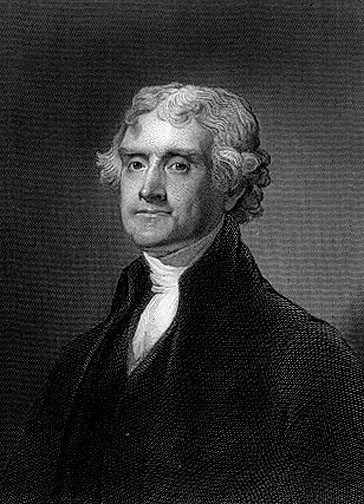
One should always beware of what America’s right-wing amateur historians of the revolution claim Thomas Jefferson said. Many times, when you’re given a Jefferson “quote” from one of these sources, though it’s always intended to back up their faith that the Founders were exactly in line with their own political beliefs, you can almost certainly guarantee that Jefferson meant the opposite of what they claim he meant.

Take for example Swinford’s 6th “Thing,” which reiterates the Republican talking point about what kind of government the Founders intended. (Note that this is word for word what my right-wing friend posted on his blog in that previous post): Continue reading