A Tory on Britain’s Sinking into an American-made Quagmire

Rory Stewart, Tory MP from Cumbria, made these observations on the 10th anniversary of British collusion with the Bush-Cheney catastrophe in Iraq. He describes the situation well and asks excellent questions, especially the very last one in this excerpt.

[O]ver the last eighteen months, this relationship has unraveled
First, contrary to the Vice-President’s predictions, the Iraqis have
insisted that every last US soldier depart. They have refused visas to
so many US diplomats that half the new multi-billion dollar Embassy is
empty. As the last US troops withdrew, they were attacked by a Shia
terrorist group; two months later that group was brought into the
Iraqi government. The day that the last soldier left, the Shia
Prime-Minister sent tanks to arrest the Sunni Vice-President.
President Obama personally called the Kurdish leader – who had been
one of the US’s closest allies – asking him to step aside and allow in
a more balanced government. The Kurdish leader refused. Three months
ago, Vice-President Biden begged the Iraqi Prime-Minister not to
release an Iranian terrorist commander, (who had been arrested by
British troops. The Iraqi Prime-Minister ignored the Vice-President,
and released him.

In August and September, Iraqi banks were teaming up with the Iranian
government to break sanctions. Iranians were being allowed to ship
weapons through Iraq to prop up the Syrian regime. And in December,
the Iraqi Prime-Minister, who arrested 615 Sunni Arabs in an hour, a
year ago, lined up his troops against the Kurdish militia. On one day
last year, there were simultaneous attacks in ten cities, killing
fifty and wounding two hundred.

Saddam – an extreme dictator – has gone. The media is much freer now.
Many young Iraqis, and particular Kurds, are very grateful that the
old regime has fallen, and are proud of their new culture. But the
international community has not achieved its objectives – however
often it redefines them. First, we aimed to create a ‘democratic Iraq,
at peace with itself and its neighbours’. By 2009, we talked only of a
stable, representative government, a place where terrorists could not
operate, and “an ally”. Instead, after a decade, a trillion pounds,
and more lives than anyone would want to count, we have helped to
create a place, which sometimes looks like a corrupt and fragile
democracy, and sometimes like a Shia rogue state – somewhere on a
scale between Iran and Pakistan.

The question for Britain is what aspect of our culture, our
government, and our national psychology, allowed us to get mired in
such catastrophe?

Hat tip, once again, to The Browser.

Happy 10th Anniversary, American Catastrophe in Iraq!

iraq-war-games

Peter Van Buren, author of We Meant Well: How I Helped Lose the Battle for the Hearts and Minds of the Iraqi People, shares his mordant thoughts on the anniversary of what he calls American’s worst foreign policy blunder. Read the whole article here:

The Iranian leadership watched carefully as the American imperial version of Iraq collapsed, concluded that Washington was a paper tiger, backed away from initial offers to talk over contested issues, and instead (at least for a while) doubled-down on achieving nuclear breakout capacity, aided by the past work of that same A.Q. Khan network. North Korea, another A.Q. Khan beneficiary, followed the same pivot ever farther from Washington, while it became a genuine nuclear power. Its neighbor China pursued its own path of economic dominance, while helping to “pay” for the Iraq War by becoming the number-one holder of U.S. debt among foreign governments. It now owns more than 21% of the U.S. debt held overseas.

And don’t put away the joke book just yet. Subbing as apologist-in-chief for an absent George W. Bush and the top officials of his administration on this 10th anniversary, former British Prime Minister Tony Blair recently reminded us that there is more on the horizon. Conceding that he had “long since given up trying to persuade people Iraq was the right decision,” Blair added that new crises are looming. “You’ve got one in Syria right now, you’ve got one in Iran to come,” he said. “We are in the middle of this struggle, it is going to take a generation, it is going to be very arduous and difficult. But I think we are making a mistake, a profound error, if we think we can stay out of that struggle.”

Think of his comment as a warning. Having somehow turned much of Islam into a foe, Washington has essentially assured itself of never-ending crises that it stands no chance whatsoever of winning. In this sense, Iraq was not an aberration, but the historic zenith and nadir for a way of thinking that is only now slowing waning. For decades to come, the U.S. will have a big enough military to ensure that our decline is slow, bloody, ugly, and reluctant, if inevitable. One day, however, even the drones will have to land.

And so, happy 10th anniversary, Iraq War! A decade after the invasion, a chaotic and unstable Middle East is the unfinished legacy of our invasion. I guess the joke is on us after all, though no one is laughing.

AIPAC and the Evils of Republicratism

Gung ho at AIPAC

Gung ho at AIPAC

MJ Rosenberg makes these observations on his eponymous blog:

It’s hard to watch the AIPAC conference for more than a few minutes at a time. For me, the worst part is the pandering (and lying) by Democratic politicians eager to raise money for their next campaign.

So far, Joe Biden has been the worst. He is heavily funded by the Adler family of Miami Beach (he even brought President Obama to their home for a fundraiser), one of the big AIPAC families. Here is Biden talking about how the head of the Adler klan and another AIPAC mogul gave him his “formal education” on the Middle East. (Not to mention all that money.

And, of course, Biden (like John Kerry) knows better than his AIPAC speeches indicate. I have talked to him about Israel and Palestine.He can name the top Palestinian leaders in Fatah and Hamas and tell you the differences between their respective positions. He believes Israel needs to end the occupation and talk to Hamas. He would not dare say it publicly, although he has said  it so often privately that it is amazing the media never reports it.

But Biden does what he thinks he has to because, for politicians like him (that is, pretty much all politicians), nothing is more important than keeping donors happy. Call him a hypocrite but he cries all the way to the bank.

The Republicans are different. Supporting the occupation and threatening war with Iran come naturally to them. They don’t need lobby money for their campaigns and they don’t get Jewish votes anyway.  (This is not to say that they don’t like Sheldon Adelson’s money, just that as the pro-business party, they don’t need it). They support Netanyahu because they believe that the west needs to crush the Muslim world. They do not feign Islamophobia. It’s them.

Do we not hear echoes of  Yeats in this accurate picture of today’s politics?: “The best lack all conviction, while the worst/ Are full of passionate intensity.” Continue reading

Another blast from the past

“[M]odern democracy is at the service of global capitalism. We will not be voting our way toward a more humanist redistribution of resources, least of all if the market does not require it. Similarly, when we voted for Obama in 2008, we did not really vote for what we had the audacity to hope we were voting for, nor for change we really could believe in. We were voting, simply, for the choice the Democratic Party, through its intricate, arduous and obscenely expensive vetting process, presented to Democrats and Americans as the titular head of its party. We were not voting for any ideas other than the usual handful that get talked about endlessly in media that also owe their existence and wealth to global capitalism. We get what global capitalism pays for and wants and needs in that office to further its aims and agenda (of enriching the rich and distributing resources toward that end).”

christofpierson's avatarTragic Farce

I call myself a Democrat because that’s how I’ve been registered all of my voting life. In fact, the older I get, the more disconnected I feel from that label. I don’t want to register as an independent because, Bernie Sanders notwithstanding, I can’t get over the prejudice that American independents are all right-wing at heart. Was it George Wallace’s American Independent Party that instilled this in me? Who knows? It’s beginning to feel, however, that the correct radical stance in this disintegrating context is to not register or vote at all. A vote begins to feel like acquiescence to the corruption.

Did Democrats or any other Obama supporter vote for the fiasco of the last month, culminating in the supreme surrender by our audacious leader last night to the anti-democrats of the Republican Party, bypassing the leaders of his own party to give the (fictional) partisanship-loathing centrists of the…

View original post 1,098 more words

Blast from the past, but it seems relevant still


“It appears that the inequality gap in the US has been caused by a combination of legalized looting of public resources by the financial class and tax policies that have favored them above all other classes in the society. This is, in effect, a government underwritten redistribution of wealth away from the bottom 99% toward the top 1% and, therefore, it would seem to violate the Paulist principle that starts this article.”

christofpierson's avatarTragic Farce

4. Government may not redistribute private wealth or grant special privileges to any individual or group.

–from The Ten Principles of a Free Society

Continuing my gradual critique of Ron Paul’s Ten Principles, the next in line is relevant to what I’ve been talking a lot about these past few weeks, the great impetus behind #OccupyWallStreet: income inequality.

It’s significant that the godfather of the Tea Party movement (the original form of it, anyway) includes wealth redistribution in his principles of liberty. It points up an area where these two movements can either come together or get driven apart.  There’s no question about where #ows stands on this point. Income inequality is a key symptom of the disease #0ws arose in response to, and one of its goals, I would argue,  is to force a correction of what it views this to be: a moral wrong. If Paul is…

View original post 1,279 more words

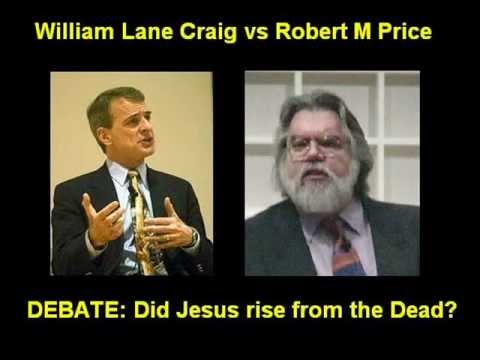
Loving Christianity Better Than Truth: The Craig-Price Debate

Craig Price

I’ve been watching and listening to numerous debates on YouTube between eminent atheists and Christian/theist apologists on subjects like “Does God Exist?”, “Does the Christian God Exist?”, “Did the Resurrection Happen?”, “What’s the Purpose of Life?” and so on. The debaters on the atheist side include Richard Dawkins, Sam Harris, the late Christopher Hitchens and Richard Carrier (whom I wrote about in my last post),  and on the theist side (among others)  Dinesh D’Souza, Rabbi David Wolpe and, most eminent of all, William Lane Craig.

If I had to score the debates he’s been in, though I disagree with him about virtually every point he makes, I’d give by far most wins to the phenomenal Dr. Craig. As atheist and debate aficionado Mark Smith notes about Craig, “He usually wins his debates. However, he wins his debates usually due not so much to being a great debater (which he is), but rather from debating people who haven’t the slightest clue how to debate.” A non-Christian rooting for one of Craig’s atheist opponents and caring about the outcome will probably wind up feeling like a Red Sox fan did last season suffering another visit from the Yankees at Fenway. Continue reading

Why You Should Doubt the Historicity of Jesus

As Richard Carrier explains in this talk given at a skeptic’s conference at the University of Wisconsin at Madison last spring, most academics who are paid to think, write and teach about Jesus will tell you that, while it’s really impossible to know for certain if Jesus was a historical figure, even the most secular of scholars in the field agree with near certainty that he probably did exist in some form or other. The key word there, of course, is the weasel word “probably.” Carrier doesn’t say so here, but these scholars are also very impatient with the alternative idea that Jesus probably wasn’t historically “real,” even though the degree of difference in certainty between their position and Carrier’s (and my) position is virtually non-existent. What the “historicists” have that Carrier and I don’t have is numbers in the academy who agree with them. That’s all they have, and when you get right down to it, that isn’t much at all.

When people who believe in a historical origin for the Jesus story find out how shaky the theoretical ground really is under their feet, they sometimes turn the conversation to less discomforting terrain, stating, for example, that it actually doesn’t matter if Jesus was real at all in the way the Bible says he was or was just made up out of thin air. The point is the wisdom in the religion and the good (or evil) that it hath wrought–or more neutrally, the impact it had on the rest of history. I disagree that this evasion is a suitable response to the challenge posed by Carrier and other mythicists. Their challenge is not aimed at the content of the religion. It’s aimed at the methods of historical research and the question of whether Christian history should be treated as a special case from other types of history,  one where it is not permitted to get too close to the central questions about its origins.

If  you think whether or not Jesus existed in history is an interesting question,  you’ll probably find Carrier’s cogent presentation on reasons not to believe in it provocative, to say the least.  Let me know what you think in the comments below.

Scrap the Constitution?

Do you consent to being governed by these people?

Do you consent to being governed by these people?

On Huffington Post’s Live channel this afternoon, Georgetown law school professor Louis Michael Seidman took up the case he made in the New York Times last weekend that the US should (as the Times piece title had it) “give up on the Constitution.” In the Times piece, Seidman wrote:

AS the nation teeters at the edge of fiscal chaos, observers are reaching the conclusion that the American system of government is broken. But almost no one blames the culprit: our insistence on obedience to the Constitution, with all its archaic, idiosyncratic and downright evil provisions….

Our obsession with the Constitution has saddled us with a dysfunctional political system, kept us from debating the merits of divisive issues and inflamed our public discourse. Instead of arguing about what is to be done, we argue about what James Madison might have wanted done 225 years ago.

As someone who has taught constitutional law for almost 40 years, I am ashamed it took me so long to see how bizarre all this is. Imagine that after careful study a government official — say, the president or one of the party leaders in Congress — reaches a considered judgment that a particular course of action is best for the country. Suddenly, someone bursts into the room with new information: a group of white propertied men who have been dead for two centuries, knew nothing of our present situation, acted illegally under existing law and thought it was fine to own slaves might have disagreed with this course of action. Is it even remotely rational that the official should change his or her mind because of this divination?

Seidman argues  that what he calls “constitutional disobedience” is not radical or new but has been applied over and over in the nation’s history. “No sooner was the Constitution in place than our leaders began ignoring it,” he wrote in the Times. He cites  several big examples, beginning with the writing of the Constitution itself, when national leaders chose expediency over fidelity to the sacred document.

On HuffPo, Seidman the non-radical was met mainly with skepticism from left and right, from defenders of civil liberties as well as from Cato Institute grandee Roger Pilon. The latter said something I actually agree with, that Seidman was getting it “exactly backwards,” suggesting a political solution when our politics is precisely what’s gone wrong. But I think Pilon’s faith in the document is misguided, as I think anyone’s faith in it is. Continue reading

#FreePussyRiot: “Punk Prayer” Translated

To mark the impending ban of Pussy Riot from the Russian Internet for being “extremists” dangerous to the state, I’m reproducing  Carol Rumen’s translation of the Riot’s “Punk Prayer,” the song that gained them a trial for “hooliganism” and world attention in the first place.

(Chorus)

Virgin Mary, Mother of God, banish Putin, banish Putin,

Virgin Mary, Mother of God, banish him, we pray thee!

Congregations genuflect,

Black robes brag gilt epaulettes,

Freedom’s phantom’s gone to heaven,

Gay Pride’s chained and in detention.

KGB’s chief saint descends

To guide the punks to prison vans.

Don’t upset His Saintship, ladies,

Stick to making love and babies.

Crap, crap, this godliness crap!

Crap, crap, this holiness crap!

(Chorus)

Virgin Mary, Mother of God.

Be a feminist, we pray thee,

Be a feminist, we pray thee.

Bless our festering bastard-boss.

Let black cars parade the Cross.

The Missionary’s in class for cash.

Meet him there, and pay his stash.

Patriarch Gundy believes in Putin.

Better believe in God, you vermin!

Fight for rights, forget the rite –

Join our protest, Holy Virgin.

(Chorus)

Virgin Mary, Mother of God, banish Putin, banish Putin,

Virgin Mary, Mother of God, we pray thee, banish him!

Kant and Capital Punishment (Take 2)

In a previous post, I responded to commenter Dudley Sharp‘s citation of a quote purporting to be from Immanuel Kant in support of the death penalty:

“If an offender has committed murder, he must die. In this case, no possible substitute can satisfy justice. For there is no parallel between death and even the most miserable life, so that there is no equality of crime and retribution unless the perpetrator is judicially put to death….A society that is not willing to demand a life of somebody who has taken somebody else’s life is simply immoral.”

Not being a philosopher but having read and thought a bit about Kant on my own, I doubted the provenance of the quote. In fact, it turns out it is from Kant’s Metaphysics of Morals. Kant did indeed believe in and argue for the morality of capital punishment.

This in itself, of course, does not solve the matter. Just because Kant thought the death penalty was moral doesn’t mean it is, in fact, so.  But I want to take the argument seriously and consider it in terms of Kant’s ethics as a whole as I understand them. Again, I’m not trained as a philosopher, as is probably apparent to anyone who wondered why I doubted the original quote was from Kant. But bear with me. This is an important and useful line of thought with respect to justice generally. And by all means, if you think my reasoning is wrong, please explain why in the comments section of this post. Continue reading