My 9/11: Afternoon

Continuing from yesterday’s posts. Rather than dig up faulty memories, I’ve decided to quote myself (writing as Burt Worm) from 2003:

The city felt like Berlin 1945

I felt like I was in a Graham Greene novel, especially when I was waiting [on the Queens side], with hundreds of tired, worried people, to be allowed to cross the 59th Street Bridge. No one was crossing any bridges at all, by car, train, bicycle or foot, and I wasn’t sure I was even going to be allowed into Manhattan. Continue reading

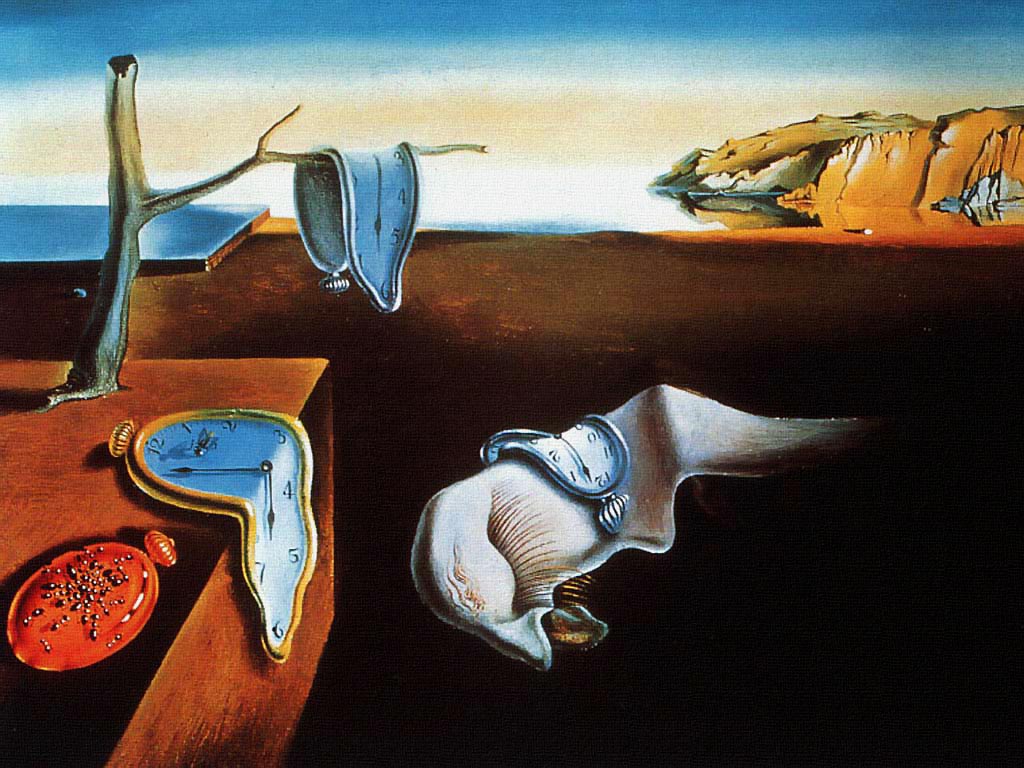
9/11: The Persistence of Memory

Dali had the right idea about memory:

After writing my post on the morning of 9/11, I read this article at Scientific American: Continue reading

My 9/11: Morning

I first became aware on September 11, 2001, that something was up, so to speak, while waiting for a B train to Rockefeller Center at the 59th Street Station in Manhattan. I was getting a slightly late start on the day, having just come from voting for Mark Green for Mayor to replace Rudolph Giuliani.  I was feeling pleased with myself for doing my civic duty and confident that my vote would count, which, after election 2000, I didn’t take for granted any more.

The trains were moving through slowly that morning, which is not too terribly unusual. The southbound platform in particular was not moving at all;  trains sat there with doors open, confused commuters standing half in, half out,  and no sign of any chance for movement any time soon. I heard an announcement to the effect that no trains were going to Brooklyn because of–I wasn’t paying close attention, so I don’t recall if the phrase was “police action” or ” incident”–at the World Trade Center. It was probably the latter, though, perhaps, the word might even have been “emergency.” That would have been an unusual phrase to hear over the MTA intercom, and you’d think it would have stuck in the mind. Continue reading

When I Heard the Learned Economist…

When I read pieces by eminent conservative economists like the Hoover Institute’s Robert J. Barro’s Keynesian Economics vs. Regular Economics, I get the sick feeling in my stomach that the rift between left and right is becoming less and less bridgeable by day. It becomes clearer and clearer to me that, while the left may be going through a prolonged crisis of self-confidence, the right is becoming more deeply mired in an ideological morass and their project is to drag the rest of us down into it whether or not we want to go.
Continue reading

#Irene Storm Over Rikers Island: Some Mitigating Facts

I was pleased this afternoon to see that the questions I posted here last night about where Rikers Island  fit into New York City’s evacuation scheme for Hurricane Irene were being asked all over Twitter and the blogosphere. I knew something was up when I saw the metrics on that post take an immediate spike, in both visits and referrals from Google. Clearly a lot of people were not writing off the Rikers residents even if the mayor and the city’s disaster planners were not going out of their way to include them in the discussion. Continue reading

#Irene: 12,000 on Rikers Island Don’t Count On NYC’s Evacuation Map

Residents of this island are not included in New York City's evacuation plan.

If you look at the map of evacuation zones New York City is sharing with New Yorkers to let them know which of the city’s coastal areas are most at risk should Hurricane Irene live up to the hype and deliver a disaster on Saturday and Sunday, you might not notice right away that only one of the large islands in the city’s waterways is uncoded:  A rather substantial white form, like a little Greenland, sitting in the place where the East River and Long Island Sound blend, just northwest of LaGuardia Airport in the bay between the Bronx and Queens.

West of that large shape are a couple of tiny ones, also uncoded. Those are uninhabited. The large white shape, however, is home to about 12,000 people, though that number fluctuates. That shape is Rikers Island, site of five of the city’s prisons. (To find it more easily on the Times map linked to above, enter “Rikers Island, Bronx, NY 10474” in the “Go to Your Address” form in the legend.) Continue reading

Fox News is Afraid of Ron Paul

As much as I criticize Dr. Libertarian from Texas, I do find Fox’s GOP-sanctioned fear of him, as pointed out by Cenk Uygur of the The Young Turks in the video below, to be utterly pathetic.

As davejoe75 says in the comments to the YouTube video: “Cenk nailed it with that last comment…O’Reilly wants the Ron Paul bump!”

NY Attorney General’s Dismissal Has “Big Banks’ Dirty Fingerprints All Over It”

Here’s a bit of outrageous news that you might not have heard today, courtesy of the Institute for Public Accuracy: Continue reading

Anarchism, Capitalism and Human Rights: A Discussion

There’s a lively little discussion going on in the comments for this post. Here’s a little sample: Continue reading

What Is Ron Paul’s Notion of Justice?

To understand Paul’s third principle for a free society (“Justly acquired property is privately owned by individuals and voluntary groups, and this ownership cannot be arbitrarily voided by governments”), it would be helpful to understand his theory of justice.

One thing seems absolutely certain: it isn’t the same as John Rawls’ theory. In fact, without being explicit about its debt, Paul’s theory, based on what I sussed out of it in the previous two posts, bears a lot of resemblance to Robert Nozick’s anti-Rawlsian theory of justice formulated in Anarchy, State and Utopia.

Full disclosure: I haven’t read Rawls or Nozick. Does this disqualify me from commenting on the ideas I’ve read about from them? I leave that up to my readers. I’m going to plow ahead because I think it’s necessary to discuss Nozick’s idea of “distributive justice” (i.e., how “justly” resources are distributed among individuals) to understand Paul’s. Continue reading