Was it John Boehner’s Intent to Sabotage the #Teaparty?

John Boehner

John Boehner (Photo credit: Keith Allison)

There’s a fascinating, very sour interview on Salon.com with Adam Brandon, a leader of Freedom Works. That organization, somewhat defanged in the wake of an acrimonious split with its former leader, the former Texas Congressman Dick Armey, was nevertheless instrumental in forging right-wing discontent with Obamacare into pockets of astroturf activism around the country. More recently Freedom Works played a role in goading Republicans into following the Tea Party line over the shutdown and debt ceiling debacles. Brandon has ideas about the shutdown and House Speaker John Boehner’s motives during it that are worth considering,

I’m not sure if he’s going to be running for Speaker again. I wonder if that’s part of all of this as well. Why did – I mean the way it was crafted…You needed Democrats to pass this. And what I don’t understand is, if the plan all along was to put just basically a pretty clean CR out there and pass it with Democratic support, Democratic members, why even do it? Why not do this a month ago? Or were they actually trying to embarrass some people, or trying to cause this fight? I mean who knows. I don’t know why these things – if this was the plan all along, he should have started this at the very beginning, and just, “Hey, listen, we’re just going to pass this with Democratic votes.”

All along, observers were wondering what Boehner was up to. He looked weak, terrified of a small group of rabid right-wingers who were insisting on an all-or-nothing fight against Obamacare, which Boehner, being an old hand in DC, had to have known was a big fat turkey that was never going to fly. He would not be Speaker without the rabid right, but he would never be able to accomplish anything worthy of a legacy with them. The Tea Party coalition is the entire reason the Republicans have become the Party of No: No major legislation, no enabling of Obama, no compromise ever. Not much ammo there to stake a Speakership on.

Brandon’s paranoid theory actually makes a kind of sense, then. What if Boehner, realizing his legacy was doomed because of this awful hand he was dealt, decided, having nothing personally to lose, to take revenge on his tormentors on the right by giving them enough rope to hang  themselves? What if he was thinking, if they’re going to tear me down, I’m taking them down with me?

Perhaps this is giving Boehner too much credit. But even if this were his intention, and even if it shows him to be more of a master Machiavellian than most had assumed, it doesn’t change the fact that the shutdown caused massive pain, to government employees, to families, to women with infants and children, to cancer patients, to people with disabilities, veterans, to local and national economies. He can’t be forgiven for that. But it would at least make his actions comprehensible. At least we would know, that cruel and heartless though he may be, he wasn’t motivated by sheer insanity.

Gary Wills: GOP Tactics Echo Antebellum South’s Secessionism

Gary Wills has a very enlightening new piece in the New York Review of Books about the debt-ceiling/shutdown crisis manufactured by the Tea Party wing of the GOP. I can’t add anything to it, Please just go and read it. It’s an opinion of the American present deeply informed by the American past.

Here’s a taste:

Republican leaders in Congress are too cowardly to say that the voting restrictions being enacted by Republican-controlled state legislatures are racially motivated. They accept the blatant lie that they are aimed only at non-existent “fraud.” They will not crack the open code by which their partners claim to object to Obama because he is a “foreign-born Muslim” when they really mean “a black man.” They will not admit that the many procedural laws adopted to prevent abortion are in violation of the law as defined by the Supreme Court. They go along with the pretence that all the new rules are “for women’s health.” De facto acts of secession are given a pseudo-legal cover.

Thus we get people who say they do not want the government in control of women’s health under Obamacare—just after they order doctors to give women vaginal probes the doctors do not consider medically necessary. Or that they do not want the government telling Americans what they should do about their health—just before they prohibit “navigators” from even discussing choices about their health. The same people who oppose background checks for gun purchases now want background checks for anyone the government authorizes to explain the law to people. This is a gag rule to rank with antebellum bans on the discussion of slavery.

So we have one condition that resembles the pre-Civil War virtual secessionism—the holding of a whole party hostage to its most extreme members. We also have the other antebellum condition—the disproportionate representation of the extreme faction. In state after state in the 2012 election, there was a large vote for President Obama, but a majority of House seats went to Republicans. In Pennsylvania, for instance, Obama won 52 percent of the votes cast, but Republicans got over twice as many seats (13 to 5), thanks to carefully planned gerrymandering of districts by Republican state legislatures. This advantage will be set in stone if all the voter restriction laws now being advanced block voters who might upset the disproportion.

The presiding spirit of this neo-secessionism is a resistance to majority rule.

(My only comment on all this I said a little over two years ago,)

Copyright Keeps Books Out of Print

adjustedtitles650

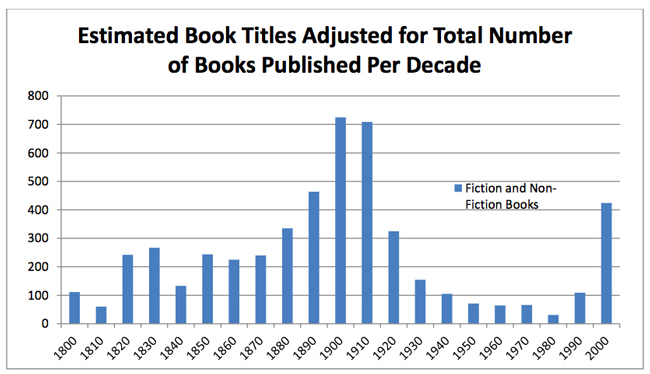
Copyright advocates have long (and successfully) argued that keeping books copyrighted assures that owners can make a profit off their intellectual property, and that that profit incentive will “assure [the books’] availability and adequate distribution.” The evidence, it appears, says otherwise.

Rebecca J. Rosen outlines that evidence in an article at the Atlantic, “The Hole in Our Collective Memory: How Copyright Made Mid-Century Books Vanish.”  It’s always worth asking ourselves just what use present copyright law is for anyone but the massive copyright hoarders like publishers and entertainment retailers. It certainly doesn’t benefit the public and now it’s even clear that it doesn’t even benefit the author whose “intellectual property’ it’s alleged to protect and promote.

Copyright law does, in any case, provide a good lesson in American civics. It demonstrates loudly and clearly whose interests our government has nearest and dearest to its heart.  It’s not the people, of course, but always the intellectual property barons. We can rely on our faithful public servants in government, when given a choice between liberalizing the law (which would have the effect of enriching the creative atmosphere for all) and making it more and more constipated, to always choose the path of most constipation. Call it the trickle out theory of American culture.

Rolling Stone Has a Right to Put Whoever They Want On Their Cover

RS Tsarnaev cover

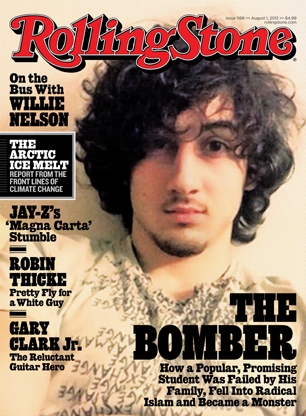
Big, stinking heap of phony outrage story of the day: Rolling Stone is printing a cover story about Boston marathon bombing suspect Dzokhar Tsarnaev and they have the nerve and lack of good taste (which is always the very first phrase we think of when we think American media, isn’t it?) to put a photo of the subject of that cover story on their cover. Shame, shame, Rolling Stone, now every body knows your name (which was probably the point to begin with, wasn’t it?).

Obvious point millions of “concerned” media members and other nervous nellies are blithely missing while falling all over themselves to feel outrage on behalf of poor, weak, innocent, defenseless, little Boston (Shame on you, Dropkick Murphys!): Rolling Stone has the same right to put on their cover whoever or whatever they want to put on their cover as all of those magazines that chose to give Osama bin Laden his celebrity treatment in the aftermath of September 11th did. What part of First Amendment right do you hypocrites not understand?

(Hey, Boston Herald, why don’t you show Rolling Stone the way and just say no to using the Tsarnaevs’ mugs to sell your cheap rag, huh?)

Grow up, America. The world is a hard place. The news media have a right (and responsibility) to make that unpleasant fact known to us.m

No use spending any more time on this ridiculous waste of a non-story. But if you want to defend the “defenders of decency” and attack Rolling Stone‘s “poor taste” and “bad judgment” in the comments, I will be more than happy to kick your ass down there.

A Time to Purge: Meltdown at DemocraticUnderground

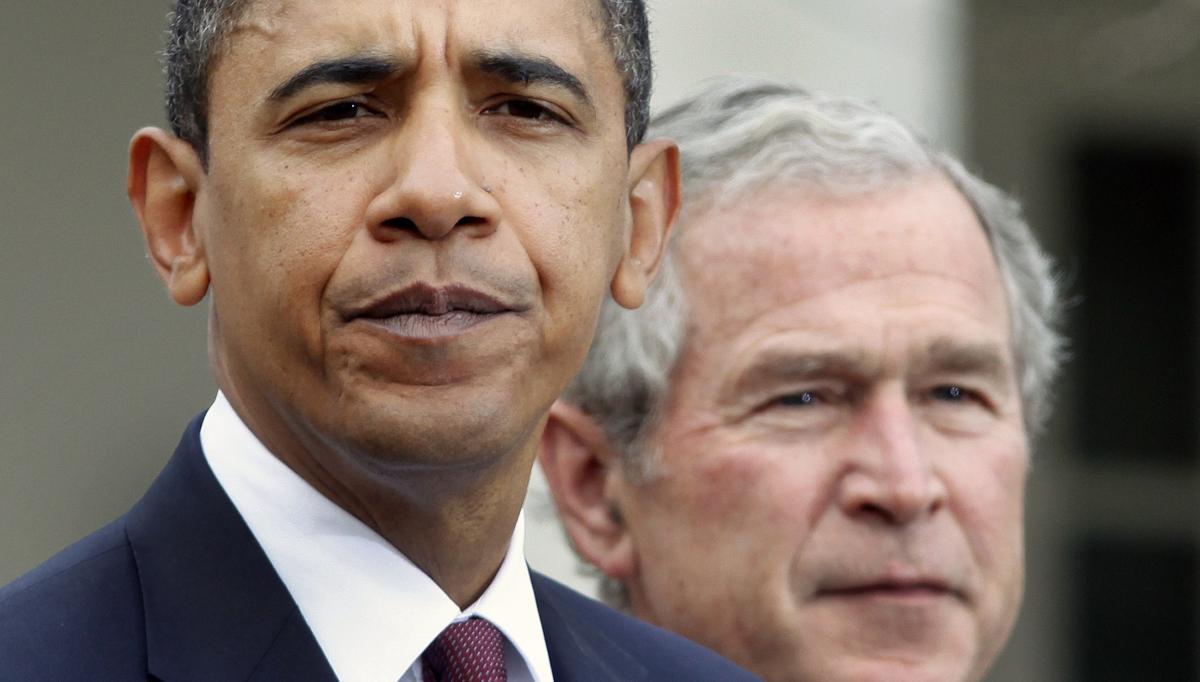
obama bush When last we checked in at DemocraticUnderground, where I posted as BurtWorm for seven years before getting the boot in December 2010  without a single warning, the Administrators had revamped the site and imposed a new set of rules emphasizing the “Democratic” part of the name and seeming to toss the “Underground” part, as it were, under the ground. If you’ve never heard of DU, it’s self-described as the largest “progressive” forum on the Internet, larger even than Dailykos (allegedly). Its politics, however, have been nearly dead centrist since (at least) the 2008 election, when Barack Obama made being a Democrat  “respectable” again.

I was curious how our friends over there have been handling the president’s embellishment of the Bush national security policies. I’m especially curious about how the Administrators are coping. These have got to be trying times for a forum with rules meant to stifle talk that disparages Democratic elected officials. Luckily, the administrators can always count on at least a handful of shameless partisans to carry team Obama’s water even during the worst of times. Continue reading

Noam Chomsky: “It’s institutional structures that block change.”

Keystone XL demonstration, White House,8-23-20...

Keystone XL demonstration, White House,8-23-2011 Photo Credit: Josh Lopez (Photo credit: Wikipedia)

If yesterday’s post of Lawrence Lessig‘s TED talk on corruption gives you reason for optimism, you may want to check that after you read this from perennial thorn in the side of the powers that be Noam Chomsky, who writes of a peculiar distinction between the most “advanced” societies in the world today and those  least touched by technological “progress” as far as the threat of climate change goes:

So, at one extreme you have indigenous, tribal societies trying to stem the race to disaster.  At the other extreme, the richest, most powerful societies in world history, like the United States and Canada, are racing full-speed ahead to destroy the environment as quickly as possible.  Unlike Ecuador, and indigenous societies throughout the world, they want to extract every drop of hydrocarbons from the ground with all possible speed.

Both political parties, President Obama, the media, and the international press seem to be looking forward with great enthusiasm to what they call “a century of energy independence” for the United States.  Energy independence is an almost meaningless concept, but put that aside.  What they mean is: we’ll have a century in which to maximize the use of fossil fuels and contribute to destroying the world.

And that’s pretty much the case everywhere.  Admittedly, when it comes to alternative energy development, Europe is doing something.  Meanwhile, the United States, the richest and most powerful country in world history, is the only nation among perhaps 100 relevant ones that doesn’t have a national policy for restricting the use of fossil fuels, that doesn’t even have renewable energy targets.  It’s not because the population doesn’t want it.  Americans are pretty close to the international norm in their concern about global warming.  It’s institutional structures that block change.  Business interests don’t want it and they’re overwhelmingly powerful in determining policy, so you get a big gap between opinion and policy on lots of issues, including this one.

This seems to be a pretty important point, but it’s very difficult to know how seriously it’s being taken: The United States government does not have the species’ or the world’s best interests at heart. And it’s not just the Republicans, who are an easy target for American liberals,  that we have to blame. The fact is the Republicans are pretty much brain-dead and useless at this point. But are the Democrats really all that much better on this issue in particular? Continue reading

Lawrence Lessig on America’s “Impossible” Corruption Problem

Lawrence Lessig, Harvard professor, lawyer, creator of Creative Commons, and author of Republic, Lost, explains via masterful use of Power Point, the profound corruption problem facing the republic and why there is reason for optimism that the people can solve it.

Will the “Final” Revolution Be Started by Second Amendment Absolutists?

Gun-porn kitsch or talisman of the "final revolution?"

Gun-porn kitsch or talisman of the “final revolution?”

“A new American revolution is long overdue. This revolution has been brewing in the hearts and minds of the people for many years, but this Independence Day, it shall take a new form as the American Revolutionary Army will march on each state capital to demand that the governors of these 50 states immediately initiate the process of an orderly dissolution of the federal government through secession and reclamation of federally held property. Should one whole year from this July 4th pass while the crimes of this government are allowed to continue, we may have passed the point at which non-violent revolution becomes impossible.

“The time to sit idly by has passed. To remain neutral is to be complicit, just doing your job is not an excuse, and the line in the sand has been drawn between the people, and the criminals in Washington, D.C. While some timid souls will say that it is too early, that we can solve this problem through democratic means provided by government, that current levels of taxation are reasonable for the services provided, and that the crimes of this government are merely a tolerable nuisance, it may already be too late.

“While there is risk in drastic action, the greater danger lies in allowing this government to continue unchallenged. So if you are content with the status quo, stay home, get fat, watch the fireworks from a safe distance, and allow this Independence Day to pass like any other. But if you see as we see, and feel as we feel, we will see you on the front lines of freedom on July 4th, 2013 for this, The Final American Revolution.”

Signed, Adam Kokesh, May 23, 2013 from a cage in the Philadelphia federal prison.

In the summer and fall of 2011, I watched with excitement as the Occupy movement spread from Wall Street to Main Streets across the nation and, surprisingly, then the world. It was thrilling to watch a movement to change the way everything is done not only launch and spread but so quickly get deep into the consciousness of people all over the globe. Even the most powerful news media, though claiming at first to be uncomprehending of its aims, were taking its ideas about the  politics of inequality and the corrupting influence of money seriously. It felt like a world-historical revolution was being born right in front of our eyes.

Then came the winter of 2012 and Occupy, most of its camps having been forcibly removed from their reclaimed public spaces, seemed to lose its momentum and its influence. Media still talk about the 99% and the tyranny of debt  and pay closer attention to the misdeeds of the bankers, but by and large, Occupy fell out of the public eye. When it resurfaced briefly after Sandy, the media mostly ignored the powerful message it was sending that where the austerity-obsessed governments were failing, people power was succeeding. Occupy Sandy was made to look like a group of civic do-gooders.  Occupy’s radical Strike Debt program to buy defaulted medical debts and forgive them and its ongoing battles against residential foreclosures were all but completely ignored.

It’s easy to forget that just because the revolution is not being televised, there might still be a revolution going on. Continue reading

Ron Paul’s Principle of Personal Responsibility: A Critique

Single_Payer_Public_Opinion.Svg

5. Individuals are responsible for their own actions; government cannot and should not protect us from ourselves.

–from The Ten Principles of a Free Society

Part of the reason I began critiquing Ron Paul’s Ten Principles of a Free Society a couple of years ago was my curiosity about whether they really were essential to any free society or just Ron Paul’s vision of one. I think I can use the fifth principle to show why they are all uniquely Paulian/Libertarian and not, in fact, essential to all notions of a free society. To do that, I just need to show you an example of a free society where government or an authority can and should protect us “from ourselves.” Continue reading

Reagan Spending vs. #TeaParty Austerity

Would Tea Party Republicans have voted to give Reagan his 50% spending increases and 700,000 more government jobs?

In an article from the Washington Post on “Tea Party” Congressman Mick Mulvaney of South Carolina, these paragraphs caught my attention:

Mulvaney mostly meets with voters through weekly town hall meetings. Sometimes he brings with him a 30-minute PowerPoint presentation, full of bar graphs and fever charts depicting the growing federal deficit and the surging cost of health care. In January, Mulvaney added a chart on the automatic spending cuts, known as sequestration, which next year will total about $100 billion.

To him the numbers make sense. “In the greater scheme of things, they are not that big,” Mulvaney said.

But, every once in a while, a personal anecdote punctures his certainty. Earlier this month, a friend and former campaign volunteer stood up at one of the town hall meetings to tell Mulvaney that the defense cuts had cost him his job of five years with a large defense contractor. “I just want you to know that these cuts are real and they hurt me,” said Jeffrey Betsch, a single father of three daughters, who was on the verge of being evicted from his home.

After the Rotary Club speech, Mulvaney was thinking about his friend as he drove down a narrow two-lane ribbon of worn blacktop, past strawberry farms and pine forests. He felt terrible, he said, but he also believed that the country faced problems that were bigger than the struggles of a single constituent.

“I don’t see how you wipe out 40 cents of spending on every dollar and not have someone get hurt,” Mulvaney said.

The punchline of the article, which is titled “As budget cuts hit S.C., a congressman is surprised at constituents’ reactions” is that his constituents are actually not angry with him, despite his stubborn refusal to shower the district with federal dollars, as his predecessor Rep.  John Spratt did. It was anger toward Spratt and his loose spending ways that propelled Mulvaney into office in 2010. That same anger may be the wind at his back if he runs for higher office in his state.

Yet principled though they may be, Mulvaney’s actions have had real consequences for his constituents. In addition to his former campaign volunteer, the Congressman faced the irritation of an Air Force general in his district who claimed the effects of the sequester had made the AF less ready for warfare than at any time in memory. To which charges, Mulvaney responded,  “If the cuts force us to look for better ways of saving money in the future, they will be a success. We can’t go backwards.”

How can a progressive argue with such principle? The chief pain caused in Mulvaney’s district is to the military and “independent” defense contractors–or should we say, to the people who work for either sector. Do progressives want to see that money continue to flow to those pockets, or can we use this opportunity of Tea Party intransigence to rethink our spending priorities? Continue reading