Memo to Rand Paul: Condescension Won’t Win You the Hearts of the “Rest of America”

Sen. Rand Paul

From the Huffington Post:

At a sold-out New Hampshire Republican Party dinner Monday night, Sen. Rand Paul (R-Ky.) encouraged the room of GOP supporters to embrace diversity and outreach if they want to take the White House in 2016, the Courier-Journal in Louisville reports.

“We need to be like the rest of America,” Paul said. “We’re going to win when we look like America. We need to be white, we need to be brown, we need to be black, we need to be with tattoos, without tattoos, with ponytails, without ponytails, with beards, without.”

Paul urged New Hampshire Republicans to reshape their party’s image and become the “party of opportunity.”

“We need to be that party that can express it in a way that shows that we care about people,” Paul said, according to the Concord Monitor. “We need to care about people even if they are on government assistance.”

Paul may be playing coy about his plans for a presidential run, but there’s no doubt at all about his plans to influence the Republican Party’s national chances for the highest office in some way. In addition to his high-profile and principled filibuster of drone attacks on Americans in March (principles that he seemed to have walked back a bit in April), Paul has also caught the press’s attention visiting Howard University,  the storied “Black Harvard” located in Washington, D.C.,  and the Hispanic Chamber of Commerce, where he spoke in favor of amnesty for undocumented workers in some cases  in opposition to his own position pre-Election 2012. Paul has been putting quite a bit more sweat into outreach to non-Republican demographics than any of his peers since, maybe, Jack Kemp in the 1980s.

So why is it almost certain that Paul will fail? It’s not just that he’s dealing with the Sisyphean task of making the Grand Old White People’s Party attractive to young multiculturals. I mean, that’s a difficult enough task, for sure, especially given the way the party’s hardcore rank-and-filers and its most visible politicians are able to undo all Paul’s efforts with just a little bit of  talk about the issues that matter most to Paul’s alleged target audiences (if his audience isn’t actually just more moderate white independents), and the way many on the right resist threats of outreach as betrayal of fundamental principles. No, I think Paul is going to fail unless he finds another way of talking about his aspirations for the party–and to really try to understand if his aspirations for the party are genuinely appealing to non-Republican groups. It’s one thing to want more diversity in the party; it’s another thing entirely to know how to build it. You do not build diversity by making speeches that scream how little you understand the audience you’re trying to appeal to. Continue reading

Krugman Trashes Austerity’s Phony Morality Economics

DAVOS/SWITZERLAND, 24JAN08 - Jean-Claude Trich...

DAVOS/SWITZERLAND, 24JAN08 – Jean-Claude Trichet, President, European Central Bank, Frankfurt, captured during the session ‘Systemic Financial Risk’ at the Annual Meeting 2008 of the World Economic Forum in Davos, Switzerland, January 24, 2008. (Photo credit: Wikipedia)

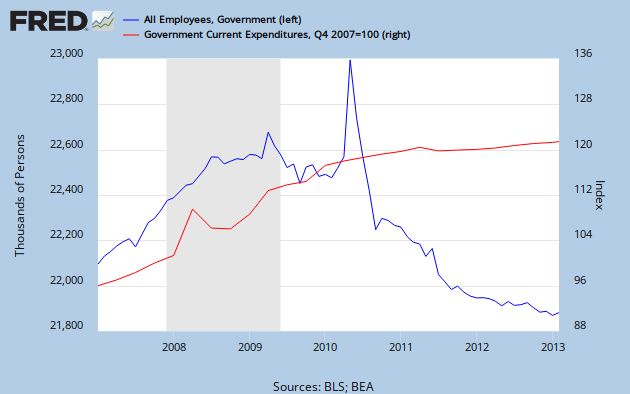
Apropos of a current theme of this blog, that the powerful Austrian school of economics that has supplanted Keynesianism as the go-to ideology of our government and, more and more, both political parties, is rooted in the same Nietzschean stew of pro-winner, anti-loser sentiment that appealed to the Nazis, Paul Krugman has a piece in the current New York Review of Books that devastates the “austerian” contention that Keynesianism feeds the Beast, while austerity corrects naughty economic behavior. His main support for his argument is the recent discovery of severe flaws in the methodology of two studies most often cited by austerians, one by Harvard profs Carmen Reinhart and Kenneth Rogoff and the other by Italy’s Alberto Alesina and Silvia Ardagna, purporting to show that government spending that exceeds 90% of GDP in the wake of a depression or financial meltdown is catastrophic for the economy in question.

David Stockman’s The Great Deformation … [is] an immensely long rant against excesses of various kinds, all of which, in Stockman’s vision, have culminated in our present crisis. History, to Stockman’s eyes, is a series of “sprees”: a “spree of unsustainable borrowing,” a “spree of interest rate repression,” a “spree of destructive financial engineering,” and, again and again, a “money-printing spree.” For in Stockman’s world, all economic evil stems from the original sin of leaving the gold standard. Any prosperity we may have thought we had since 1971, when Nixon abandoned the last link to gold, or maybe even since 1933, when FDR took us off gold for the first time, was an illusion doomed to end in tears. And of course, any policies aimed at alleviating the current slump will just make things worse.

In itself, Stockman’s book isn’t important. Aside from a few swipes at Republicans, it consists basically of standard goldbug bombast. But the attention the book has garnered, the ways it has struck a chord with many people, including even some liberals, suggest just how strong remains the urge to see economics as a morality play, three generations after Keynes tried to show us that it is nothing of the kind. Continue reading

The Idle Rich and the Working Stiff: Nietzche von Hayek on Capital v. Labor

Corey Robin, whose Nation piece on Nietzsche and Hayek I referred to here, posted this comparison of the two thinkers’ ideas on class on his own blog. They support his contention that Hayek was more in tune with Nietzschean philosophy than commonly supposed. Whatever you think of Robin’s thesis, it is instructive at least to see the contempt or, at least, casual dismissal of the worth of the working class in Hayek’s musings.

Corey Robin's avatarCorey Robin

Nietzsche, Human, All Too Human:

Culture and caste.—A higher culture can come into existence only when there are two different castes in society: that of the workers and that of the idle, of those capable of true leisure; or, expressed more vigorously: the caste compelled to work and the caste that works if it wants to….the caste of the idle is the more capable of suffering and suffers more, its enjoyment of existence is less, its task heavier. (§439)

My utopia.—In a better ordering of society the heavy work and exigencies of life will be apportioned to him who suffers least as a consequence of them, that is to say to the most insensible, and thus step by step up to him who is most sensitive to the most highly substantiated species of suffering and who therefore suffers even when life is alleviated to the greatest…

View original post 575 more words

The Secret Seizure and “Progressive” Democrats’ Failure of Heart

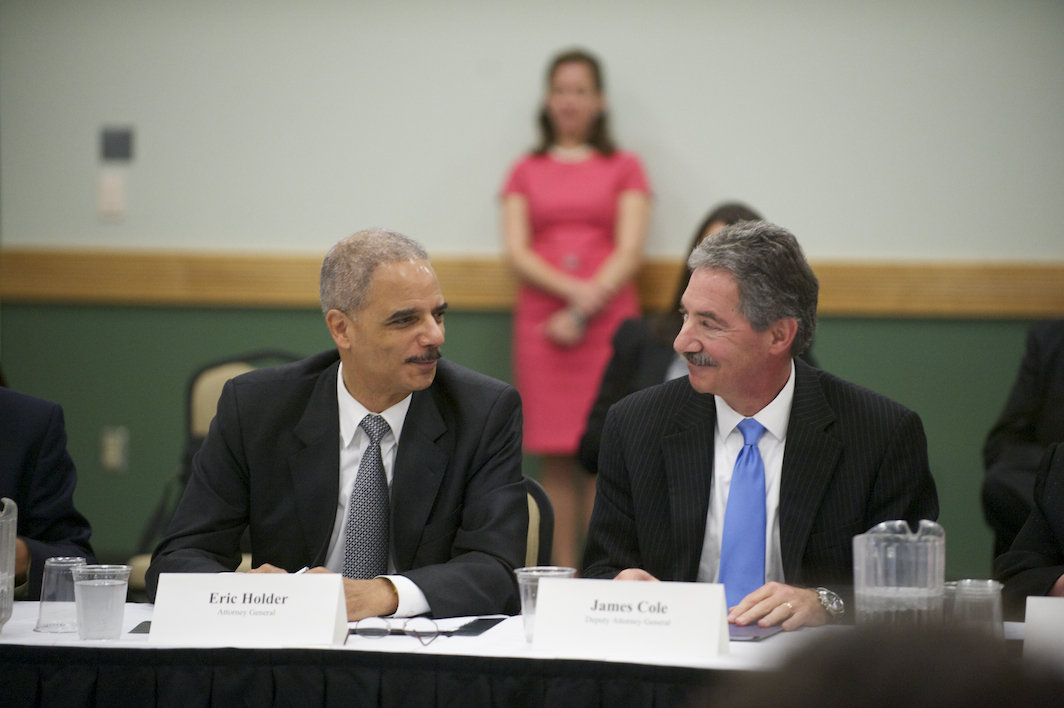
Attorney General Eric Holder with Deputy AG James Cole, who made the call to seize two months of phone records of 20 AP reporters.

AG Eric Holder with Deputy AG James Cole, who made the call to secretly seize two months of records of 20 phone lines of AP reporters in search of a  leaker in the Obama administration.

My first instinct when I heard Monday’s revelation of the DOJ’s secret seizure of certain AP reporters’ work and home phone records was to say to myself, I’m glad I voted for Jill Stein.

My second was to fume over how infuriating this story is, what ham-handed ineptitude it displays. If there’s only one area of Obama’s administration that progressive Democrats who voted for him twice should agree with me about it’s this nauseatingly phony tougher-than-Bush approach to questions of national security. I mean, if I were the same person I was in, say, 2004 and had voted for Obama’s second term, I would be having some serious cognitive dissonance issues to deal with today. On the other hand, these are the same people who boasted loudly for half the campaign season about Osama bin Laden’s death (rather than his capture, which would really have been something to boast about), so chances are they won’t be too upset over anything Obama does in the name of national security. Continue reading

Also Sprach Hayek: Nietzsche and the Libertarians

Friedrich Wilhelm Nietzsche

Friedrich Wilhelm Nietzsche (Photo credit: risu)

Whatever has value in our world now does not have value in itself, according to its nature—nature is always value-less, but has been given value at some time, as a present—and it was we who gave and bestowed it.

Friedrich Nietzsche, The Gay Science (1882)

Value is therefore nothing inherent in goods, no property of them, but merely the importance that we first attribute to the satisfaction of our needs, that is, to our lives and well-being.

Carl Menger, Principles of Economics (1871)

Corey Robin has a fascinating, very long post up at The Nation on the possible (or even likely)  connections between Nietzsche and the Austrian school economists (Hayek, von Mises and their American disciples). He’s added a bit at Crooked Timber, where a lively discussion is underway.

Here’s his opening:

In the last half-century of American politics, conservatism has hardened around the defense of economic privilege and rule. Whether it’s the libertarianism of the GOP or the neoliberalism of the Democrats, that defense has enabled an upward redistribution of rights and a downward redistribution of duties. The 1 percent possesses more than wealth and political influence; it wields direct and personal power over men and women. Capital governs labor, telling workers what to say, how to vote and when to pee. It has all the substance of noblesse and none of the style of oblige. That many of its most vocal defenders believe Barack Obama to be their mortal enemy—a socialist, no less—is a testament less to the reality about which they speak than to the resonance of the vocabulary they deploy.

The Nobel Prize–winning economist Friedrich Hayek is the leading theoretician of this movement, formulating the most genuinely political theory of capitalism on the right we’ve ever seen. The theory does not imagine a shift from government to the individual, as is often claimed by conservatives; nor does it imagine a simple shift from the state to the market or from society to the atomized self, as is sometimes claimed by the left. Rather, it recasts our understanding of politics and where it might be found. This may explain why the University of Chicago chose to reissue Hayek’s The Constitution of Liberty two years ago after the fiftieth anniversary of its publication. Like The Road to Serfdom (1944), which a swooning Glenn Beck catapulted to the bestseller list in 2010, The Constitution of Liberty is a text, as its publisher says, of “our present moment.”

The benefit of Robin’s article is that it doesn’t dismiss libertarian thought out of hand, as most leftist critiques might be tempted to do, but takes it very seriously and digs deep into its roots, showing precisely where the ancestral ideas that gave rise to our right-wing, market-obsessed American brethren diverged from the extremist right-wing ideology of the fascists in Germany. Libertarians may find the article unsettling, if they take Robin’s arguments as seriously as he takes theirs. Most Americans, left or right, may find it a disturbing read. I certainly did. Continue reading

Thoughts on the Cherokee Blood-Feud, or Anthropology is Only Fun Till Someone Puts an Eye Out!

This is a fascinating piece (with an irresistible title!). It reminded me of a documentary film called Push Back (or Pushback?),  Payback by Margaret Atwood. It’s a difficult film to remember because it’s a little all over the place, but one segment concerns a blood feud in Albania of all places. The consequences of the patriarch of this little family in the Albanian mountains having killed a neighbor over a dispute involving land was that every member of the family was marked for assassination if they left the property. The entire family, in other words, was serving the murder sentence. As “northier” says, this is not an anomalous form of justice; this is the apparent human default. Are there other animals that behave this way? Or is this sense of debt unique to us?

David Graeber touches on this in his history of debt. But northier makes an interesting observation about the collective guilt shared by the customer support staff operator (who’s often half a world away from the actual perpetrators of banking chicanery) with the whole corporation, at least in the view of the irritated customer.

Really interesting food for thought here.

danielwalldammit's avatarnorthierthanthou

…and of course that is when it gets really interesting.

By poking an eye out, I am of course talking about a special sort of moment one gets from time to time in the study of anthropology, at least I do. It’s the sort of moment when some cultural practice causes the hair on the back of your neck stand up and your stomach tries to dig its way to China (or Antarctica, as would be the case here in Barrow). I’m talking about that kind of moment when you encounter something in an ethnography that just seems like too much. So, you sit there and ask yourself, “How in the Hell could that be anything but wrong?” And for a little while anyway, your mind just doesn’t want to travel down that road, the one that leads to understanding the practice in its own context. You’d rather just say ‘no’. Hell, you’d…

View original post 2,095 more words

Harris v. Greenwald II: Is Islam Worse Than Other Religions?

Crusades1

Commenting on my previous post, adpr wrote:

[M]y simple question is: Does Islam at this moment constitute a greater threat compared to other religion for peace. This question was brought up by Harris in his lengthy response on his blog. The key question being, should we consider Islam a greater threat to peace than Jainism, a religion that strictly adheres to non-violence?This question set be back because initially I was agreeing with Greenwald. But Jainism, although still a religion that believes in supernatural deity, has a lot less that I criticize than Islam, Christianity or Zionism?

So, if we were equally critical of all these religions, are we not saying we consider each of these religions equally detrimental to the state of society that we want to change.

This is what Harris wrote on his blog, the passage adpr is referring to (emphasis in the original):

My criticism of faith-based religion focuses on what I consider to be bad ideas, held for bad reasons, leading to bad behavior. Because I am concerned about the logical and behavioral consequences of specific beliefs, I do not treat all religions the same. Not all religious doctrines are mistaken to the same degree, intellectually or ethically, and it would be dishonest and ultimately dangerous to pretend otherwise. People in every tradition can be seen making the same errors, of course—e.g. relying on faith instead of evidence in matters of great personal and public concern—but the doctrines and authorities in which they place their faith run the gamut from the quaint to the psychopathic. For instance, a dogmatic belief in the spiritual and ethical necessity of complete nonviolence lies at the very core of Jainism, whereas an equally dogmatic commitment to using violence to defend one’s faith, both from within and without, is similarly central to the doctrine of Islam. These beliefs, though held for identical reasons (faith) and in varying degrees by individual practitioners of these religions, could not be more different. And this difference has consequences in the real world. (Let that be the first barrier to entry into this conversation: If you will not concede this point, you will not understand anything I say about Islam. Unfortunately, many of my most voluble critics cannot clear this bar—and no amount of quotation from the Koran, the hadith, the ravings of modern Islamists, or from the plaints of their victims, makes a bit of difference.)

If you’re interested, you can read a sort of Muslim rebuttal to Harris here. [On edit: If you follow this link you may or may not be shocked by the Truther headline, which I don’t endorse. However you react to that, the thrust of the discussion below this is on the question of the Quran’s edicts on the murder of a non-Muslim. You and Sam Harris might also be shocked by what the author of this page has to say on that subject, but it won’t be the cheap sort of shock you get with a gratuitous anti-Muslim slur from Ann Coulter.]

Rather than reinvent the wheel, I’m going to try to explain my own position on this question redacting my responses to adpr’s comments and replies to my comments, following the jump. Continue reading

Harris v. Greenwald: Is there an Anti-Islam Bias in New Atheism?

In any war

A few weeks ago, a fight broke out between two heavyweights of the blogosphere: Sam Harris and Glenn Greenwald. I respect both of them so didn’t want to have to choose sides. Harris, author of The End of Faith, etc., is one of the most formidable defenders of secularism and atheism, and Greenwald, formerly of Salon and now blogging for the Guardian, is a ferocious advocate for civil liberties in the wake of 9/11.  They’ve been friendly en0ugh in the past to have each other’s private email addresses, apparently, which is where the fight began.

It started over a series of articles in the media claiming the “New Atheists” exhibit bigotry in their attacks on Islam. The first salvo in this attack came from Nathan Lean at Salon:

Until 9/11, Islam didn’t figure in the New Atheists’ attacks in a prominent way. As a phenomenon with its roots in Europe, atheism has traditionally been the archenemy of Christianity, though Jews and Judaism have also slipped into the mix. But emboldened by their newfound fervor in the wake of the terrorist attacks, the New Atheists joined a growing chorus of Muslim-haters, mixing their abhorrence of religion in general with a specific distaste for Islam (In 2009, Hitchens published a book called “God Is Not Great,” a direct smack at Muslims who commonly recite the Arabic refrain Allah Akbar, meaning “God is great”). Conversations about the practical impossibility of God’s existence and the science-based irrationality of an afterlife slid seamlessly into xenophobia over Muslim immigration or the practice of veiling. The New Atheists became the new Islamophobes, their invectives against Muslims resembling the rowdy, uneducated ramblings of backwoods racists rather than appraisals based on intellect, rationality and reason. “Islam, more than any other religion human beings have devised, has all the makings of a thoroughgoing cult of death,” writes Harris, whose nonprofit foundation Project Reason ironically aims to “erode the influence of bigotry in our world.”

Frankly, this strikes me as revisionist history if not an outright slur. It’s true that Harris’s The End of Faith was inspired by his revulsion against the religion (and religiosity) of the 9/11 attackers,  and it’s also true that the appearance of his bestselling book in 2004 often marks the opening of the American mind (and media and bookstore shelves) to atheism. In fact, by 9/11/01, the new, more aggressive atheism had already been bubbling up to the sunlight from various backwaters of the Internet, particularly on Usenet groups like talk.origins, sci.skeptic and alt.atheism, since before 1995 when I first came into contact with it. Most of those atheists rose in response to Christian evangelicalism and creationism of the 1970s and 1980s, and I think it’s a virtual certainty that Christianity remains by far the most frequent target of most American atheists’ critiques, if only because, like most Americans in general, they still lack more than a rudimentary understanding of Islam.

After reading his article, I criticized Lean on Twitter for his broad brush slander of all new atheists as Islamophobe bigots. He denied the charge. He claimed “I never mention atheists in any general sense. I’m quite specific,” and pointed me to the third paragraph of his Salon piece:

The New Atheists, they are called, offer a departure from the theologically based arguments of the past, which claimed that science wasn’t all that important in disproving the existence of God. Instead, Dawkins and other public intellectuals like Sam Harris and the late Christopher Hitchens suffocate their opponents with scientific hypotheses, statistics and data about the physical universe — their weapons of choice in a battle to settle the scores in a debate that has raged since the days of Aristotle. They’re atheists with attitudes, as polemical as they are passionate, brash as they are brainy, and while they view anyone who does not share their unholier-than-thou worldview with skepticism and scorn, their cogitations on the creation of the universe have piqued the interest of even many believers. With that popularity, they’ve built lucrative empires. Dawkins and Harris are regulars in major publications like the New York Times and the Economist, and their books — “The Selfish Gene” and “The God Delusion” by Dawkins and “The End of Faith” and “Letter to a Christian Nation” by Harris — top bestseller lists and rake in eye-popping royalties.

Maybe I’m being oversensitive, but I don’t see the clear distinction Lean claims he’s making between Harris, Dawkins and Hitchens and atheists at large. It looks like his distinction  is between “New Atheists” and “past” atheists–in other words, like he is, in fact, accusing all Dawkins-Harris-Hitchens–influenced atheists of today (which is virtually all of us) of anti-Muslim bigotry. To me, it looks as though Lean is advancing a bit of a bigotry himself, against New (or new) atheists. If you’re making a charge against someone of thoughtless and unjustified condemnation of a group, shouldn’t you be very careful that your own words don’t render you guilty of the very same charge? Continue reading

#TeaParty Patriot Founder: “Why do the politicians and media figures want us to hate each other?”

Mark Meckler, one of the founders of Tea Party Patriots, spoke to a crowd of leftists at Seattle’s Citizen University conference recently (hat tip to Upworthy), and what he said resonates in a way with what I was arguing in my debate  with partisan Democrat Milt Shook yesterday on Twitter:

Meckler’s answer to the question above, if you haven’t watched this brief video, is that it profits politicians and others at the center of the DC power structure to maintain the false divide between left and right: the strategy is called Divide and Conquer. I’m thrilled to hear that Meckler is apparently refusing to play along. Imagine if all of us who were inspired by the occupy movement and all of those who were fired up by the Tea Party came to the same conclusion: our enemies are not among the people. Our enemies are the ones who think we owe them votes and viewership, who manufacture our opinions and sell them retail as the stuff of our national politics.

Here’s hoping this is another sign of a new phase of revolution, one that will enable us to take  back the democracy and make it work for people again.

Tortured Argument from a Straight Talker: On Democrats, Progressives and Centrists

I’m in the middle (or hopefully, at the end) of a much more involved debate than I was expecting on Twitter with a fellow named Milt Shook, who operates a blog called, colorfully enough, Please…Cut the Crap. It’s on a topic that is bound to get a reaction from me: the question of whether progressives harm Democrats’ chances with centrists and other purported persuadables by criticizing the party’s standard bearers. He puts his case in a nutshell in the last graph of an article he calls “Stop Complaining About Dems. In 2014, Voters Will Still Only Have 2 Choices: Them or Disaster“:

Voters have two choices every November, and these days, the choice is between competence and disaster. When you trash “the Democrats” mercilessly, the Republicans gain. And if you don’t think we lose when Republicans gain, then you haven’t been paying attention. And we cannot allow 2014 to become just like 2010. We really can’t afford it.

Shook’s central point, it seems to me, is that the system may be severely flawed, but it’s the only one we have, therefore, progressives need to make peace with that and work with the one of only two (face it) parties most closely resembling (vaguely) a progressive one. Here’s how he puts it himself a the beginning of this post:

I know many of the people who read this blog would love to see a “third party” pop up. Unfortunately, our system is built in such a way that all a third party does is weaken one of the other two. This is why the progressive movement keeps failing; we keep hoping for things that can’t happen, and we look down on those things that can happen.

It’s important for everyone to realize that elections are the most important element in a democratic republic. They are the linchpin for everything. Marching and occupying is not, in itself, an expression of democracy. If such activism is not followed by effective campaign strategy that puts the best available people in office every single time, then it’s pretty much worthless.

That phrase is key. The BEST AVAILABLE candidate. In a democracy as diverse as ours, the best available candidate will almost never be far left, unless he or she represents a full-on left district. Sorry.

We might call Shook a “good-enough” progressive (since he identifies himself as a progressive and not a moderate–we’ll give him the benefit of the doubt). He sees the same rickety representative democracy we all see, the same crappy candidates, the same ineffectual institutions; but unlike his fellow lefties, he knows there’s no use breathing even a word of complaint against any of it (except the part to the left of him, perhaps). You might as well complain against the weather or our impending deaths. It’s written before we’re here. It’ll be here after we go. Roll with it, Henry.

It seems reasonable to ask Shook why he bothers to complain about progressives complaining about Democrats. Hasn’t that been going on (in some form or other) since the dawn of American political time as well? I think our friend Shook is concerned that we’re due for a repeat of 2010, which, I’ve just had confirmed by him on Twitter, he believes was “100%” the  fault of progressives rather than of any given Democrat:

I was a progressive working for a Dem in GOP district. I blame progs 100% for 2010.— Milt Shook (@MiltShook) April 16, 2013

Continue reading