Tax Increases or Books: A Library Fights Back

This video tells the tale of how Troy, Michigan’s public library cleverly and successfully fought back (with the help of an ad agency) against a Tea Party effort to shut it down in lieu of authorizing a 0.7% tax increase to keep it open. This story is probably a common one in the age of austerity. Although the election was almost two months ago, this is the first I heard of the campaign.

I’d like to believe that the Tea Partiers are sincere in their chagrin over the sense that they’ve lost control of their government. We on the left certainly can understand that. But they repeatedly show poor value judgment, as in this instance in Michigan. They can often seem to embody Oscar Wilde’s quip about a cynic knowing the price of everything and the value of nothing. But they’re witless cynics if they don’t know that 0.7% added to a yearly tax bill is a very small price to pay for a library.

Jill Stein on Change: Not Just Something to Believe In

If Pres. Obama and the Democrats talked this talk and walked this walk, they would be giving me something to vote for. Come to think of it, that’s exactly what Jill Stein of the Green Party is giving me.

Blasphemy, Islam and Free Speech: A Twittersation

This afternoon, I had a very interesting conversation with Shabbir R Hassanally on Twitter about events of the last week in Libya and Egypt.

This raging mess in American relations with the Islamic nations, which has, as Michelle Obama might say, “revealed” more about both candidates’ character and abilities in foreign policy than either may have wished for, was alleged to have begun when a trailer for an intentionally inflammatory anti-Islamic film called “Innocence of the Muslims” made in California in July was translated into Arabic and posted on YoutTube. Thus, it became known to Egyptian Islamists who consequently rioted at the American embassy, starting a chain reaction of anti-American protests around the Middle East and beyond. According to the New York Times, the fatal attack on Ambassador Christopher Stevens and three others in Benghazi was the premeditated work of a Libyan paramilitary group with links to al-Qaeda that took advantage of the chaos over the riots against the film to execute a planned attack in retaliation for the drone-strike killing of a Libyan-born Qaeda official.

Huffington Post reports that the auteur behind the offensive film is one Nakoula Basseley Nakoula, a 55-year-old Egyptian-born Coptic Christian with a background that includes bank fraud and possibly meth manufacturing among  other enterprises. Though the story is weird and complicated, it seems Nakoula, in cahoots with a group of radical right-wing Christian Islamophobes, hired a bunch of actors to shoot a script they were told was about a fictional character. After the cheapie was shot, Nakoula dubbed in the offending dialogue denigrating Mohammed as a clueless sex maniac, pedophile and with various other Nakoula-like interests. When the story broke on the afternoon of September 11, Nakoula’s identity was not yet known. He was hiding behind the pseudonym “Sam Bacile” and claiming to be an Israeli-born American who was working with contributions from a hundred Israelis. In the Muslim world, word spread quickly that Israel and the US had colluded on the film, that it reflected not just the opinions of a nutty director but official US policy, as dictated to it by Zionist Israel. Why Nakoula tried to implicate Israel in his offense is not known (as far as I know). (Was he trying to give the Apocalypse a little boost? If so, maybe he succeeded better than he expected.) Continue reading

On Moral Arguments for the Death Penalty: “Kant” and Retribution

Immanuel Kant: “If an offender has committed murder, he must die. In this case, no possible substitute can satisfy justice. For there is no parallel between death and even the most miserable life, so that there is no equality of crime and retribution unless the perpetrator is judicially put to death.”.

“A society that is not willing to demand a life of somebody who has taken somebody else’s life is simply immoral.”

Cited by Dudley Sharp in comments on a previous post

Continuing a conversation begun here and taken up by commenter Dudley Sharp (for whose contribution I’m grateful), I want to turn to Sharp’s “MORAL FOUNDATIONS OF THE DEATH PENALTY, Part I) (See the comment linked to above–and I hope Sharp will share Part II or more). I probably won’t spend much time addressing the religious arguments–or I may come back to them later. I will just say that I don’t believe any human is capable of speaking for the alleged ultimate authority on morality, which many name “God.” I think it’s more fruitful to assume that justice on earth is more of a political or social problem than a cosmic one. So let me focus on Sharp’s “foundations” that jibe with that view, such as the argument from “Kant” above for starters. Continue reading

Fambul Tok: The Movie

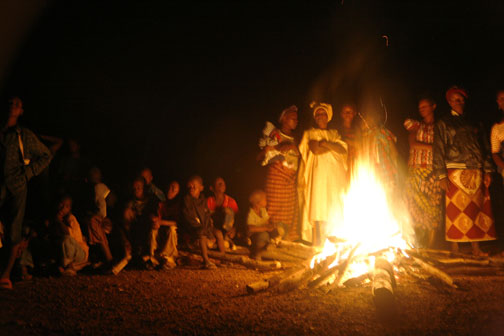
My last post on  Sierre Leone’s NGO Fambul Tok was based on my viewing several weeks ago of the 2011 film of the same name, directed by Sara Terry and co-produced by Libby Hoffman, which I highly recommend for anyone interested in questions of crime, punishment, and justice.  In brief, it concerns the NGO’s work in Sierra Leone’s communities with reconciling victims and perpetrators of the country’s civil war, which lasted from 1991-2002. It begins at a bonfire in a small village with a rape victim confronting and eventually forgiving the rapist, her uncle. In another village, former best friends are reconciled; one, as an impressed child soldier for the rebels, had killed the other’s father. A sister of a notorious rebel leader, who remains missing, begs and receives forgiveness on her brother’s behalf from the cousins and neighbors whose families he had brutalized by torture, rape and murder.

As the film explains through its central spokesperson John Caulker, Fambul Tok was developed as an alternative to the post-war commissions that had, until the film was released, prosecuted only a handful of war criminals, none of them of top rank. The cost to the nation of that nearly decade-long Western-style process was in the tens of millions of dollars. Meanwhile, Fambul Tok’s brand of justice had cost about $US 1 million  since it was founded in 2007 until the film’s release last year and had reconciled hundreds of former antagonists. Continue reading

A Radical Approach to Justice: Fambul Tok

As I was saying yesterday, we Americans carry with us a pretty basic understanding of how “justice” is officially carried out in our names, and we “law-abiding” ones don’t usually give it much thought other than to see it as a deterrent to any “criminal” urges we or our fellow citizens might have. Which is not necessarily a bad thing, if it really does deter people from injuring others in some way. I think most would agree that when a person is violent or injurious to other people, we want that person’s liberty restrained so that they aren’t able to cause harm anymore. The question becomes, however, how long should their liberty be taken from them? And beyond that, who is responsible for dispensing this justice and why them? (And, furthermore, who guards the guards?) Continue reading

Why We Need a New Approach to Justice

I’ve been absent from this blog for a while, feeling frankly too hopeless about the political situation to pick up on my usual themes and too busy reading for pay as a professional reviewer to have much time to explore other ideas. But I have been thinking about something that I’d like to begin exploring on this blog, just setting aside the question of whether it can ever become a more generally salient idea for discussion elsewhere, let alone a movement for radical change. In a word: I’d like to propose a radical rethinking of justice, crime and punishment.

Continue reading

Ron Paul, Lew Rockwell and “Voluntary Association”

“State-enforced segregation,” Rockwell wrote, “was wrong, but so is State-enforced integration. State-enforced segregation was not wrong because separateness is wrong, however. Wishing to associate with members of one’s own race, nationality, religion, class, sex, or even political party is a natural and normal human impulse.”

Lew Rockwell quoted in “Who Wrote Ron Paul’s Newsletters,” by Julian Sanchez and Dave Weigel

Sanchez and Weigel, in the piece linked to above, plausibly trace the history and possible provenance of the most vilely racist items in Ron Paul’s popular newsletters from the late 1980s and early 1990s to libertarian intellectual Lew Rockwell, a former Paul political aide and campaign staffer. Rockwell, like Paul, shares many views in common with anti-imperialists on the left, not least of which is plain, unfettered anti-imperialism. But whereas the left views capitalism as a major source of and impetus for imperialism, Rockwell and company are undistilled free marketeers. The Rockwell quote above quite eloquently elaborates, I think, on Paul’s second principle, which I discussed in a previous post, particularly on the phrase “voluntary association.” Continue reading

Is Ron Paul’s Principle of “Voluntary Associations” Racist Code?

2. All peaceful, voluntary economic and social associations are permitted; consent is the basis of the social and economic order.

–from The Ten Principles of a Free Society

I mentioned in the first of this series that Tea Party and post-Democrat leftist favorite Ron Paul long ago left a trail of basely racist remarks as he crept to his current place of near-prominence in the national and world debate on issues of war, peace and economics. The article that first detailed Paul’s association with fringe-right ideas is by James Kirchik and it that appeared in The New Republic in January 2008 (quoted after the jump): Continue reading

Gun Rights of the Mentally Ill: “Rights Belong to Individuals, Not Groups”

I imagine Ron Paul and his fans would have read this front page story in today’s New York Times with a very different reaction (not to mention, frame of reference) from mine:

Across the country, states are increasingly allowing people like Mr. French, who lost their firearm rights because of mental illness, to petition to have them restored. Continue reading