A Statement From the 90 5th Avenue #Occupation

Here’s a fascinating and encouraging development from yesterday’s second-month celebration of the occupation of Zuccotti Park, something to indicate that the movement is far from being a flash in the pan and far from being defanged. A group of students and other protesters have taken over a space at 90 Fifth Avenue in preparation for creating a free “people’s university.” It may also provide an alternative space for at least some of #OWS’s displaced denizens during the winter months, provided the city and the owners  of the building (which happens to be one of the nation’s largest banks, according to the protesters) don’t try to Bloomberg/Brookfield them out.

A Statement From the 90 5th Avenue Occupation follows the jump: Continue reading

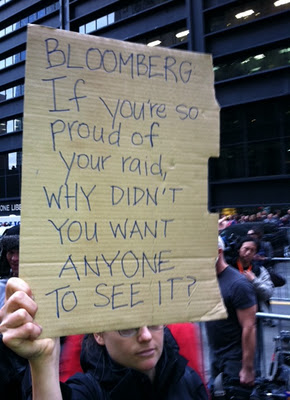
#OWS Signage: Question for Bloomberg

h/t Charles Bivona

UPDATE: State of Seized Library

From the blog of #OccupyWallStreet’s People’s Library:

UPDATE: State of Seized Library.

The movement will no doubt survive, even if its flagship camp is forced to move elsewhere. But its flagship library is not as easily replaced.  More than any other aspect of Bloomberg/Kelly’s Monday night raid on Zuccotti Park, the thoughtless destruction of the People’s Library symbolizes the soullessness of the authorities threatened by our wonderfully rebellious American Fall.

May the embers of this shameful moment be kept alive in our hearts and minds to kindle an even more wonderful American Spring.

#OWS: Sometimes the Good Guys Don’t Wear White

Don Emmert/Agence France-Presse — Getty Images


The Standells – Sometimes Good Guys Don’t Wear White

#OWS Economics: Ron Paul on Wealth and Privileges

4. Government may not redistribute private wealth or grant special privileges to any individual or group.

–from The Ten Principles of a Free Society

Continuing my gradual critique of Ron Paul’s Ten Principles, the next in line is relevant to what I’ve been talking a lot about these past few weeks, the great impetus behind #OccupyWallStreet: income inequality.

It’s significant that the godfather of the Tea Party movement (the original form of it, anyway) includes wealth redistribution in his principles of liberty. It points up an area where these two movements can either come together or get driven apart.  There’s no question about where #ows stands on this point. Income inequality is a key symptom of the disease #0ws arose in response to, and one of its goals, I would argue,  is to force a correction of what it views this to be: a moral wrong. If Paul is any indication (and I’m sure he is), the Tea Party is not so much troubled by this gap as it is by the idea that government should try to close it. Continue reading

#TeaParty Rep. Loses Cool with Skeptical Constituents

Rep. Joe Walsh of Illinois demonstrates his concept of representative democracy at a townhall held in a bar in his district last weekend. What exercised the Congressman’s patience was the suggestion, apparently popular among the unrattled attendees, that, as I suggested yesterday,  private banks were as much at fault for the depressed or recessed economy as politicians. Walsh displays the Tea Party mindset at its most rigid worst when he asserts that consistency of ideology is more important than accuracy of fact. He doesn’t want the people of his district to forget is that he will not stray from the Tea Party (Republican) line that  private interests are more important than the public interest.

The bottom line: The people get it. Some politicians don’t and don’t want to get it.

PS: Perhaps the most astonishing moment of this video is when Walsh says, “”What has made this mess is your government­, which has demanded for many years that everybody be in a home.” Is a Tea Party Republican actually blaming the American dream of universal home ownership for the economic mess? Is he really suggesting that the American dream is the product of government rather than of individuals? Setting aside the question of whether or not this is right, this seems to be a startling position for a conservative, pro-market, pro-individualist to be taking. I wonder if this will be a new shade of conservatism: anti-American Dream libertarianism.


#OWS Economics: Who’s to Blame?

Here’s an interesting video from a Texas-based libertarian, John Barksdale (my spelling may be incorrect), who calls himself order9066. I’m impressed with the research he put into this subject, and I take his point very well that it was not just Republicans who were responsible for throwing out the Glass-Steagall Act of 1933, which prohibited financial holding companies insured by the FDIC from owning other companies engaged in financial speculation such as Wall Street investment firms or insurance companies, with the Gramm-Leach Bliley Act of 1999.

While this video does serve as a corrective for the idea that Democrats share little or no blame in the gutting of New Deal protections that set-up the disaster of 2008, it goes overboard in pushing Republicans into the background of the blame picture. After all, the three authors and main sponsors of the bill were all Republicans, and both houses of Congress were, in fact, controlled by the GOP.  But it does highlight two main points: The fingerprints of “Third Way” Democrats in Clinton’s White House (including Clinton himself, of course) are as much in evidence on the financial deregulation of the late 1990s as the Republicans’ are; and Congressional Democrats were ineffective, at best, in preventing (and, at worst, complicit in bringing on) Glass-Steagall’s demise. Continue reading

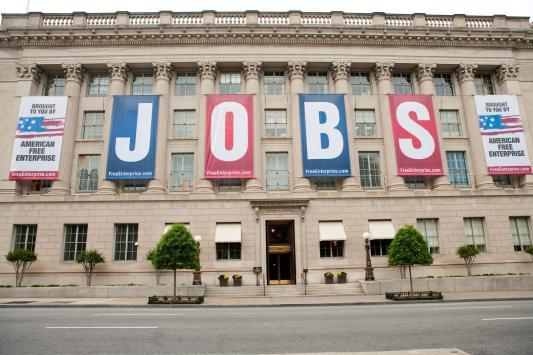
Unleash the Entrepreneurs?

US Chamber of Commerce's major contribution to jobs creation dialog: A giant banner taunting the White House across Pennsylvania Avenue.

What’s wrong with this rosy picture of entrepreneurship painted by the Manhattan Institute’s Edward L. Glaeser in his article “Unleash the Entrepreneurs” at City Journal?:

Three years have passed since the financial crisis of 2008, and unemployment rates remain painfully high. As of August 2011, America employed 6.6 million fewer workers than it did four years earlier. To try to fix the problem, the Obama administration has pursued a variety of Keynesian measures—above all, the huge stimulus package of 2009, which included not only direct government spending but also such features as tax credits for home buyers and temporary tax cuts for most Americans.

Such policies ignore a simple but vital truth: job growth comes from entrepreneurs—and public spending projects are as likely to crowd out entrepreneurship as to encourage it. By putting a bit more cash in consumers’ pockets, the tax cuts in the stimulus package may have induced a bit more car- and home-buying, but the next Steve Jobs is not being held back by too little domestic consumer spending. Tax credits for home buyers and the infamous program Cash for Clunkers encourage spending on old industries, not the development of the new products that are likelier to bring America jobs and prosperity.

Unemployment represents a crisis of imagination, a failure to figure out how to make potential workers productive in the modern economy. The people who make creative leaps to solve that problem are entrepreneurs. If we want to bring America’s jobs back, our governments—federal, state, and local—need to tear down barriers to entrepreneurship, create a fertile field for start-up businesses, and unleash the risk-taking innovators who have always been at the heart of our economic growth.

Isn’t the default position of American economic policy precisely what Glaeser is selling as the solution to the nation’s economic problems? It looks to me like advocating hitting oneself in the head with a baseball bat to prevent injuries caused by hitting oneself in the head with a hammer.  Glaeser and all “free marketers” are slaves to the notion that entrepreneurship in itself is a panacea for all economic and social ills. What they seem to ignore is that some entrepreneurship can cause economic and social ills. As an example, consider the many franchise-based companies (think food-service) that pay their employees unlivable wages with flimsy benefits packages, forcing many  to supplement their incomes with public services like food stamps or to use emergency rooms as primary doctors offices. Continue reading

Murmuration

Here is video of an astonishing natural phenomenon that looks truly unreal, a virtual undulation written in starling form across the sky.  As my Swedish grandmother would have said,  “How do dey du it?”

Murmuration from Sophie Windsor Clive on Vimeo.

The Bishops and Their Pawns

Archbishop Timothy Dolan, President of the US Conference of Catholic Bishops, spreading smoke at his day job.

I’ve been focusing on monied interests in the past few weeks, but if you want a striking example of how American democracy has evolved to favor the interests of the powerful over the people, consider this article on Huffington Post by Laura Basset about another form of ungodly influence over the body politic:

A group of men with no real background in law or medicine, but blessed with a strong personal interest in women’s bodies, have quietly influenced all of the major anti-abortion legislation over the past several years. The U.S. Conference of Catholic Bishops may be one of the quietest, yet most powerful lobbies on Capitol Hill, with political allies that have enabled them to roll back decades of law and precedent. Continue reading