The movement will no doubt survive, even if its flagship camp is forced to move elsewhere. But its flagship library is not as easily replaced. More than any other aspect of Bloomberg/Kelly’s Monday night raid on Zuccotti Park, the thoughtless destruction of the People’s Library symbolizes the soullessness of the authorities threatened by our wonderfully rebellious American Fall.
May the embers of this shameful moment be kept alive in our hearts and minds to kindle an even more wonderful American Spring.
Continuing my gradual critique of Ron Paul’s Ten Principles, the next in line is relevant to what I’ve been talking a lot about these past few weeks, the great impetus behind #OccupyWallStreet: income inequality.
It’s significant that the godfather of the Tea Party movement (the original form of it, anyway) includes wealth redistribution in his principles of liberty. It points up an area where these two movements can either come together or get driven apart. There’s no question about where #ows stands on this point. Income inequality is a key symptom of the disease #0ws arose in response to, and one of its goals, I would argue, is to force a correction of what it views this to be: a moral wrong. If Paul is any indication (and I’m sure he is), the Tea Party is not so much troubled by this gap as it is by the idea that government should try to close it. Continue reading →
Rep. Joe Walsh of Illinois demonstrates his concept of representative democracy at a townhall held in a bar in his district last weekend. What exercised the Congressman’s patience was the suggestion, apparently popular among the unrattled attendees, that, as I suggested yesterday, private banks were as much at fault for the depressed or recessed economy as politicians. Walsh displays the Tea Party mindset at its most rigid worst when he asserts that consistency of ideology is more important than accuracy of fact. He doesn’t want the people of his district to forget is that he will not stray from the Tea Party (Republican) line that private interests are more important than the public interest.
The bottom line: The people get it. Some politicians don’t and don’t want to get it.
PS: Perhaps the most astonishing moment of this video is when Walsh says, “”What has made this mess is your government, which has demanded for many years that everybody be in a home.” Is a Tea Party Republican actually blaming the American dream of universal home ownership for the economic mess? Is he really suggesting that the American dream is the product of government rather than of individuals? Setting aside the question of whether or not this is right, this seems to be a startling position for a conservative, pro-market, pro-individualist to be taking. I wonder if this will be a new shade of conservatism: anti-American Dream libertarianism.
Here’s an interesting video from a Texas-based libertarian, John Barksdale (my spelling may be incorrect), who calls himself order9066. I’m impressed with the research he put into this subject, and I take his point very well that it was not just Republicans who were responsible for throwing out the Glass-Steagall Act of 1933, which prohibited financial holding companies insured by the FDIC from owning other companies engaged in financial speculation such as Wall Street investment firms or insurance companies, with the Gramm-Leach Bliley Act of 1999.
While this video does serve as a corrective for the idea that Democrats share little or no blame in the gutting of New Deal protections that set-up the disaster of 2008, it goes overboard in pushing Republicans into the background of the blame picture. After all, the three authors and main sponsors of the bill were all Republicans, and both houses of Congress were, in fact, controlled by the GOP. But it does highlight two main points: The fingerprints of “Third Way” Democrats in Clinton’s White House (including Clinton himself, of course) are as much in evidence on the financial deregulation of the late 1990s as the Republicans’ are; and Congressional Democrats were ineffective, at best, in preventing (and, at worst, complicit in bringing on) Glass-Steagall’s demise. Continue reading →
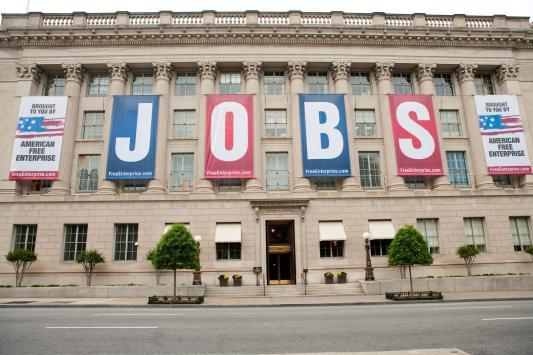
US Chamber of Commerce's major contribution to jobs creation dialog: A giant banner taunting the White House across Pennsylvania Avenue.
What’s wrong with this rosy picture of entrepreneurship painted by the Manhattan Institute’s Edward L. Glaeser in his article “Unleash the Entrepreneurs” at City Journal?:
Three years have passed since the financial crisis of 2008, and unemployment rates remain painfully high. As of August 2011, America employed 6.6 million fewer workers than it did four years earlier. To try to fix the problem, the Obama administration has pursued a variety of Keynesian measures—above all, the huge stimulus package of 2009, which included not only direct government spending but also such features as tax credits for home buyers and temporary tax cuts for most Americans.
Such policies ignore a simple but vital truth: job growth comes from entrepreneurs—and public spending projects are as likely to crowd out entrepreneurship as to encourage it. By putting a bit more cash in consumers’ pockets, the tax cuts in the stimulus package may have induced a bit more car- and home-buying, but the next Steve Jobs is not being held back by too little domestic consumer spending. Tax credits for home buyers and the infamous program Cash for Clunkers encourage spending on old industries, not the development of the new products that are likelier to bring America jobs and prosperity.
Unemployment represents a crisis of imagination, a failure to figure out how to make potential workers productive in the modern economy. The people who make creative leaps to solve that problem are entrepreneurs. If we want to bring America’s jobs back, our governments—federal, state, and local—need to tear down barriers to entrepreneurship, create a fertile field for start-up businesses, and unleash the risk-taking innovators who have always been at the heart of our economic growth.
Isn’t the default position of American economic policy precisely what Glaeser is selling as the solution to the nation’s economic problems? It looks to me like advocating hitting oneself in the head with a baseball bat to prevent injuries caused by hitting oneself in the head with a hammer. Glaeser and all “free marketers” are slaves to the notion that entrepreneurship in itself is a panacea for all economic and social ills. What they seem to ignore is that some entrepreneurship can cause economic and social ills. As an example, consider the many franchise-based companies (think food-service) that pay their employees unlivable wages with flimsy benefits packages, forcing many to supplement their incomes with public services like food stamps or to use emergency rooms as primary doctors offices. Continue reading →
In The Shock Doctrine, Naomi Klein brought to light the neoliberal tactic of crisis capitalism, unleashed in circumstances (as in Chile, Argentina, Poland, Russia, South Africa) where political powers have exploited (or even created) extreme conditions–such as coups, natural disasters, or economic crises–during which the local population is disoriented and their defenses are down, to instigate corporation- and “investment”-friendly policies like lowered taxes and the cutting and privatization of government services. The justification given for such maneuvers is to bring the target economy in line with the global economy, but, of course, very few people (only a tiny few) in the world actually benefit from these capitalistic incursions. One of the most obscene instances of the Shock Doctrine in action resulted in the rape of the former Soviet Union”s assets by the oligarchs in the name of Boris Yelstin’s economic “reforms.” But that’s only one of the most obvious and well known cases.
Catherine Austin Fitts
During the Clinton years, as former communist apparatchiks were helping themselves to radically discounted oil fields and other rich resources in Russia, Catherine Austin Fitts says she witnessed a similar feeding frenzy much closer to home. A former managing director and board member at the Wall Street firm Dillon Read who served as Assistant Secretary at HUD in the first Bush administration, Fitts started a financial company of her own, The Hamilton Securities Group of Washington, D.C., to help communities make the most of federal monies and improve their standing in what she calls the Popsicle Index, which measures the confidence families in a community feel to send a six-year-old by herself to the corner store and back. Fitts witnessed firsthand the collusion between Washington and Wall Street insiders (often the same people on opposite sides of a revolving door) to employ crisis capitalism techniques in the US as part of the daily repertoire of government actions (my emphasis):
Our efforts at The Hamilton Securities Group to help HUD achieve maximum return on the sale of its defaulted mortgage assets coincided with a widespread process of “privatization” in which assets were, in fact, being transferred out of governments worldwide at significantly below market value in a manner providing extraordinary windfall profits, capital gains and financial equity to private corporations and investors. In addition, government functions were being outsourced at prices way above what should have been market price or government costs — again stripping governmental and community resources in a manner that subsidized private interests. The financial equity gained by private interests was often the result of financial, human, environmental and living equity stripped and stolen from communities — often without communities being able to understand what had happened or to clearly identify their loss. This is why I now refer to privatization as “piratization.”
One of the consequences was to steadily increase the political power of companies and investors who were increasingly dependent on lucrative back door subsidies — thus lowering overall social and economic productivity. Hence, the doubling of FHA’s mortgage recovery rates from 35% to 70-90% ran counter to global trends and ruffled feathers…. Continue reading →
As I said in previous articles, IF we participate in the system, I’m not opposed to it at all. How could I be? I’d be a tyrant if I wanted to force hundreds of millions of people to change their behavior. And the fact is, that “IF” was answered long ago. We Americans have chosen the material benefits of being managed by the financial system for generations. We like demand-side freedom, i.e. choosing between Coke and Pepsi, but don’t want supply-side freedom. We like the supply-side to be taken care of for us. We love the benefits that come from it being imperially run—the credit card always works, the gas station is always open, our water faucets and light switches do what they’re supposed to do, the markets keep going up (oops…maybe not). All of our economic needs are outsourced to others, so we have the luxury of spending our time pursuing wants. And if these types of benefits are good for us, they’re good for the rest of the world. We have no moral authority to stand opposed just because we’re now going to lose our privileged position—a rather childlike perspective.
Do I detect some sarcasm? Many of the items Vrabel ticked off as buying our disinterest in changing the imperial system are, of course, threatening to stop working in the near-long term, if they haven’t already stopped working for many of us, which is why, I suspect, #OWS has resonated so deeply so fast.
In any case, perhaps responding to the Arab spring and certainly responding to questions from viewers of Renaissance 2.0, Vrabel returned to YouTube with a new series titled “Debunking Money.” Again, I highly recommend it to anyone wanting to understand how the world really works and why we, the people (or the peasantry, as the case may be), are experiencing a diminution of our liberties. In this series, Vrabel makes explicit his rejection of various ideas from the left and right, including Austrian school economics and Milton Friedman’s neoliberalism.
The lesson below is particularly interesting as it debunks the notion, popular among Libertarians and popularized by Ron Paul, that “ending the Fed” is a viable solution to the problem. Vrabel says the American people would be “cutting their own throat.” If you have difficulty following this, I strongly suggest starting from the first video and hanging on his every word, if possible. Not to say this is the ultimate truth, of course, but it is certainly much closer to the truth than anything you will be hearing from Republicans or Democrats:
A couple of nights ago, as I was following links deeper into the blogosphere in search of a possible explanation for why #occupyWallStreet has sprung at this moment and where it might go, I came upon a series of videos by Damon Vrabel, a self-described “post-neoclassical economic philosopher”, for a “course” he calls Renaissance 2.0 that purports to explain money in a way it isn’t usually thought about by philosophers on the left or right. I’m not particularly clever with money or economics myself, so I was curious to see if Vrabel, whom I’d just watched in a very interesting interview with Max Keiser (it’s in three parts, with part 2 here and part 3 here), could help me get a handle on it. I recommend the whole series.


 Tragic Farce