Defending #OWS, Ron Paul Says He Supports Bailout of People with Bad Mortgages

I applaud him for that. He is certainly the rare politician who seems to actually understand the legitimacy of the #occupyWallStreet protest.

Of course, the last time I heard applause for him like this at one of these debates, he was arguing against bailing out people with catastrophic illnesses who have no health insurance.

#OWS: The Status Quo Strikes Back

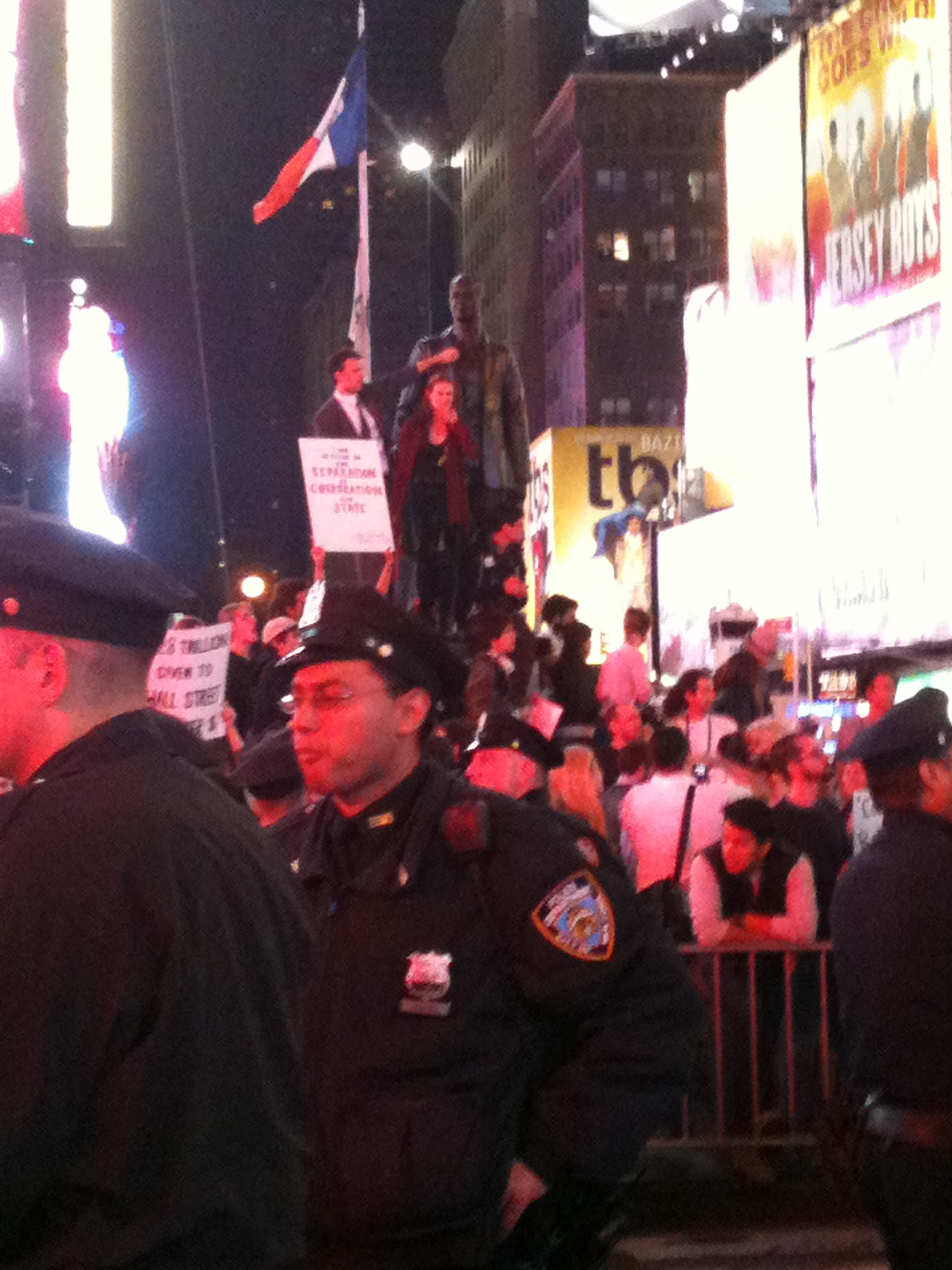
I went with my wife and daughter to Times Square on Saturday evening, October 15, to add our numbers to the #occupationWallStreet demonstration that ended up there, climaxing a day of global protest. It was invigorating to know people were there, like us,  specifically for the shared purpose of declaring to the world that this is a movement–or a revolution, I like to think– only just beginning. And on top of that, to witness the tourists and ordinary denizens of the shops, hotels, restaurants and street corners near America’s Crossroads seeming to get that they were observing history being made around them, like the diners pressed against the windows on the second story of  T.G.I.Friday’s staring down at the throng-choked sidewalk below.  It was difficult to tell how many in the crowd were existing in the gray area between tourist just happening to be on the spot and protester in the making. (Truth be told, probably not many. But among the workers, that’s another matter.)

When we got home, my wife read aloud a report from Reuters called “Wall Street protests go global, riots in Rome,” that stunned me–actually depressed me, to be more precise. The story, by Philip Pullella from Rome with additional reporting by Ray Sanchez and Ed McAllister in New York (among others elsewhere), gave the distinct impression that, besides the Roman riots, the news service’s reporters were unimpressed with the subject. Continue reading

Revolution Inchoate: Political vs. Civil Disobedience at #OWS

Mic check: A revolution needs a revolutionary communication system

Bernard Harcourt has an essay in the New York Times‘ The Stone blog in which he proposes a syntagm, as the continental philosophers would call it, standing for the unique mode of resistance energizing #occupationWallStreet and its sister occupations around the world:

Occupy Wall Street is best understood, I would suggest, as a new form of what could be called “political disobedience,” as opposed to civil disobedience, that fundamentally rejects the political and ideological landscape that we inherited from the Cold War.

Civil disobedience accepted the legitimacy of political institutions, but resisted the moral authority of resulting laws. Political disobedience, by contrast, resists the very way in which we are governed: it resists the structure of partisan politics, the demand for policy reforms, the call for party identification, and the very ideologies that dominated the post-War period.

Occupy Wall Street, which identifies itself as a “leaderless resistance movement with people of many … political persuasions,” is politically disobedient precisely in refusing to articulate policy demands or to embrace old ideologies. Those who incessantly want to impose demands on the movement may show good will and generosity, but fail to understand that the resistance movement is precisely about disobeying that kind of political maneuver. Similarly, those who want to push an ideology onto these new forms of political disobedience, like Slavoj Zizek or Raymond Lotta, are missing the point of the resistance. Continue reading

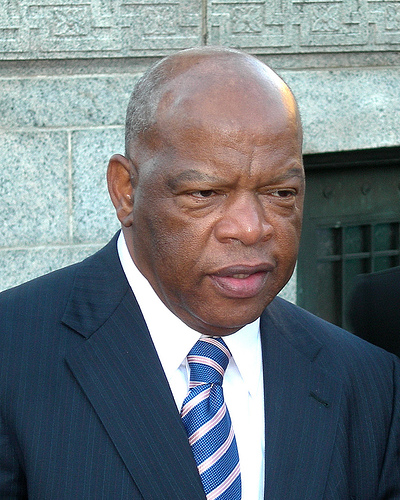
This Is What #Democracy Looks Like: John Lewis and #OccupyAtlanta

"They really didn't deny me," Lewis said.

One thing The New Republic, in its dismissal of the #OccupyWallStreet movement, misled its readers about regarding the John Lewis incident at Occupy Atlanta, and one thing anyone who doesn’t watch the video, painful as it may be, will miss: The General Assembly did not “groupthink” Lewis away, which would imply that the decision was, like the Washington crowd’s bullheaded decision to go to war in Iraq, assumed by everyone present to be a reasonable fait accompli. On the contrary, there was a strong pro-Lewis contingent among the Assembly–so strong that after the facilitator ruled that no consensus had been reached, a chant of “Let him speak!” rose up.

You can see for yourself if you watch the video below, which I recommend, especially to anyone prejudiced into a negative opinion about the Atlanta occupation’s impoliteness. You may draw the same conclusion, but it’s important to be accurate about what really happened there: An agenda had been previously agreed to, Lewis was requesting to interrupt it, and, according to the agreed upon Assembly rules, changing the agenda required “consensus,” which the Assembly was unable to reach.Therefore, the previously agreed to agenda remained in effect and Lewis was unable to interrupt. Lewis himself humbly accepted the Assembly’s decision. Continue reading

Liberals Are Terrified of #OccupyWallStreet

TNR: Liberals should be nervous

Picking up where we left off yesterday, The New Republic has now offered its official two cents on the protests on Wall Street and, as one would expect of the stuffy self-appointed organ of the liberal power elite inside the Beltway, it disapproves.

[T]o draw on the old cliché, the enemy of my enemy is not necessarily my friend. Just because liberals are frustrated with Wall Street does not mean that we should automatically find common cause with a group of people who are protesting Wall Street. Indeed, one of the first obligations of liberalism is skepticism—of governments, of arguments, and of movements. And so it is important to look at what Occupy Wall Street actually believes and then to ask two, related questions: Is their rhetoric liberal, or at least a close cousin of liberalism? And is this movement helpful to the achievement of liberal aims?

This task is made especially difficult by the fact that there is no single leader who is speaking for the crowds, no book of demands that has been put forward by the movement. Like all such gatherings, it undoubtedly includes a broad range of views. But the volume of interviews, speeches, and online declarations associated with the protests does make it possible to arrive at some broad generalizations about what Occupy Wall Street stands for. And these, in turn, suggest a few reasons for liberals to be nervous about the movement.

The Editors responsible for the unsigned editorial then go on to outline the differences between #ows’s radicalism and TNR’s proper liberalism (the former is dreamy, “group-thinky” and utopian, the latter skeptical, pragmatic and pro-capitalist) , before urging liberals to stay the hell away. Continue reading

#TeaParty Terrified of #OccupyWallStreet’s New American Revolution

Dress-up rebel doing the bidding of the corporate class.

James Oliphant of the Los Angeles Times quotes prominent self-anointed leaders of the Tea Party movement on their reaction to the recent sprouting of Occupy America encampments in dozens of cities across North America from Boston and New York to Seattle and L.A. Clearly the Tea Party bosses don’t get it Continue reading

Right Wing Americans Need to Wake Up And Get Real

A blogger calling himself Mark America demonstrates the fear-sodden ideology of the right that is disabling many conservatives’ ability to think clearly about what is really going on:

On Saturday, the “Occupy DC” contingent of the greater “Occupy Wall Street” movement clashed with guards and police outside the National Air and Space Museum.  At least one was pepper-sprayed, and one was arrested.  They’re now combining with the even more radical October2011 group, the object of which is to overturn our system of government.  All of these groups have direct ties to Barack Obama from his years in the left-wing community organizing movement, and to the Democrat party structure reaching back two decades.  Let’s be honest:  These are the shock-troops of the communist movement in America.

For those of you who don’t yet understand what this is all about, it’s time to clear it up.  These people aren’t protesting for reform.  They are protesting for the absolute destruction of the United States of America of any description by which you’ve known it.  I once thought that to believe this, a person would need the tin-foil hat and the basement computer terminal and be a conspiracy kook, but this is simply not the case any longer.  These people have powerful, well-heeled backers, and they are acting in concert with Barack Obama and the extreme leftist fringe of American politics.

They  make the mistake of believing the Republican Party is the United States. Big, big mistake. It misleads them into making mistakes of thinking all around. Continue reading

Jeffrey Sachs Supports #OccupyWallStreet

This is what democracy looks like when it works: media dialoguing with a rational person telling the truth about what’s wrong and what needs to change:

This is just over 22 minutes, but it’s 22 minutes well spent.

Info from the YouTube video on Sachs:

Watch Jeffrey Sachs, leading environmentalist and economist, and a respected Professor at Columbia University, speak out at the growing, inspiring Occupy Wall Street movement. Sachs is one of many professors, celebrities, community leaders, spiritual leaders and public figures who are speaking out in support of the OWS movement and what it stands for.

The Burnett Rule: If You Buy Something, Don’t Say Something

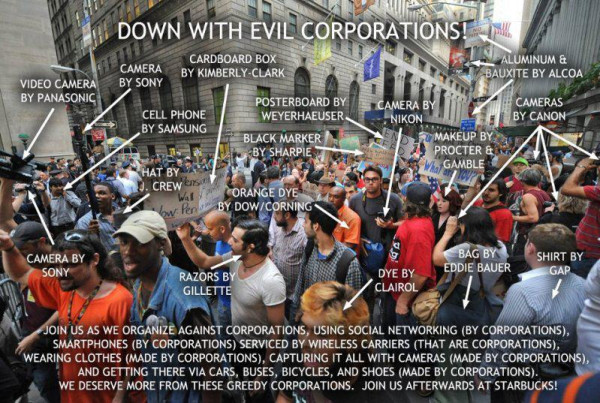
Erin Burnett’s snide putdown of #OccupationWallStreet on her new CNN platform OutFront included some sniffing over the fact that the protesters (like other Americans) drink bottled water, eat “catered lunch,” (actually slices of pizza from a local pizzeria, probably courtesy of anonymous online supporters), wear designer clothes, use Apple computers and Blackberries. The implicit “argument” in Burnett’s patrician sniffs, which we’ll no doubt be hearing over and over from the protest’s sideline critics in the days to come, is rendered explicit in this ironic photo art found on Twitter:

http://twitpic.com/6wh19u via @ForceMajeure_

So on this account, if you consume any of the products of corporate capitalism, it’s hypocritical to protest against corporate capitalism. What, then, do the Burnettists think is the correct attitude of consumers toward corporate capitalism? Obedience? Submission? Worship?

We are not only consumers–not only economic animals, but also political animals. The fact that we consume the products of the predominant economic  system doesn’t disqualify us from criticizing the political system that serves the interests of the “captains” of the system at the rest of our expense, does it? The protest is not about the economic behavior of corporations–not about capitalism per se, in other words–but about their social, political and moral behavior.

Burnett pretends to be a journalist, which of course she is not. (Seriously, Erin, a journalist?!) She is an apologist for the 1%. But anyone who is not in the role Burnett has chosen to play ought to pay closer attention to what the occupation is about, ought to use their minds to examine what the occupiers are actually saying.  I think most Americans will tend to get it if they give it a little thought, because I think most Americans can see that the system does not favor their own interests any more than it favors the protesters.
What Does #OccupyWallStreet Stand For? Read This.

The media have repeated over and over that the protesters in Zuccotti Park have no coherent position. Belying that common narrative, the group’s General Assembly put the document below up for a vote as representing the sense of the occupation’s aims and it was accepted. I found it here, but am posting it in full on my blog as I consider it both historic and newsworthy enough that it belongs to the world now, not just the document’s authors. Is it worthy of a revolution? I think so. I think it makes clear that #occupywallstreet understands who our King George is and they intend to speak truth to the actual power. Continue reading