Poof of Heaven: Eben Alexander’s Truth Problem

bouguereau-a-soul-brought-to-heaven

Esquire magazine has a long article (available online for $1.99 for non-subscribers) in the August issue by Luke Dittrich investigating the claims of Eben Alexander, a so-called “Harvard neurologist” whose book Proof of Heaven purporting to describe his “near death experience” has been on the best-seller lists for almost a year.  (I wrote about the Newsweek article that preceded the book last year.) Of course Dittrich was unable to verify or falsify the central claim, that Alexander actually went to heaven while he was in a coma during a bout of bacterial meningitis. However, Dittrich did uncover a number of awkward facts about Alexander’s career as a neurosurgeon, including a history of malpractice suits (five in ten years) that eventually deprived him of his license to practice neurosurgery and which suggested to Dittrich a possible motive for Alexander to write the book besides a reportorial one.

Over at Huffington Post, Paul Raeburn has written a blog that admirably summarizes Dittrich’s article:

Dittrich comes as close as one could, without access to Alexander’s private thoughts, to showing that the book was a cynical effort to provide a new career — as a prophet! — for a neurosurgeon whose career was being consumed by malpractice suits. He was, Esquire‘s editors write in the deck, “a neurosurgeon with a troubled history and a man in need of reinvention.”

One of Dittrich’s most damning revelations (so to speak) concerns the story of one of Alexander’s own doctors who says, in contradiction of Alexander’s claim that the  e. coli bacteria that caused his meningitis also caused his coma, that she chemically induced the coma because Alexander’s involuntary movements made it impossible to operate on him. This would give the lie to Alexander’s contention that his brain had ceased all activity and that he essentially died on the gurney. It would also suggest (though Dittrich doesn’t mention the drug used to induce the coma–one major shortcoming of the Esquire piece) a likely chemical source for Alexander’s ecstatic vision.

Of course, believers will continue to believe, and as evidence of that, you need only look at the comments section on Raeburn’s blog. Continue reading

NYT Asks: Should Atheists Pray?

Joshua Reynolds - The Infant Samuel

In last week’s Room for Debate, the question the New York Times posed was this:

With atheist church services this month in Louisiana and New York, nonbelievers are borrowing some of the rituals of believers: gathering, singing, sermons.

Would it be fruitful for atheists to pray? For believers and others, what is the point of prayer?

I suppose the Times should be applauded for asking a question that seems to take atheism seriously, even if they allowed just one self-identified atheist into this “room ” to answer the question.

The simple answer, from this atheist’s perspective, is a great big fat obvious no. Prayer is by definition something asked of someone (or something), and it seems ludicrous to ask people who don’t believe in the supernatural to close their eyes, put their hands together, bow their heads and concentrate on asking something that might theoretically hear their sublingual thoughts for anything. What is the point? Leave prayer to the believers! Continue reading

Noam Chomsky: “It’s institutional structures that block change.”

Keystone XL demonstration, White House,8-23-20...

Keystone XL demonstration, White House,8-23-2011 Photo Credit: Josh Lopez (Photo credit: Wikipedia)

If yesterday’s post of Lawrence Lessig‘s TED talk on corruption gives you reason for optimism, you may want to check that after you read this from perennial thorn in the side of the powers that be Noam Chomsky, who writes of a peculiar distinction between the most “advanced” societies in the world today and those  least touched by technological “progress” as far as the threat of climate change goes:

So, at one extreme you have indigenous, tribal societies trying to stem the race to disaster.  At the other extreme, the richest, most powerful societies in world history, like the United States and Canada, are racing full-speed ahead to destroy the environment as quickly as possible.  Unlike Ecuador, and indigenous societies throughout the world, they want to extract every drop of hydrocarbons from the ground with all possible speed.

Both political parties, President Obama, the media, and the international press seem to be looking forward with great enthusiasm to what they call “a century of energy independence” for the United States.  Energy independence is an almost meaningless concept, but put that aside.  What they mean is: we’ll have a century in which to maximize the use of fossil fuels and contribute to destroying the world.

And that’s pretty much the case everywhere.  Admittedly, when it comes to alternative energy development, Europe is doing something.  Meanwhile, the United States, the richest and most powerful country in world history, is the only nation among perhaps 100 relevant ones that doesn’t have a national policy for restricting the use of fossil fuels, that doesn’t even have renewable energy targets.  It’s not because the population doesn’t want it.  Americans are pretty close to the international norm in their concern about global warming.  It’s institutional structures that block change.  Business interests don’t want it and they’re overwhelmingly powerful in determining policy, so you get a big gap between opinion and policy on lots of issues, including this one.

This seems to be a pretty important point, but it’s very difficult to know how seriously it’s being taken: The United States government does not have the species’ or the world’s best interests at heart. And it’s not just the Republicans, who are an easy target for American liberals,  that we have to blame. The fact is the Republicans are pretty much brain-dead and useless at this point. But are the Democrats really all that much better on this issue in particular? Continue reading

Reagan Spending vs. #TeaParty Austerity

Would Tea Party Republicans have voted to give Reagan his 50% spending increases and 700,000 more government jobs?

In an article from the Washington Post on “Tea Party” Congressman Mick Mulvaney of South Carolina, these paragraphs caught my attention:

Mulvaney mostly meets with voters through weekly town hall meetings. Sometimes he brings with him a 30-minute PowerPoint presentation, full of bar graphs and fever charts depicting the growing federal deficit and the surging cost of health care. In January, Mulvaney added a chart on the automatic spending cuts, known as sequestration, which next year will total about $100 billion.

To him the numbers make sense. “In the greater scheme of things, they are not that big,” Mulvaney said.

But, every once in a while, a personal anecdote punctures his certainty. Earlier this month, a friend and former campaign volunteer stood up at one of the town hall meetings to tell Mulvaney that the defense cuts had cost him his job of five years with a large defense contractor. “I just want you to know that these cuts are real and they hurt me,” said Jeffrey Betsch, a single father of three daughters, who was on the verge of being evicted from his home.

After the Rotary Club speech, Mulvaney was thinking about his friend as he drove down a narrow two-lane ribbon of worn blacktop, past strawberry farms and pine forests. He felt terrible, he said, but he also believed that the country faced problems that were bigger than the struggles of a single constituent.

“I don’t see how you wipe out 40 cents of spending on every dollar and not have someone get hurt,” Mulvaney said.

The punchline of the article, which is titled “As budget cuts hit S.C., a congressman is surprised at constituents’ reactions” is that his constituents are actually not angry with him, despite his stubborn refusal to shower the district with federal dollars, as his predecessor Rep.  John Spratt did. It was anger toward Spratt and his loose spending ways that propelled Mulvaney into office in 2010. That same anger may be the wind at his back if he runs for higher office in his state.

Yet principled though they may be, Mulvaney’s actions have had real consequences for his constituents. In addition to his former campaign volunteer, the Congressman faced the irritation of an Air Force general in his district who claimed the effects of the sequester had made the AF less ready for warfare than at any time in memory. To which charges, Mulvaney responded,  “If the cuts force us to look for better ways of saving money in the future, they will be a success. We can’t go backwards.”

How can a progressive argue with such principle? The chief pain caused in Mulvaney’s district is to the military and “independent” defense contractors–or should we say, to the people who work for either sector. Do progressives want to see that money continue to flow to those pockets, or can we use this opportunity of Tea Party intransigence to rethink our spending priorities? Continue reading

Memo to Rand Paul: Condescension Won’t Win You the Hearts of the “Rest of America”

Sen. Rand Paul

From the Huffington Post:

At a sold-out New Hampshire Republican Party dinner Monday night, Sen. Rand Paul (R-Ky.) encouraged the room of GOP supporters to embrace diversity and outreach if they want to take the White House in 2016, the Courier-Journal in Louisville reports.

“We need to be like the rest of America,” Paul said. “We’re going to win when we look like America. We need to be white, we need to be brown, we need to be black, we need to be with tattoos, without tattoos, with ponytails, without ponytails, with beards, without.”

Paul urged New Hampshire Republicans to reshape their party’s image and become the “party of opportunity.”

“We need to be that party that can express it in a way that shows that we care about people,” Paul said, according to the Concord Monitor. “We need to care about people even if they are on government assistance.”

Paul may be playing coy about his plans for a presidential run, but there’s no doubt at all about his plans to influence the Republican Party’s national chances for the highest office in some way. In addition to his high-profile and principled filibuster of drone attacks on Americans in March (principles that he seemed to have walked back a bit in April), Paul has also caught the press’s attention visiting Howard University,  the storied “Black Harvard” located in Washington, D.C.,  and the Hispanic Chamber of Commerce, where he spoke in favor of amnesty for undocumented workers in some cases  in opposition to his own position pre-Election 2012. Paul has been putting quite a bit more sweat into outreach to non-Republican demographics than any of his peers since, maybe, Jack Kemp in the 1980s.

So why is it almost certain that Paul will fail? It’s not just that he’s dealing with the Sisyphean task of making the Grand Old White People’s Party attractive to young multiculturals. I mean, that’s a difficult enough task, for sure, especially given the way the party’s hardcore rank-and-filers and its most visible politicians are able to undo all Paul’s efforts with just a little bit of  talk about the issues that matter most to Paul’s alleged target audiences (if his audience isn’t actually just more moderate white independents), and the way many on the right resist threats of outreach as betrayal of fundamental principles. No, I think Paul is going to fail unless he finds another way of talking about his aspirations for the party–and to really try to understand if his aspirations for the party are genuinely appealing to non-Republican groups. It’s one thing to want more diversity in the party; it’s another thing entirely to know how to build it. You do not build diversity by making speeches that scream how little you understand the audience you’re trying to appeal to. Continue reading

Krugman Trashes Austerity’s Phony Morality Economics

DAVOS/SWITZERLAND, 24JAN08 - Jean-Claude Trich...

DAVOS/SWITZERLAND, 24JAN08 – Jean-Claude Trichet, President, European Central Bank, Frankfurt, captured during the session ‘Systemic Financial Risk’ at the Annual Meeting 2008 of the World Economic Forum in Davos, Switzerland, January 24, 2008. (Photo credit: Wikipedia)

Apropos of a current theme of this blog, that the powerful Austrian school of economics that has supplanted Keynesianism as the go-to ideology of our government and, more and more, both political parties, is rooted in the same Nietzschean stew of pro-winner, anti-loser sentiment that appealed to the Nazis, Paul Krugman has a piece in the current New York Review of Books that devastates the “austerian” contention that Keynesianism feeds the Beast, while austerity corrects naughty economic behavior. His main support for his argument is the recent discovery of severe flaws in the methodology of two studies most often cited by austerians, one by Harvard profs Carmen Reinhart and Kenneth Rogoff and the other by Italy’s Alberto Alesina and Silvia Ardagna, purporting to show that government spending that exceeds 90% of GDP in the wake of a depression or financial meltdown is catastrophic for the economy in question.

David Stockman’s The Great Deformation … [is] an immensely long rant against excesses of various kinds, all of which, in Stockman’s vision, have culminated in our present crisis. History, to Stockman’s eyes, is a series of “sprees”: a “spree of unsustainable borrowing,” a “spree of interest rate repression,” a “spree of destructive financial engineering,” and, again and again, a “money-printing spree.” For in Stockman’s world, all economic evil stems from the original sin of leaving the gold standard. Any prosperity we may have thought we had since 1971, when Nixon abandoned the last link to gold, or maybe even since 1933, when FDR took us off gold for the first time, was an illusion doomed to end in tears. And of course, any policies aimed at alleviating the current slump will just make things worse.

In itself, Stockman’s book isn’t important. Aside from a few swipes at Republicans, it consists basically of standard goldbug bombast. But the attention the book has garnered, the ways it has struck a chord with many people, including even some liberals, suggest just how strong remains the urge to see economics as a morality play, three generations after Keynes tried to show us that it is nothing of the kind. Continue reading

The Secret Seizure and “Progressive” Democrats’ Failure of Heart

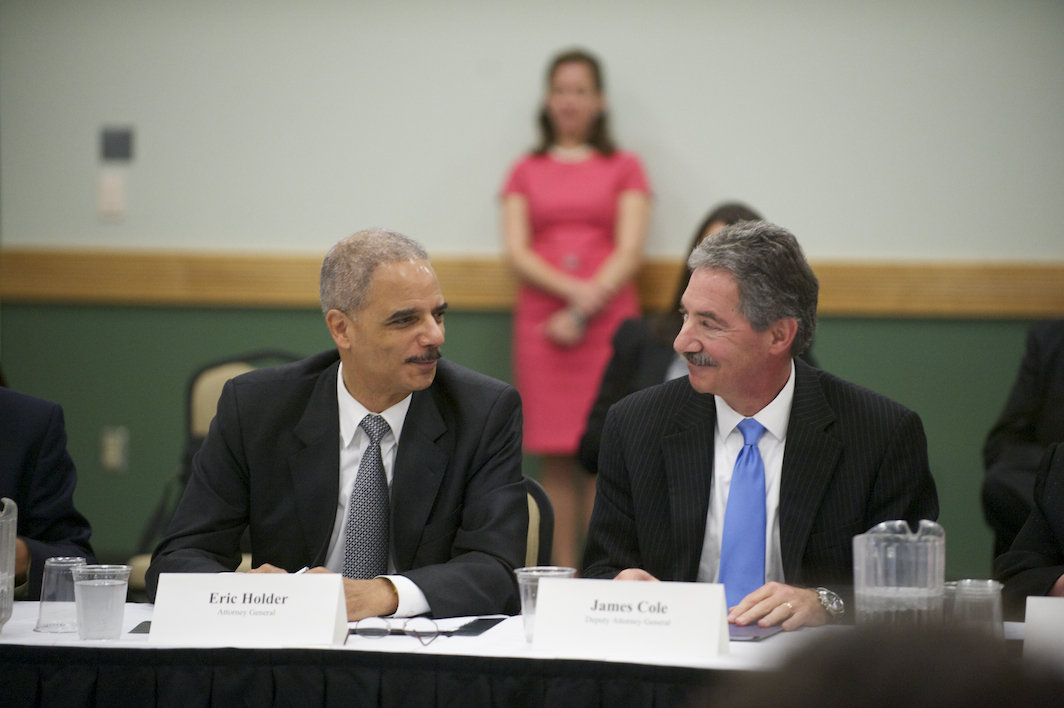
Attorney General Eric Holder with Deputy AG James Cole, who made the call to seize two months of phone records of 20 AP reporters.

AG Eric Holder with Deputy AG James Cole, who made the call to secretly seize two months of records of 20 phone lines of AP reporters in search of a  leaker in the Obama administration.

My first instinct when I heard Monday’s revelation of the DOJ’s secret seizure of certain AP reporters’ work and home phone records was to say to myself, I’m glad I voted for Jill Stein.

My second was to fume over how infuriating this story is, what ham-handed ineptitude it displays. If there’s only one area of Obama’s administration that progressive Democrats who voted for him twice should agree with me about it’s this nauseatingly phony tougher-than-Bush approach to questions of national security. I mean, if I were the same person I was in, say, 2004 and had voted for Obama’s second term, I would be having some serious cognitive dissonance issues to deal with today. On the other hand, these are the same people who boasted loudly for half the campaign season about Osama bin Laden’s death (rather than his capture, which would really have been something to boast about), so chances are they won’t be too upset over anything Obama does in the name of national security. Continue reading

Congressional Record by Dean Drummond, played by Newband

DRUMMOND-obit-articleLarge

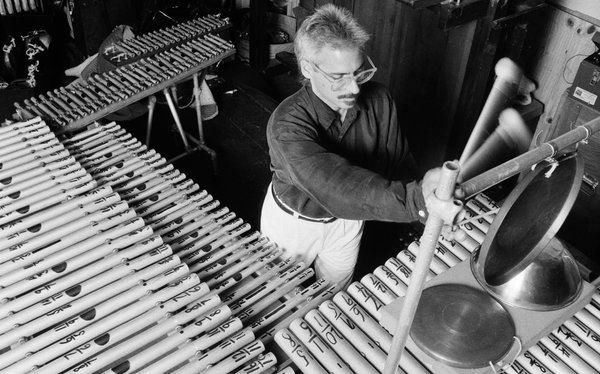
I was reading today’s paper, looking at the obituary of George Jones, when I glanced across at a photo of someone who looked familiar. I realized it was Dean Drummond, an American composer, musician, teacher and acolyte of Harry Partch, whose musical instruments and scores Drummond assembled as founder of the Harry Partch Institute at Montclair State University in New Jersey. I was wondering what an arts piece was doing in the front section of the New York Times, when I realized, shocked, that I was looking at an illustration for Drummond’s obituary. Continue reading

#TeaParty Patriot Founder: “Why do the politicians and media figures want us to hate each other?”

Mark Meckler, one of the founders of Tea Party Patriots, spoke to a crowd of leftists at Seattle’s Citizen University conference recently (hat tip to Upworthy), and what he said resonates in a way with what I was arguing in my debate  with partisan Democrat Milt Shook yesterday on Twitter:

Meckler’s answer to the question above, if you haven’t watched this brief video, is that it profits politicians and others at the center of the DC power structure to maintain the false divide between left and right: the strategy is called Divide and Conquer. I’m thrilled to hear that Meckler is apparently refusing to play along. Imagine if all of us who were inspired by the occupy movement and all of those who were fired up by the Tea Party came to the same conclusion: our enemies are not among the people. Our enemies are the ones who think we owe them votes and viewership, who manufacture our opinions and sell them retail as the stuff of our national politics.

Here’s hoping this is another sign of a new phase of revolution, one that will enable us to take  back the democracy and make it work for people again.

Peggy Noonan: Iraq “Half-Killed” the GOP

freepersrally

I never thought I’d be quoting Peggy Noonan to the extent I do in this post, but her latest column is an enjoyably slashing critique of the effect of the Iraq war catastrophe on the Republican Party.  It also coincides nicely with my series of “anniversary cards” to the Iraq invasion. From my perspective, she’s not right on the money on everything she says–as usual, e.g. she gives the mediocrity that was President Ronald Reagan way too much personal credit for “vision” and “stewardship” during his administration–but in general, her points should be well-taken by the bloodied remains of her party. The rest of us can just enjoy the spectacle of the good ol’ party beating up on itself.

Did the Iraq war hurt the GOP? Yes. The war, and the crash of ’08, half killed it. It’s still digging out, and whether it can succeed is an open question….:

It ruined the party’s hard-earned reputation for foreign-affairs probity. They started a war and didn’t win it. It was longer and costlier by every measure than the Bush administration said it would be. Before Iraq, the GOP’s primary calling card was that it was the party you could trust in foreign affairs. For half a century, throughout the Cold War, they were serious about the Soviet Union, its moves, feints and threats. Republicans were not ambivalent about the need for and uses of American power, as the Democrats were in the 1970s and 1980s, but neither were they wild. After Iraq it was the Republicans who seemed at best the party of historical romantics or, alternatively, the worst kind of cynic, which is an incompetent one. Iraq marked a departure in mood and tone from past conservatism.

It muddied up the meaning of conservatism and bloodied up its reputation. No Burkean prudence or respect for reality was evident. Ronald Reagan hated the Soviet occupation of the Warsaw Pact countries—really, hated the oppression and violence. He said it, named it, and forced the Soviets to defend it. He did not, however, invade Eastern Europe to liberate it. He used military power sparingly. He didn’t think the right or lucky thing would necessarily happen. His big dream was a nuclear-free world, which he pursued daringly but peacefully.

It ended the Republican political ascendance that had begun in 1980. This has had untold consequences, and not only in foreign affairs. And that ascendance was hard-earned. By 2006 Republicans had lost the House, by 2008 the presidency. Curry quotes National Review’s Ramesh Ponnuru at a recent debate at the American Enterprise Institute: “You could make the argument that the beginning of the end of Republican dominance in Washington was the Iraq War, at least a stage of the Iraq War, 2005-06.” In 2008 a solid majority of voters said they disapproved of the war. Three-quarters of them voted for Barack Obama.

It undermined respect for Republican economic stewardship. War is costly. No one quite knows or will probably ever know the exact financial cost of Iraq and Afghanistan, which is interesting in itself. Some estimates put it at $1 trillion, some $2 trillion. Mr. Curry cites a Congressional Budget Office report saying the Iraq operation had cost $767 billion as of January 2012. Whatever the number, it added to deficits and debt, and along with the Bush administration’s domestic spending helped erode the Republican Party’s reputation for sobriety in fiscal affairs.

It quashed debate within the Republican Party. Political parties are political; politics is about a fight. The fight takes place at the polls and in debate. But the high stakes and high drama of the wars—and the sense within the Bush White House that it was fighting for our very life after 9/11—stoked an atmosphere in which doubters and critics were dismissed as weak, unpatriotic, disloyal. The GOP—from top, the Washington establishment, to bottom, the base—was left festering, confused and, as the years passed, lashing out. A conservative movement that had prided itself, in the 1970s and 1980s, on its intellectualism—”Of a sudden, the Republican Party is the party of ideas,” marveled New York’s Democratic senator Pat Moynihan in 1979—seemed no longer capable of an honest argument. Free of internal criticism, national candidates looked daffy and reflexively aggressive—John McCain sang “Bomb, Bomb Iran”—and left the party looking that way, too.

It killed what remained of the Washington Republican establishment. This was not entirely a loss, to say the least. But establishments exist for a reason: They’re supposed to function as The Elders, and sometimes they’re actually wise. During Iraq they dummied up—criticizing might be bad for the lobbying firm. It removed what credibility the establishment had. And they know it.