Dear Mr. Wolfowitz: Iraq Didn’t Go Quite As You Planned

wolfowitz_wideweb__470x341,0

One more (at least) in my continuing series of Iraq war “anniversary cards,” if you will. This one is from an open letter by Andrew J. Bacevich to Bush doctrine architect Paul Wolfowitz.

So even conceding a hat tip to Albert Wohlstetter, the Bush Doctrine was largely your handiwork. The urgency of invading Iraq stemmed from the need to validate that doctrine before the window of opportunity closed. What made it necessary to act immediately was not Saddam’s purported WMD program. It was not his nearly nonexistent links to Al Qaeda. It was certainly not the way he abused his own people. No, what drove events was the imperative of claiming for the United States prerogatives allowed no other nation.

I do not doubt the sincerity of your conviction (shared by President Bush) that our country could be counted on to exercise those prerogatives in ways beneficial to all humankind — promoting peace, democracy, and human rights. But the proximate aim was to unshackle American power. Saddam Hussein’s demise would serve as an object lesson for all: Here’s what we can do. Here’s what we will do.

Although you weren’t going to advertise the point, this unshackling would also contribute to the security of Israel. To Wohlstetter’s five precepts you had added a silent codicil. According to the unwritten sixth precept, Israeli interests and U.S. interests must align. You understood that making Israelis feel safer makes Israel less obstreperous, and that removing the sources of Israeli insecurity makes the harmonizing of U.S. and Israeli policies easier. Israel’s most effective friends are those who work quietly to keep the divergent tendencies in U.S.-Israeli relations from getting out of hand. You have always been such a friend. Preventive war to overthrow an evil dictator was going to elevate the United States to the status of Big Kahuna while also making Israelis feel just a little bit safer. This audacious trifecta describes your conception. And you almost pulled it off.

Imagine — you must have done so many times — if that notorious mission accomplished banner had accurately portrayed the situation on the ground in Iraq in May 2003. Imagine if U.S. forces had achieved a clean, decisive victory. Imagine that the famous (if staged) photo of Saddam’s statue in Baghdad’s Al Firdos Square being pulled down had actually presaged a rapid transition to a pro-American liberal democracy, just as your friend Ahmed Chalabi had promised. Imagine if none of the ensuing horrors and disappointments had occurred: the insurgency; Fallujah and Abu Ghraib; thousands of American lives lost and damaged; at least 125,000 Iraqis killed, and some 3 million others exiled or displaced; more than a trillion dollars squandered….

[P]reventive war was supposed to solve problems. Eliminating threats before they could materialize was going to enhance our standing, positioning us to call the shots. Instead, the result was a train wreck of epic proportions. Granted, as you yourself have said, “the world is better off” with Saddam Hussein having met his maker. But taken as a whole, the cost-benefit ratio is cause for weeping. As for global hegemony, we can kiss it goodbye.

PS: Edited to add just this deliciously sharp little jab from Bacevich to the whole Bush Iraq enterprise and it’s managers:

One of the questions emerging from the Iraq debacle must be this one: Why did liberation at gunpoint yield results that differed so radically from what the war’s advocates had expected? Or, to sharpen the point, How did preventive war undertaken by ostensibly the strongest military in history produce a cataclysm?

Not one of your colleagues from the Bush Administration possesses the necessary combination of honesty, courage, and wit to answer these questions. If you don’t believe me, please sample the tediously self-exculpatory memoirs penned by (or on behalf of) Bush himself, Cheney, Rumsfeld, Rice, Tenet, Bremer, Feith, and a small squad of eminently forgettable generals.

Pre-Iraq War Flashback: Ron Rosenbaum’s Red Herring (October 2002)

Did anyone ever actually trust this man?

Did anyone ever actually trust this man?

I wrote the article that follows in response to a cutting dismissal of the brand new anti-war movement that sprung to life in the fall of 2002, just as it became clear what the Bush-Cheney administration was up to with its pot-stirring war preparations. It was intended as a letter to the editor for the New York Observer, where the offending article I was responding to was published,  but became too long for that purpose. I tried to place it at DemocraticUnderground.com, but they passed on it.

In any case, reading old  pablum from George Packer  and Bill Keller in the “liberal hawk” organ of record (Judy Miller‘s New York Times), I thought of this piece which expressed my disgust with the useful idiots of the center left pundit class lending aid and comfort to the Bushist program. Truly nauseating stuff, these guys wrote, if you can stomach it.

Anyway, without further ado, my response to “all that.” Continue reading

A Tory on Britain’s Sinking into an American-made Quagmire

Rory Stewart, Tory MP from Cumbria, made these observations on the 10th anniversary of British collusion with the Bush-Cheney catastrophe in Iraq. He describes the situation well and asks excellent questions, especially the very last one in this excerpt.

[O]ver the last eighteen months, this relationship has unraveled
First, contrary to the Vice-President’s predictions, the Iraqis have
insisted that every last US soldier depart. They have refused visas to
so many US diplomats that half the new multi-billion dollar Embassy is
empty. As the last US troops withdrew, they were attacked by a Shia
terrorist group; two months later that group was brought into the
Iraqi government. The day that the last soldier left, the Shia
Prime-Minister sent tanks to arrest the Sunni Vice-President.
President Obama personally called the Kurdish leader – who had been
one of the US’s closest allies – asking him to step aside and allow in
a more balanced government. The Kurdish leader refused. Three months
ago, Vice-President Biden begged the Iraqi Prime-Minister not to
release an Iranian terrorist commander, (who had been arrested by
British troops. The Iraqi Prime-Minister ignored the Vice-President,
and released him.

In August and September, Iraqi banks were teaming up with the Iranian
government to break sanctions. Iranians were being allowed to ship
weapons through Iraq to prop up the Syrian regime. And in December,
the Iraqi Prime-Minister, who arrested 615 Sunni Arabs in an hour, a
year ago, lined up his troops against the Kurdish militia. On one day
last year, there were simultaneous attacks in ten cities, killing
fifty and wounding two hundred.

Saddam – an extreme dictator – has gone. The media is much freer now.
Many young Iraqis, and particular Kurds, are very grateful that the
old regime has fallen, and are proud of their new culture. But the
international community has not achieved its objectives – however
often it redefines them. First, we aimed to create a ‘democratic Iraq,
at peace with itself and its neighbours’. By 2009, we talked only of a
stable, representative government, a place where terrorists could not
operate, and “an ally”. Instead, after a decade, a trillion pounds,
and more lives than anyone would want to count, we have helped to
create a place, which sometimes looks like a corrupt and fragile
democracy, and sometimes like a Shia rogue state – somewhere on a
scale between Iran and Pakistan.

The question for Britain is what aspect of our culture, our
government, and our national psychology, allowed us to get mired in
such catastrophe?

Hat tip, once again, to The Browser.

Happy 10th Anniversary, American Catastrophe in Iraq!

iraq-war-games

Peter Van Buren, author of We Meant Well: How I Helped Lose the Battle for the Hearts and Minds of the Iraqi People, shares his mordant thoughts on the anniversary of what he calls American’s worst foreign policy blunder. Read the whole article here:

The Iranian leadership watched carefully as the American imperial version of Iraq collapsed, concluded that Washington was a paper tiger, backed away from initial offers to talk over contested issues, and instead (at least for a while) doubled-down on achieving nuclear breakout capacity, aided by the past work of that same A.Q. Khan network. North Korea, another A.Q. Khan beneficiary, followed the same pivot ever farther from Washington, while it became a genuine nuclear power. Its neighbor China pursued its own path of economic dominance, while helping to “pay” for the Iraq War by becoming the number-one holder of U.S. debt among foreign governments. It now owns more than 21% of the U.S. debt held overseas.

And don’t put away the joke book just yet. Subbing as apologist-in-chief for an absent George W. Bush and the top officials of his administration on this 10th anniversary, former British Prime Minister Tony Blair recently reminded us that there is more on the horizon. Conceding that he had “long since given up trying to persuade people Iraq was the right decision,” Blair added that new crises are looming. “You’ve got one in Syria right now, you’ve got one in Iran to come,” he said. “We are in the middle of this struggle, it is going to take a generation, it is going to be very arduous and difficult. But I think we are making a mistake, a profound error, if we think we can stay out of that struggle.”

Think of his comment as a warning. Having somehow turned much of Islam into a foe, Washington has essentially assured itself of never-ending crises that it stands no chance whatsoever of winning. In this sense, Iraq was not an aberration, but the historic zenith and nadir for a way of thinking that is only now slowing waning. For decades to come, the U.S. will have a big enough military to ensure that our decline is slow, bloody, ugly, and reluctant, if inevitable. One day, however, even the drones will have to land.

And so, happy 10th anniversary, Iraq War! A decade after the invasion, a chaotic and unstable Middle East is the unfinished legacy of our invasion. I guess the joke is on us after all, though no one is laughing.

AIPAC and the Evils of Republicratism

Gung ho at AIPAC

Gung ho at AIPAC

MJ Rosenberg makes these observations on his eponymous blog:

It’s hard to watch the AIPAC conference for more than a few minutes at a time. For me, the worst part is the pandering (and lying) by Democratic politicians eager to raise money for their next campaign.

So far, Joe Biden has been the worst. He is heavily funded by the Adler family of Miami Beach (he even brought President Obama to their home for a fundraiser), one of the big AIPAC families. Here is Biden talking about how the head of the Adler klan and another AIPAC mogul gave him his “formal education” on the Middle East. (Not to mention all that money.

And, of course, Biden (like John Kerry) knows better than his AIPAC speeches indicate. I have talked to him about Israel and Palestine.He can name the top Palestinian leaders in Fatah and Hamas and tell you the differences between their respective positions. He believes Israel needs to end the occupation and talk to Hamas. He would not dare say it publicly, although he has said  it so often privately that it is amazing the media never reports it.

But Biden does what he thinks he has to because, for politicians like him (that is, pretty much all politicians), nothing is more important than keeping donors happy. Call him a hypocrite but he cries all the way to the bank.

The Republicans are different. Supporting the occupation and threatening war with Iran come naturally to them. They don’t need lobby money for their campaigns and they don’t get Jewish votes anyway.  (This is not to say that they don’t like Sheldon Adelson’s money, just that as the pro-business party, they don’t need it). They support Netanyahu because they believe that the west needs to crush the Muslim world. They do not feign Islamophobia. It’s them.

Do we not hear echoes of  Yeats in this accurate picture of today’s politics?: “The best lack all conviction, while the worst/ Are full of passionate intensity.” Continue reading

#Frankenstorm and the Way We Talk About Climate Change

Andrew Revkin, in his Dot Earth blog for the New York Times, has been writing a lot over the past few days about the relation of global warming/climate change to the ferocious late-season appearance of #Frankenstorm Sandy, which flooded lower Manhattan, Brooklyn and Queens, tore up the Jersey shore, killed some 40 people in the US and left more than 7 million on the East Coast with no power for several days (not to mention the overlooked damage it wrought in the Caribbean before smashing into Delaware on Sunday). Many of his readers (including climate activist Dan Miller) accuse Revkin (who is a science journalist and not a professional scientist) of taking too cautious a tack on climate change generally and on human responsibility for the increase of North Atlantic storm activity in particular. Continue reading

Circumstances of Jill Stein’s Hofstra Arrest: “Symbolic” of What CPD Has Done to Democracy

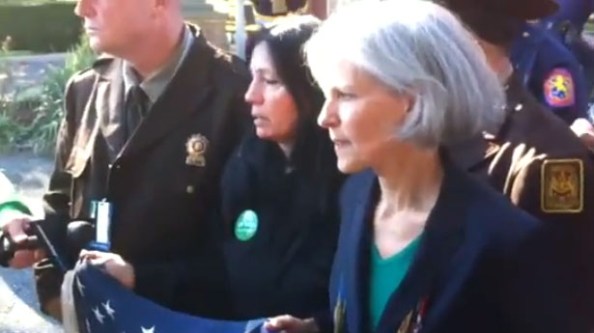
Jill Stein and Cheri Honkala, the Green Party’s candidate for President and Vice President, you may have heard, were arrested a little over a week ago as they attempted to confront representatives of the Commission on Presidential Debates on the campus of Hofstra University in Hempstead, New York, on the eve of the second official Presidential debate between Democrat Barack Obama and Republican Mitt Romney. What you may not have heard about are the actual circumstances of the arrest.

In a suit for injunctive relief filed on October 22 in Circuit Court in Palm Beach, Florida, to prevent that night’s third official debate from occurring at Lynn University in Boca Raton without inclusion of third parties, Stein’s attorney related the salient details of that arrest:

24.  On October 16th, 2012, less than one week ago, the United States Presidential Green Party candidate, Dr. Jill Stein, and her Vice-Presidential running mate, Ms. Cheri Honkala, were arrested for being on the grounds of the site of the Presidential debate which was scheduled to take place approximately seven hours later.

25.  Dr. Stein arrived on the grounds of Hofstra University at approximately 2:00pm in order to speak with defendant Commission for Presidential Debates to request that she and other “third party” candidates be allowed to participate in that evening’s Presidential debate. Fifteen minutes after making that request to a representative of defendant Commission, Dr. Stein and Ms. Honkala were approached by local police and the Secret Service, at which time they were handcuffed, taken to a remote detention facility/wharehouse/ especially set up to house “protestors”, where they were forced to remain for over eight hours while tightly handcuffed to metal chairs until such time as the debate between the only two candidates “invited” to participate in the debate was over.

26.  When Dr. Stein and Ms. Honkala were finally “un-hancuffed” from the metal chairs and released, they were sent out into the cold night in a remote location with no notice to their lawyers or staff of their release.

27.  Dr. Stein’s comments concerning her arrest, handcuffing, and incarceration are, in essence, the basis for this injunction. Upon her release, Dr. Stein stated: “It was painful but symbolic to be handcuffed for all those hours, because that’s what the Commission on Presidential Debates has essentially done to American democracy.”

We know the suit failed in its primary purpose to stop the debate.  But I hope you will take a minute and think about what happened to Stein and Honkala on the afternoon and evening of October 16. Think about these two women, candidates for president and vice-president,  on the ballot in 38 states with their Republican and Democratic opponents, handcuffed with plastic restraints to metal chairs for eight hours in an “undisclosed location,” like common criminals or terrorists.

This is what American democracy in 2012 looks like.

This Was a Foreign Policy Debate?

I made a comment to Washington Post Associate Editor Robert Kaiser in an online chat this afternoon about the debate last night:

It’s likely that Romney’s limitations [in last night’s debate], which kept him trying to drag the subject back to domestic politics, owe to real limitations and inexperience. I don’t know why Obama was so ready to oblige Romney’s fallback to safety and follow him there. Nor do I understand why Bob Schieffer restricted most of the discussion to the Middle East and the military, as though that’s all the foreign policy worthy of being discussed or that Americans are capable of caring about. What about climate change, energy and geopolitics, immigration, drug war policy, the Eurozone and currency wars? This was the least informative debate in memory, except it did tell us almost too much about how vacant the discourse in the US has become, especially among the political class.

Kaiser replied:

Good comments, thanks. But I think both candidates are convinced that domestic issues will be much more important in voters’ final decisions than any concerns about foreign affairs.

The discussion is over, but here is how I respond to Kaiser:  Why have a foreign policy debate at all if it’s understood that the candidates and their campaigns don’t think it’s important to the voters and the media are willing to go along with them on that? Who was this debate for? Who are any of these debates for?

If you want to hear candidates actually talk about the stuff of foreign policy–how politics and economics in the US relates to politics and economics in other countries around the world–you have to watch democracynow.org’s Expanding the Debates, in which Democracy Now! host Amy Goodman allowed the Green Party’s Jill Stein and the Justice Party’s  Rocky Anderson to respond to questions Bob Schieffer put to the president and Mitt Romney. (Libertarian Party candidate Gary Johnson declined Democracy Now’s invitation. )  It’s doubtful, if you watched the official debate only, that you’ll have learned very much at all, given the extremely limited subjects discussed and the frequent derailments with domestic politics. But it’s almost guaranteed you will learn something watching the expanded format.

A Sufi View on the Proper Islamic Response to “Innocence of Muslims”

Sheik Imran Hosein is an Islamic scholar of the Sufi tradition, born in Trinidad and educated in Pakistan and Europe. He’s been a diplomat in his native Trinidad and Tobago and imam at a Long Island masjid, among many other accomplishments.  His academic specialty is Islamic eschatology, which, like Christian eschatology, concerns the end times. He gives a hint of the flavor of his scholarship at the end of the video posted above, the final segment of a three-part interview with a British vlogger who calls himself 108Morris108.

I’m posting the video here because, in a sense, Sheik Hosein answers a comment from Sreenivas on a previous post marveling at the audacity of Islamic protests against the film Innocence of Muslims in Libya and Pakistan. I have to say I think  Sreenivas’s main point about the irrationality of the attacks is hard to argue against. And in fact, Hosein expresses a similar disdain for what he suggests is a non-Islamic reaction that, without reflection and in pure reflex, lashes out violently at the wrong targets. He suggests the protestors behave like puppets on a string being yanked by their enemies. Protestors should peacefully target their own governments, he says, as the Tunisians and Egyptians did in the spring of 2011. Why? Because their governments are enabling the enemies of Islam.

Oddly, he criticizes governments in the Arab world (namely Saudi Arabia) that are lending moral and other forms of aid to the Syrian rebels. Is it because he thinks the Syrian rebellion is essentially violent and “un-Islamic?” Actually, he implies that it’s because the Syrian government, whatever evils it has done in the past, is a steadfast bulwark against Israel. And here is where the Sheik’s eschatology comes in. Just like George W. Bush, the imam believes end times are nigh.

What a mad world we live in!

Underdog Democratic Opponent to Entrenched CA Reactionary Responds to Homophobia Charge

David Secor, who is running as a Democrat in California’s 50th Congressional District based in San Diego against Republican stalwart Duncan Hunter, has replied at length to my previous post. I’ve decided to highlight it as a blog post unto itself rather than hope it will be read in the comments section. I recommend reading the previous post  first to get a sense of what exactly the candidate is responding to.  I won’t comment on Secor’s response here but will, rather, yield the floor to him and respond later.

Before I turn the blog over to Secor, I want to thank him for taking the time to explain himself. I also want to say a word about why I think this dialogue is important. This conflict interests me because it points to some of the less visible strains running through progressive discourse in the US. Here are two “opponents” (I refer to Secor and Mike Flynn) who inhabit more common ground than this personal antagonism between them would suggest, notably on the National Defense Authorization Act of 2012 (NDAA) that Secor refers to here. But beyond the personal disagreement is a political one, over the notion that the system as it stands is capable of change or whether a new counter-system is required to effect real, meaningful change.  This is a conflict that has raged on the left for a long time–and on the right, as well–but only recently has it come to be a vital, relevant debate beyond the merely academic.

So thank you, again,  to David Secor for his contribution to this dialogue. It follows in full after the jump: Continue reading