Copyright Keeps Books Out of Print

adjustedtitles650

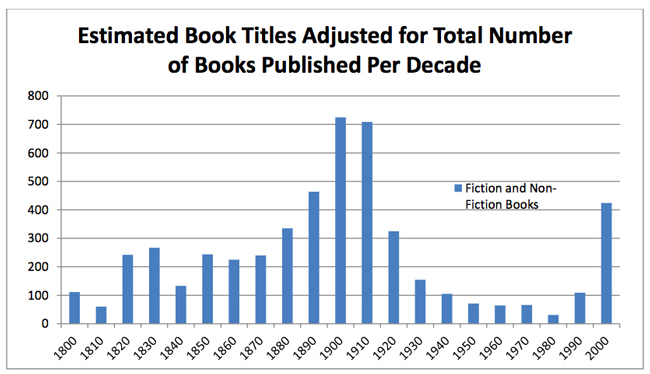
Copyright advocates have long (and successfully) argued that keeping books copyrighted assures that owners can make a profit off their intellectual property, and that that profit incentive will “assure [the books’] availability and adequate distribution.” The evidence, it appears, says otherwise.

Rebecca J. Rosen outlines that evidence in an article at the Atlantic, “The Hole in Our Collective Memory: How Copyright Made Mid-Century Books Vanish.”  It’s always worth asking ourselves just what use present copyright law is for anyone but the massive copyright hoarders like publishers and entertainment retailers. It certainly doesn’t benefit the public and now it’s even clear that it doesn’t even benefit the author whose “intellectual property’ it’s alleged to protect and promote.

Copyright law does, in any case, provide a good lesson in American civics. It demonstrates loudly and clearly whose interests our government has nearest and dearest to its heart.  It’s not the people, of course, but always the intellectual property barons. We can rely on our faithful public servants in government, when given a choice between liberalizing the law (which would have the effect of enriching the creative atmosphere for all) and making it more and more constipated, to always choose the path of most constipation. Call it the trickle out theory of American culture.

Rolling Stone Has a Right to Put Whoever They Want On Their Cover

RS Tsarnaev cover

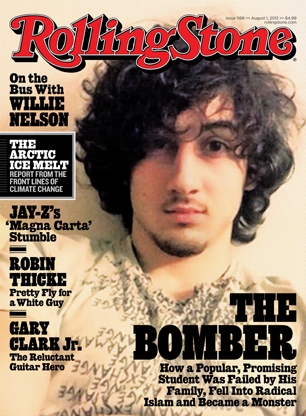
Big, stinking heap of phony outrage story of the day: Rolling Stone is printing a cover story about Boston marathon bombing suspect Dzokhar Tsarnaev and they have the nerve and lack of good taste (which is always the very first phrase we think of when we think American media, isn’t it?) to put a photo of the subject of that cover story on their cover. Shame, shame, Rolling Stone, now every body knows your name (which was probably the point to begin with, wasn’t it?).

Obvious point millions of “concerned” media members and other nervous nellies are blithely missing while falling all over themselves to feel outrage on behalf of poor, weak, innocent, defenseless, little Boston (Shame on you, Dropkick Murphys!): Rolling Stone has the same right to put on their cover whoever or whatever they want to put on their cover as all of those magazines that chose to give Osama bin Laden his celebrity treatment in the aftermath of September 11th did. What part of First Amendment right do you hypocrites not understand?

(Hey, Boston Herald, why don’t you show Rolling Stone the way and just say no to using the Tsarnaevs’ mugs to sell your cheap rag, huh?)

Grow up, America. The world is a hard place. The news media have a right (and responsibility) to make that unpleasant fact known to us.m

No use spending any more time on this ridiculous waste of a non-story. But if you want to defend the “defenders of decency” and attack Rolling Stone‘s “poor taste” and “bad judgment” in the comments, I will be more than happy to kick your ass down there.

Noam Chomsky: “It’s institutional structures that block change.”

Keystone XL demonstration, White House,8-23-20...

Keystone XL demonstration, White House,8-23-2011 Photo Credit: Josh Lopez (Photo credit: Wikipedia)

If yesterday’s post of Lawrence Lessig‘s TED talk on corruption gives you reason for optimism, you may want to check that after you read this from perennial thorn in the side of the powers that be Noam Chomsky, who writes of a peculiar distinction between the most “advanced” societies in the world today and those  least touched by technological “progress” as far as the threat of climate change goes:

So, at one extreme you have indigenous, tribal societies trying to stem the race to disaster.  At the other extreme, the richest, most powerful societies in world history, like the United States and Canada, are racing full-speed ahead to destroy the environment as quickly as possible.  Unlike Ecuador, and indigenous societies throughout the world, they want to extract every drop of hydrocarbons from the ground with all possible speed.

Both political parties, President Obama, the media, and the international press seem to be looking forward with great enthusiasm to what they call “a century of energy independence” for the United States.  Energy independence is an almost meaningless concept, but put that aside.  What they mean is: we’ll have a century in which to maximize the use of fossil fuels and contribute to destroying the world.

And that’s pretty much the case everywhere.  Admittedly, when it comes to alternative energy development, Europe is doing something.  Meanwhile, the United States, the richest and most powerful country in world history, is the only nation among perhaps 100 relevant ones that doesn’t have a national policy for restricting the use of fossil fuels, that doesn’t even have renewable energy targets.  It’s not because the population doesn’t want it.  Americans are pretty close to the international norm in their concern about global warming.  It’s institutional structures that block change.  Business interests don’t want it and they’re overwhelmingly powerful in determining policy, so you get a big gap between opinion and policy on lots of issues, including this one.

This seems to be a pretty important point, but it’s very difficult to know how seriously it’s being taken: The United States government does not have the species’ or the world’s best interests at heart. And it’s not just the Republicans, who are an easy target for American liberals,  that we have to blame. The fact is the Republicans are pretty much brain-dead and useless at this point. But are the Democrats really all that much better on this issue in particular? Continue reading

Ron Paul’s Principle of Personal Responsibility: A Critique

Single_Payer_Public_Opinion.Svg

5. Individuals are responsible for their own actions; government cannot and should not protect us from ourselves.

–from The Ten Principles of a Free Society

Part of the reason I began critiquing Ron Paul’s Ten Principles of a Free Society a couple of years ago was my curiosity about whether they really were essential to any free society or just Ron Paul’s vision of one. I think I can use the fifth principle to show why they are all uniquely Paulian/Libertarian and not, in fact, essential to all notions of a free society. To do that, I just need to show you an example of a free society where government or an authority can and should protect us “from ourselves.” Continue reading

The Idle Rich and the Working Stiff: Nietzche von Hayek on Capital v. Labor

Corey Robin, whose Nation piece on Nietzsche and Hayek I referred to here, posted this comparison of the two thinkers’ ideas on class on his own blog. They support his contention that Hayek was more in tune with Nietzschean philosophy than commonly supposed. Whatever you think of Robin’s thesis, it is instructive at least to see the contempt or, at least, casual dismissal of the worth of the working class in Hayek’s musings.

Corey Robin's avatarCorey Robin

Nietzsche, Human, All Too Human:

Culture and caste.—A higher culture can come into existence only when there are two different castes in society: that of the workers and that of the idle, of those capable of true leisure; or, expressed more vigorously: the caste compelled to work and the caste that works if it wants to….the caste of the idle is the more capable of suffering and suffers more, its enjoyment of existence is less, its task heavier. (§439)

My utopia.—In a better ordering of society the heavy work and exigencies of life will be apportioned to him who suffers least as a consequence of them, that is to say to the most insensible, and thus step by step up to him who is most sensitive to the most highly substantiated species of suffering and who therefore suffers even when life is alleviated to the greatest…

View original post 575 more words

Wealth Inequality in America: It’s Worse Than You Think

Hat tip to Upworthy for this astonishing and superbly well made video.

Also Sprach Hayek: Nietzsche and the Libertarians

Friedrich Wilhelm Nietzsche

Friedrich Wilhelm Nietzsche (Photo credit: risu)

Whatever has value in our world now does not have value in itself, according to its nature—nature is always value-less, but has been given value at some time, as a present—and it was we who gave and bestowed it.

Friedrich Nietzsche, The Gay Science (1882)

Value is therefore nothing inherent in goods, no property of them, but merely the importance that we first attribute to the satisfaction of our needs, that is, to our lives and well-being.

Carl Menger, Principles of Economics (1871)

Corey Robin has a fascinating, very long post up at The Nation on the possible (or even likely)  connections between Nietzsche and the Austrian school economists (Hayek, von Mises and their American disciples). He’s added a bit at Crooked Timber, where a lively discussion is underway.

Here’s his opening:

In the last half-century of American politics, conservatism has hardened around the defense of economic privilege and rule. Whether it’s the libertarianism of the GOP or the neoliberalism of the Democrats, that defense has enabled an upward redistribution of rights and a downward redistribution of duties. The 1 percent possesses more than wealth and political influence; it wields direct and personal power over men and women. Capital governs labor, telling workers what to say, how to vote and when to pee. It has all the substance of noblesse and none of the style of oblige. That many of its most vocal defenders believe Barack Obama to be their mortal enemy—a socialist, no less—is a testament less to the reality about which they speak than to the resonance of the vocabulary they deploy.

The Nobel Prize–winning economist Friedrich Hayek is the leading theoretician of this movement, formulating the most genuinely political theory of capitalism on the right we’ve ever seen. The theory does not imagine a shift from government to the individual, as is often claimed by conservatives; nor does it imagine a simple shift from the state to the market or from society to the atomized self, as is sometimes claimed by the left. Rather, it recasts our understanding of politics and where it might be found. This may explain why the University of Chicago chose to reissue Hayek’s The Constitution of Liberty two years ago after the fiftieth anniversary of its publication. Like The Road to Serfdom (1944), which a swooning Glenn Beck catapulted to the bestseller list in 2010, The Constitution of Liberty is a text, as its publisher says, of “our present moment.”

The benefit of Robin’s article is that it doesn’t dismiss libertarian thought out of hand, as most leftist critiques might be tempted to do, but takes it very seriously and digs deep into its roots, showing precisely where the ancestral ideas that gave rise to our right-wing, market-obsessed American brethren diverged from the extremist right-wing ideology of the fascists in Germany. Libertarians may find the article unsettling, if they take Robin’s arguments as seriously as he takes theirs. Most Americans, left or right, may find it a disturbing read. I certainly did. Continue reading

Harris v. Greenwald II: Is Islam Worse Than Other Religions?

Crusades1

Commenting on my previous post, adpr wrote:

[M]y simple question is: Does Islam at this moment constitute a greater threat compared to other religion for peace. This question was brought up by Harris in his lengthy response on his blog. The key question being, should we consider Islam a greater threat to peace than Jainism, a religion that strictly adheres to non-violence?This question set be back because initially I was agreeing with Greenwald. But Jainism, although still a religion that believes in supernatural deity, has a lot less that I criticize than Islam, Christianity or Zionism?

So, if we were equally critical of all these religions, are we not saying we consider each of these religions equally detrimental to the state of society that we want to change.

This is what Harris wrote on his blog, the passage adpr is referring to (emphasis in the original):

My criticism of faith-based religion focuses on what I consider to be bad ideas, held for bad reasons, leading to bad behavior. Because I am concerned about the logical and behavioral consequences of specific beliefs, I do not treat all religions the same. Not all religious doctrines are mistaken to the same degree, intellectually or ethically, and it would be dishonest and ultimately dangerous to pretend otherwise. People in every tradition can be seen making the same errors, of course—e.g. relying on faith instead of evidence in matters of great personal and public concern—but the doctrines and authorities in which they place their faith run the gamut from the quaint to the psychopathic. For instance, a dogmatic belief in the spiritual and ethical necessity of complete nonviolence lies at the very core of Jainism, whereas an equally dogmatic commitment to using violence to defend one’s faith, both from within and without, is similarly central to the doctrine of Islam. These beliefs, though held for identical reasons (faith) and in varying degrees by individual practitioners of these religions, could not be more different. And this difference has consequences in the real world. (Let that be the first barrier to entry into this conversation: If you will not concede this point, you will not understand anything I say about Islam. Unfortunately, many of my most voluble critics cannot clear this bar—and no amount of quotation from the Koran, the hadith, the ravings of modern Islamists, or from the plaints of their victims, makes a bit of difference.)

If you’re interested, you can read a sort of Muslim rebuttal to Harris here. [On edit: If you follow this link you may or may not be shocked by the Truther headline, which I don’t endorse. However you react to that, the thrust of the discussion below this is on the question of the Quran’s edicts on the murder of a non-Muslim. You and Sam Harris might also be shocked by what the author of this page has to say on that subject, but it won’t be the cheap sort of shock you get with a gratuitous anti-Muslim slur from Ann Coulter.]

Rather than reinvent the wheel, I’m going to try to explain my own position on this question redacting my responses to adpr’s comments and replies to my comments, following the jump. Continue reading

#TeaParty Patriot Founder: “Why do the politicians and media figures want us to hate each other?”

Mark Meckler, one of the founders of Tea Party Patriots, spoke to a crowd of leftists at Seattle’s Citizen University conference recently (hat tip to Upworthy), and what he said resonates in a way with what I was arguing in my debate  with partisan Democrat Milt Shook yesterday on Twitter:

Meckler’s answer to the question above, if you haven’t watched this brief video, is that it profits politicians and others at the center of the DC power structure to maintain the false divide between left and right: the strategy is called Divide and Conquer. I’m thrilled to hear that Meckler is apparently refusing to play along. Imagine if all of us who were inspired by the occupy movement and all of those who were fired up by the Tea Party came to the same conclusion: our enemies are not among the people. Our enemies are the ones who think we owe them votes and viewership, who manufacture our opinions and sell them retail as the stuff of our national politics.

Here’s hoping this is another sign of a new phase of revolution, one that will enable us to take  back the democracy and make it work for people again.

Tortured Argument from a Straight Talker: On Democrats, Progressives and Centrists

I’m in the middle (or hopefully, at the end) of a much more involved debate than I was expecting on Twitter with a fellow named Milt Shook, who operates a blog called, colorfully enough, Please…Cut the Crap. It’s on a topic that is bound to get a reaction from me: the question of whether progressives harm Democrats’ chances with centrists and other purported persuadables by criticizing the party’s standard bearers. He puts his case in a nutshell in the last graph of an article he calls “Stop Complaining About Dems. In 2014, Voters Will Still Only Have 2 Choices: Them or Disaster“:

Voters have two choices every November, and these days, the choice is between competence and disaster. When you trash “the Democrats” mercilessly, the Republicans gain. And if you don’t think we lose when Republicans gain, then you haven’t been paying attention. And we cannot allow 2014 to become just like 2010. We really can’t afford it.

Shook’s central point, it seems to me, is that the system may be severely flawed, but it’s the only one we have, therefore, progressives need to make peace with that and work with the one of only two (face it) parties most closely resembling (vaguely) a progressive one. Here’s how he puts it himself a the beginning of this post:

I know many of the people who read this blog would love to see a “third party” pop up. Unfortunately, our system is built in such a way that all a third party does is weaken one of the other two. This is why the progressive movement keeps failing; we keep hoping for things that can’t happen, and we look down on those things that can happen.

It’s important for everyone to realize that elections are the most important element in a democratic republic. They are the linchpin for everything. Marching and occupying is not, in itself, an expression of democracy. If such activism is not followed by effective campaign strategy that puts the best available people in office every single time, then it’s pretty much worthless.

That phrase is key. The BEST AVAILABLE candidate. In a democracy as diverse as ours, the best available candidate will almost never be far left, unless he or she represents a full-on left district. Sorry.

We might call Shook a “good-enough” progressive (since he identifies himself as a progressive and not a moderate–we’ll give him the benefit of the doubt). He sees the same rickety representative democracy we all see, the same crappy candidates, the same ineffectual institutions; but unlike his fellow lefties, he knows there’s no use breathing even a word of complaint against any of it (except the part to the left of him, perhaps). You might as well complain against the weather or our impending deaths. It’s written before we’re here. It’ll be here after we go. Roll with it, Henry.

It seems reasonable to ask Shook why he bothers to complain about progressives complaining about Democrats. Hasn’t that been going on (in some form or other) since the dawn of American political time as well? I think our friend Shook is concerned that we’re due for a repeat of 2010, which, I’ve just had confirmed by him on Twitter, he believes was “100%” the  fault of progressives rather than of any given Democrat:

I was a progressive working for a Dem in GOP district. I blame progs 100% for 2010.— Milt Shook (@MiltShook) April 16, 2013

Continue reading