AIPAC and the Evils of Republicratism

Gung ho at AIPAC

Gung ho at AIPAC

MJ Rosenberg makes these observations on his eponymous blog:

It’s hard to watch the AIPAC conference for more than a few minutes at a time. For me, the worst part is the pandering (and lying) by Democratic politicians eager to raise money for their next campaign.

So far, Joe Biden has been the worst. He is heavily funded by the Adler family of Miami Beach (he even brought President Obama to their home for a fundraiser), one of the big AIPAC families. Here is Biden talking about how the head of the Adler klan and another AIPAC mogul gave him his “formal education” on the Middle East. (Not to mention all that money.

And, of course, Biden (like John Kerry) knows better than his AIPAC speeches indicate. I have talked to him about Israel and Palestine.He can name the top Palestinian leaders in Fatah and Hamas and tell you the differences between their respective positions. He believes Israel needs to end the occupation and talk to Hamas. He would not dare say it publicly, although he has said  it so often privately that it is amazing the media never reports it.

But Biden does what he thinks he has to because, for politicians like him (that is, pretty much all politicians), nothing is more important than keeping donors happy. Call him a hypocrite but he cries all the way to the bank.

The Republicans are different. Supporting the occupation and threatening war with Iran come naturally to them. They don’t need lobby money for their campaigns and they don’t get Jewish votes anyway.  (This is not to say that they don’t like Sheldon Adelson’s money, just that as the pro-business party, they don’t need it). They support Netanyahu because they believe that the west needs to crush the Muslim world. They do not feign Islamophobia. It’s them.

Do we not hear echoes of  Yeats in this accurate picture of today’s politics?: “The best lack all conviction, while the worst/ Are full of passionate intensity.” Continue reading

Another blast from the past

“[M]odern democracy is at the service of global capitalism. We will not be voting our way toward a more humanist redistribution of resources, least of all if the market does not require it. Similarly, when we voted for Obama in 2008, we did not really vote for what we had the audacity to hope we were voting for, nor for change we really could believe in. We were voting, simply, for the choice the Democratic Party, through its intricate, arduous and obscenely expensive vetting process, presented to Democrats and Americans as the titular head of its party. We were not voting for any ideas other than the usual handful that get talked about endlessly in media that also owe their existence and wealth to global capitalism. We get what global capitalism pays for and wants and needs in that office to further its aims and agenda (of enriching the rich and distributing resources toward that end).”

christofpierson's avatarTragic Farce

I call myself a Democrat because that’s how I’ve been registered all of my voting life. In fact, the older I get, the more disconnected I feel from that label. I don’t want to register as an independent because, Bernie Sanders notwithstanding, I can’t get over the prejudice that American independents are all right-wing at heart. Was it George Wallace’s American Independent Party that instilled this in me? Who knows? It’s beginning to feel, however, that the correct radical stance in this disintegrating context is to not register or vote at all. A vote begins to feel like acquiescence to the corruption.

Did Democrats or any other Obama supporter vote for the fiasco of the last month, culminating in the supreme surrender by our audacious leader last night to the anti-democrats of the Republican Party, bypassing the leaders of his own party to give the (fictional) partisanship-loathing centrists of the…

View original post 1,098 more words

Blast from the past, but it seems relevant still


“It appears that the inequality gap in the US has been caused by a combination of legalized looting of public resources by the financial class and tax policies that have favored them above all other classes in the society. This is, in effect, a government underwritten redistribution of wealth away from the bottom 99% toward the top 1% and, therefore, it would seem to violate the Paulist principle that starts this article.”

christofpierson's avatarTragic Farce

4. Government may not redistribute private wealth or grant special privileges to any individual or group.

–from The Ten Principles of a Free Society

Continuing my gradual critique of Ron Paul’s Ten Principles, the next in line is relevant to what I’ve been talking a lot about these past few weeks, the great impetus behind #OccupyWallStreet: income inequality.

It’s significant that the godfather of the Tea Party movement (the original form of it, anyway) includes wealth redistribution in his principles of liberty. It points up an area where these two movements can either come together or get driven apart.  There’s no question about where #ows stands on this point. Income inequality is a key symptom of the disease #0ws arose in response to, and one of its goals, I would argue,  is to force a correction of what it views this to be: a moral wrong. If Paul is…

View original post 1,279 more words

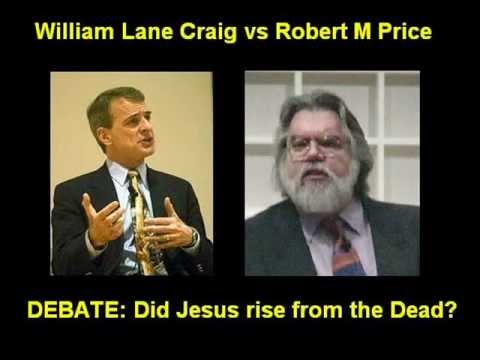
Loving Christianity Better Than Truth: The Craig-Price Debate

Craig Price

I’ve been watching and listening to numerous debates on YouTube between eminent atheists and Christian/theist apologists on subjects like “Does God Exist?”, “Does the Christian God Exist?”, “Did the Resurrection Happen?”, “What’s the Purpose of Life?” and so on. The debaters on the atheist side include Richard Dawkins, Sam Harris, the late Christopher Hitchens and Richard Carrier (whom I wrote about in my last post),  and on the theist side (among others)  Dinesh D’Souza, Rabbi David Wolpe and, most eminent of all, William Lane Craig.

If I had to score the debates he’s been in, though I disagree with him about virtually every point he makes, I’d give by far most wins to the phenomenal Dr. Craig. As atheist and debate aficionado Mark Smith notes about Craig, “He usually wins his debates. However, he wins his debates usually due not so much to being a great debater (which he is), but rather from debating people who haven’t the slightest clue how to debate.” A non-Christian rooting for one of Craig’s atheist opponents and caring about the outcome will probably wind up feeling like a Red Sox fan did last season suffering another visit from the Yankees at Fenway. Continue reading

Why You Should Doubt the Historicity of Jesus

As Richard Carrier explains in this talk given at a skeptic’s conference at the University of Wisconsin at Madison last spring, most academics who are paid to think, write and teach about Jesus will tell you that, while it’s really impossible to know for certain if Jesus was a historical figure, even the most secular of scholars in the field agree with near certainty that he probably did exist in some form or other. The key word there, of course, is the weasel word “probably.” Carrier doesn’t say so here, but these scholars are also very impatient with the alternative idea that Jesus probably wasn’t historically “real,” even though the degree of difference in certainty between their position and Carrier’s (and my) position is virtually non-existent. What the “historicists” have that Carrier and I don’t have is numbers in the academy who agree with them. That’s all they have, and when you get right down to it, that isn’t much at all.

When people who believe in a historical origin for the Jesus story find out how shaky the theoretical ground really is under their feet, they sometimes turn the conversation to less discomforting terrain, stating, for example, that it actually doesn’t matter if Jesus was real at all in the way the Bible says he was or was just made up out of thin air. The point is the wisdom in the religion and the good (or evil) that it hath wrought–or more neutrally, the impact it had on the rest of history. I disagree that this evasion is a suitable response to the challenge posed by Carrier and other mythicists. Their challenge is not aimed at the content of the religion. It’s aimed at the methods of historical research and the question of whether Christian history should be treated as a special case from other types of history,  one where it is not permitted to get too close to the central questions about its origins.

If  you think whether or not Jesus existed in history is an interesting question,  you’ll probably find Carrier’s cogent presentation on reasons not to believe in it provocative, to say the least.  Let me know what you think in the comments below.

Scrap the Constitution?

Do you consent to being governed by these people?

Do you consent to being governed by these people?

On Huffington Post’s Live channel this afternoon, Georgetown law school professor Louis Michael Seidman took up the case he made in the New York Times last weekend that the US should (as the Times piece title had it) “give up on the Constitution.” In the Times piece, Seidman wrote:

AS the nation teeters at the edge of fiscal chaos, observers are reaching the conclusion that the American system of government is broken. But almost no one blames the culprit: our insistence on obedience to the Constitution, with all its archaic, idiosyncratic and downright evil provisions….

Our obsession with the Constitution has saddled us with a dysfunctional political system, kept us from debating the merits of divisive issues and inflamed our public discourse. Instead of arguing about what is to be done, we argue about what James Madison might have wanted done 225 years ago.

As someone who has taught constitutional law for almost 40 years, I am ashamed it took me so long to see how bizarre all this is. Imagine that after careful study a government official — say, the president or one of the party leaders in Congress — reaches a considered judgment that a particular course of action is best for the country. Suddenly, someone bursts into the room with new information: a group of white propertied men who have been dead for two centuries, knew nothing of our present situation, acted illegally under existing law and thought it was fine to own slaves might have disagreed with this course of action. Is it even remotely rational that the official should change his or her mind because of this divination?

Seidman argues  that what he calls “constitutional disobedience” is not radical or new but has been applied over and over in the nation’s history. “No sooner was the Constitution in place than our leaders began ignoring it,” he wrote in the Times. He cites  several big examples, beginning with the writing of the Constitution itself, when national leaders chose expediency over fidelity to the sacred document.

On HuffPo, Seidman the non-radical was met mainly with skepticism from left and right, from defenders of civil liberties as well as from Cato Institute grandee Roger Pilon. The latter said something I actually agree with, that Seidman was getting it “exactly backwards,” suggesting a political solution when our politics is precisely what’s gone wrong. But I think Pilon’s faith in the document is misguided, as I think anyone’s faith in it is. Continue reading

#FreePussyRiot: “Punk Prayer” Translated

To mark the impending ban of Pussy Riot from the Russian Internet for being “extremists” dangerous to the state, I’m reproducing  Carol Rumen’s translation of the Riot’s “Punk Prayer,” the song that gained them a trial for “hooliganism” and world attention in the first place.

(Chorus)

Virgin Mary, Mother of God, banish Putin, banish Putin,

Virgin Mary, Mother of God, banish him, we pray thee!

Congregations genuflect,

Black robes brag gilt epaulettes,

Freedom’s phantom’s gone to heaven,

Gay Pride’s chained and in detention.

KGB’s chief saint descends

To guide the punks to prison vans.

Don’t upset His Saintship, ladies,

Stick to making love and babies.

Crap, crap, this godliness crap!

Crap, crap, this holiness crap!

(Chorus)

Virgin Mary, Mother of God.

Be a feminist, we pray thee,

Be a feminist, we pray thee.

Bless our festering bastard-boss.

Let black cars parade the Cross.

The Missionary’s in class for cash.

Meet him there, and pay his stash.

Patriarch Gundy believes in Putin.

Better believe in God, you vermin!

Fight for rights, forget the rite –

Join our protest, Holy Virgin.

(Chorus)

Virgin Mary, Mother of God, banish Putin, banish Putin,

Virgin Mary, Mother of God, we pray thee, banish him!

Kant and Capital Punishment (Take 2)

In a previous post, I responded to commenter Dudley Sharp‘s citation of a quote purporting to be from Immanuel Kant in support of the death penalty:

“If an offender has committed murder, he must die. In this case, no possible substitute can satisfy justice. For there is no parallel between death and even the most miserable life, so that there is no equality of crime and retribution unless the perpetrator is judicially put to death….A society that is not willing to demand a life of somebody who has taken somebody else’s life is simply immoral.”

Not being a philosopher but having read and thought a bit about Kant on my own, I doubted the provenance of the quote. In fact, it turns out it is from Kant’s Metaphysics of Morals. Kant did indeed believe in and argue for the morality of capital punishment.

This in itself, of course, does not solve the matter. Just because Kant thought the death penalty was moral doesn’t mean it is, in fact, so.  But I want to take the argument seriously and consider it in terms of Kant’s ethics as a whole as I understand them. Again, I’m not trained as a philosopher, as is probably apparent to anyone who wondered why I doubted the original quote was from Kant. But bear with me. This is an important and useful line of thought with respect to justice generally. And by all means, if you think my reasoning is wrong, please explain why in the comments section of this post. Continue reading

#Frankenstorm and the Way We Talk About Climate Change

Andrew Revkin, in his Dot Earth blog for the New York Times, has been writing a lot over the past few days about the relation of global warming/climate change to the ferocious late-season appearance of #Frankenstorm Sandy, which flooded lower Manhattan, Brooklyn and Queens, tore up the Jersey shore, killed some 40 people in the US and left more than 7 million on the East Coast with no power for several days (not to mention the overlooked damage it wrought in the Caribbean before smashing into Delaware on Sunday). Many of his readers (including climate activist Dan Miller) accuse Revkin (who is a science journalist and not a professional scientist) of taking too cautious a tack on climate change generally and on human responsibility for the increase of North Atlantic storm activity in particular. Continue reading

Circumstances of Jill Stein’s Hofstra Arrest: “Symbolic” of What CPD Has Done to Democracy

Jill Stein and Cheri Honkala, the Green Party’s candidate for President and Vice President, you may have heard, were arrested a little over a week ago as they attempted to confront representatives of the Commission on Presidential Debates on the campus of Hofstra University in Hempstead, New York, on the eve of the second official Presidential debate between Democrat Barack Obama and Republican Mitt Romney. What you may not have heard about are the actual circumstances of the arrest.

In a suit for injunctive relief filed on October 22 in Circuit Court in Palm Beach, Florida, to prevent that night’s third official debate from occurring at Lynn University in Boca Raton without inclusion of third parties, Stein’s attorney related the salient details of that arrest:

24.  On October 16th, 2012, less than one week ago, the United States Presidential Green Party candidate, Dr. Jill Stein, and her Vice-Presidential running mate, Ms. Cheri Honkala, were arrested for being on the grounds of the site of the Presidential debate which was scheduled to take place approximately seven hours later.

25.  Dr. Stein arrived on the grounds of Hofstra University at approximately 2:00pm in order to speak with defendant Commission for Presidential Debates to request that she and other “third party” candidates be allowed to participate in that evening’s Presidential debate. Fifteen minutes after making that request to a representative of defendant Commission, Dr. Stein and Ms. Honkala were approached by local police and the Secret Service, at which time they were handcuffed, taken to a remote detention facility/wharehouse/ especially set up to house “protestors”, where they were forced to remain for over eight hours while tightly handcuffed to metal chairs until such time as the debate between the only two candidates “invited” to participate in the debate was over.

26.  When Dr. Stein and Ms. Honkala were finally “un-hancuffed” from the metal chairs and released, they were sent out into the cold night in a remote location with no notice to their lawyers or staff of their release.

27.  Dr. Stein’s comments concerning her arrest, handcuffing, and incarceration are, in essence, the basis for this injunction. Upon her release, Dr. Stein stated: “It was painful but symbolic to be handcuffed for all those hours, because that’s what the Commission on Presidential Debates has essentially done to American democracy.”

We know the suit failed in its primary purpose to stop the debate.  But I hope you will take a minute and think about what happened to Stein and Honkala on the afternoon and evening of October 16. Think about these two women, candidates for president and vice-president,  on the ballot in 38 states with their Republican and Democratic opponents, handcuffed with plastic restraints to metal chairs for eight hours in an “undisclosed location,” like common criminals or terrorists.

This is what American democracy in 2012 looks like.