Kant and Capital Punishment (Take 2)

In a previous post, I responded to commenter Dudley Sharp‘s citation of a quote purporting to be from Immanuel Kant in support of the death penalty:

“If an offender has committed murder, he must die. In this case, no possible substitute can satisfy justice. For there is no parallel between death and even the most miserable life, so that there is no equality of crime and retribution unless the perpetrator is judicially put to death….A society that is not willing to demand a life of somebody who has taken somebody else’s life is simply immoral.”

Not being a philosopher but having read and thought a bit about Kant on my own, I doubted the provenance of the quote. In fact, it turns out it is from Kant’s Metaphysics of Morals. Kant did indeed believe in and argue for the morality of capital punishment.

This in itself, of course, does not solve the matter. Just because Kant thought the death penalty was moral doesn’t mean it is, in fact, so.  But I want to take the argument seriously and consider it in terms of Kant’s ethics as a whole as I understand them. Again, I’m not trained as a philosopher, as is probably apparent to anyone who wondered why I doubted the original quote was from Kant. But bear with me. This is an important and useful line of thought with respect to justice generally. And by all means, if you think my reasoning is wrong, please explain why in the comments section of this post. Continue reading

#Frankenstorm and the Way We Talk About Climate Change

Andrew Revkin, in his Dot Earth blog for the New York Times, has been writing a lot over the past few days about the relation of global warming/climate change to the ferocious late-season appearance of #Frankenstorm Sandy, which flooded lower Manhattan, Brooklyn and Queens, tore up the Jersey shore, killed some 40 people in the US and left more than 7 million on the East Coast with no power for several days (not to mention the overlooked damage it wrought in the Caribbean before smashing into Delaware on Sunday). Many of his readers (including climate activist Dan Miller) accuse Revkin (who is a science journalist and not a professional scientist) of taking too cautious a tack on climate change generally and on human responsibility for the increase of North Atlantic storm activity in particular. Continue reading

Circumstances of Jill Stein’s Hofstra Arrest: “Symbolic” of What CPD Has Done to Democracy

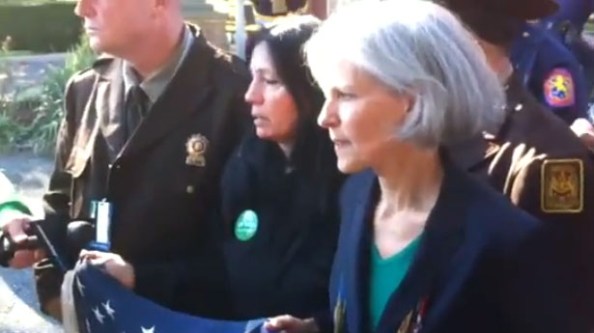
Jill Stein and Cheri Honkala, the Green Party’s candidate for President and Vice President, you may have heard, were arrested a little over a week ago as they attempted to confront representatives of the Commission on Presidential Debates on the campus of Hofstra University in Hempstead, New York, on the eve of the second official Presidential debate between Democrat Barack Obama and Republican Mitt Romney. What you may not have heard about are the actual circumstances of the arrest.

In a suit for injunctive relief filed on October 22 in Circuit Court in Palm Beach, Florida, to prevent that night’s third official debate from occurring at Lynn University in Boca Raton without inclusion of third parties, Stein’s attorney related the salient details of that arrest:

24.  On October 16th, 2012, less than one week ago, the United States Presidential Green Party candidate, Dr. Jill Stein, and her Vice-Presidential running mate, Ms. Cheri Honkala, were arrested for being on the grounds of the site of the Presidential debate which was scheduled to take place approximately seven hours later.

25.  Dr. Stein arrived on the grounds of Hofstra University at approximately 2:00pm in order to speak with defendant Commission for Presidential Debates to request that she and other “third party” candidates be allowed to participate in that evening’s Presidential debate. Fifteen minutes after making that request to a representative of defendant Commission, Dr. Stein and Ms. Honkala were approached by local police and the Secret Service, at which time they were handcuffed, taken to a remote detention facility/wharehouse/ especially set up to house “protestors”, where they were forced to remain for over eight hours while tightly handcuffed to metal chairs until such time as the debate between the only two candidates “invited” to participate in the debate was over.

26.  When Dr. Stein and Ms. Honkala were finally “un-hancuffed” from the metal chairs and released, they were sent out into the cold night in a remote location with no notice to their lawyers or staff of their release.

27.  Dr. Stein’s comments concerning her arrest, handcuffing, and incarceration are, in essence, the basis for this injunction. Upon her release, Dr. Stein stated: “It was painful but symbolic to be handcuffed for all those hours, because that’s what the Commission on Presidential Debates has essentially done to American democracy.”

We know the suit failed in its primary purpose to stop the debate.  But I hope you will take a minute and think about what happened to Stein and Honkala on the afternoon and evening of October 16. Think about these two women, candidates for president and vice-president,  on the ballot in 38 states with their Republican and Democratic opponents, handcuffed with plastic restraints to metal chairs for eight hours in an “undisclosed location,” like common criminals or terrorists.

This is what American democracy in 2012 looks like.

This Was a Foreign Policy Debate?

I made a comment to Washington Post Associate Editor Robert Kaiser in an online chat this afternoon about the debate last night:

It’s likely that Romney’s limitations [in last night’s debate], which kept him trying to drag the subject back to domestic politics, owe to real limitations and inexperience. I don’t know why Obama was so ready to oblige Romney’s fallback to safety and follow him there. Nor do I understand why Bob Schieffer restricted most of the discussion to the Middle East and the military, as though that’s all the foreign policy worthy of being discussed or that Americans are capable of caring about. What about climate change, energy and geopolitics, immigration, drug war policy, the Eurozone and currency wars? This was the least informative debate in memory, except it did tell us almost too much about how vacant the discourse in the US has become, especially among the political class.

Kaiser replied:

Good comments, thanks. But I think both candidates are convinced that domestic issues will be much more important in voters’ final decisions than any concerns about foreign affairs.

The discussion is over, but here is how I respond to Kaiser:  Why have a foreign policy debate at all if it’s understood that the candidates and their campaigns don’t think it’s important to the voters and the media are willing to go along with them on that? Who was this debate for? Who are any of these debates for?

If you want to hear candidates actually talk about the stuff of foreign policy–how politics and economics in the US relates to politics and economics in other countries around the world–you have to watch democracynow.org’s Expanding the Debates, in which Democracy Now! host Amy Goodman allowed the Green Party’s Jill Stein and the Justice Party’s  Rocky Anderson to respond to questions Bob Schieffer put to the president and Mitt Romney. (Libertarian Party candidate Gary Johnson declined Democracy Now’s invitation. )  It’s doubtful, if you watched the official debate only, that you’ll have learned very much at all, given the extremely limited subjects discussed and the frequent derailments with domestic politics. But it’s almost guaranteed you will learn something watching the expanded format.

A Sufi View on the Proper Islamic Response to “Innocence of Muslims”

Sheik Imran Hosein is an Islamic scholar of the Sufi tradition, born in Trinidad and educated in Pakistan and Europe. He’s been a diplomat in his native Trinidad and Tobago and imam at a Long Island masjid, among many other accomplishments.  His academic specialty is Islamic eschatology, which, like Christian eschatology, concerns the end times. He gives a hint of the flavor of his scholarship at the end of the video posted above, the final segment of a three-part interview with a British vlogger who calls himself 108Morris108.

I’m posting the video here because, in a sense, Sheik Hosein answers a comment from Sreenivas on a previous post marveling at the audacity of Islamic protests against the film Innocence of Muslims in Libya and Pakistan. I have to say I think  Sreenivas’s main point about the irrationality of the attacks is hard to argue against. And in fact, Hosein expresses a similar disdain for what he suggests is a non-Islamic reaction that, without reflection and in pure reflex, lashes out violently at the wrong targets. He suggests the protestors behave like puppets on a string being yanked by their enemies. Protestors should peacefully target their own governments, he says, as the Tunisians and Egyptians did in the spring of 2011. Why? Because their governments are enabling the enemies of Islam.

Oddly, he criticizes governments in the Arab world (namely Saudi Arabia) that are lending moral and other forms of aid to the Syrian rebels. Is it because he thinks the Syrian rebellion is essentially violent and “un-Islamic?” Actually, he implies that it’s because the Syrian government, whatever evils it has done in the past, is a steadfast bulwark against Israel. And here is where the Sheik’s eschatology comes in. Just like George W. Bush, the imam believes end times are nigh.

What a mad world we live in!

Underdog Democratic Opponent to Entrenched CA Reactionary Responds to Homophobia Charge

David Secor, who is running as a Democrat in California’s 50th Congressional District based in San Diego against Republican stalwart Duncan Hunter, has replied at length to my previous post. I’ve decided to highlight it as a blog post unto itself rather than hope it will be read in the comments section. I recommend reading the previous post  first to get a sense of what exactly the candidate is responding to.  I won’t comment on Secor’s response here but will, rather, yield the floor to him and respond later.

Before I turn the blog over to Secor, I want to thank him for taking the time to explain himself. I also want to say a word about why I think this dialogue is important. This conflict interests me because it points to some of the less visible strains running through progressive discourse in the US. Here are two “opponents” (I refer to Secor and Mike Flynn) who inhabit more common ground than this personal antagonism between them would suggest, notably on the National Defense Authorization Act of 2012 (NDAA) that Secor refers to here. But beyond the personal disagreement is a political one, over the notion that the system as it stands is capable of change or whether a new counter-system is required to effect real, meaningful change.  This is a conflict that has raged on the left for a long time–and on the right, as well–but only recently has it come to be a vital, relevant debate beyond the merely academic.

So thank you, again,  to David Secor for his contribution to this dialogue. It follows in full after the jump: Continue reading

Homophobia in CA District 50

I’m shocked and a little shaken by something going on in a Congressional district far, far away from my own, here on on the Upper West Side of Manhattan. I wouldn’t have noticed if I hadn’t decided a couple of weeks ago to follow @MikeFlynn14. I don’t remember why I chose to follow Mike, or how our paths crossed, but it was clear to me his politics were sympatico to mine, in the #occupyWallStreet domain of the spectrum. A couple of nights ago, this Tweet from Mike caught my eye:

https://twitter.com/MikeFlynn14/status/253368650462031873

That certainly looked like a slur to me from this David Secor, whoever he was. I clicked through to Secor’s Twitter page expecting to find a Tea Party member and was surprised to find a Congressional candidate instead. For some reason, Secor doesn’t make his party affiliation terribly clear in his self-description (“House Candidate CA D-50.” You can easily miss the D there, as I did) but the politics he promotes there (“End Gridlock, Xtremist Control. GetMoneyOut! I take NO $ over $100! JOBS, ProtectRights4ALL,Women+,Vets+,PubEd+,Build USA RTs a +”) were confusingly left of center for someone who seemed to have just sent a homophobic taunt over Twitter.

I tweeted to Secor:

@davidsecor2012 @mikeflynn14 You’re really running for Congress? From CA? With an attitude [like] that? So you even have a chance?

Continue reading

#TeaParty Does the Devil’s Work in Ohio

Looks Like they do what they’re told.

Along the lines of my last post, the LA Times reports today on an effort by Tea Party groups to purge 2,100 names from Ohio voter rolls: Continue reading

Tax Increases or Books: A Library Fights Back

This video tells the tale of how Troy, Michigan’s public library cleverly and successfully fought back (with the help of an ad agency) against a Tea Party effort to shut it down in lieu of authorizing a 0.7% tax increase to keep it open. This story is probably a common one in the age of austerity. Although the election was almost two months ago, this is the first I heard of the campaign.

I’d like to believe that the Tea Partiers are sincere in their chagrin over the sense that they’ve lost control of their government. We on the left certainly can understand that. But they repeatedly show poor value judgment, as in this instance in Michigan. They can often seem to embody Oscar Wilde’s quip about a cynic knowing the price of everything and the value of nothing. But they’re witless cynics if they don’t know that 0.7% added to a yearly tax bill is a very small price to pay for a library.

Jill Stein on Change: Not Just Something to Believe In

If Pres. Obama and the Democrats talked this talk and walked this walk, they would be giving me something to vote for. Come to think of it, that’s exactly what Jill Stein of the Green Party is giving me.