Is Private Property in America Ever Justly Acquired?

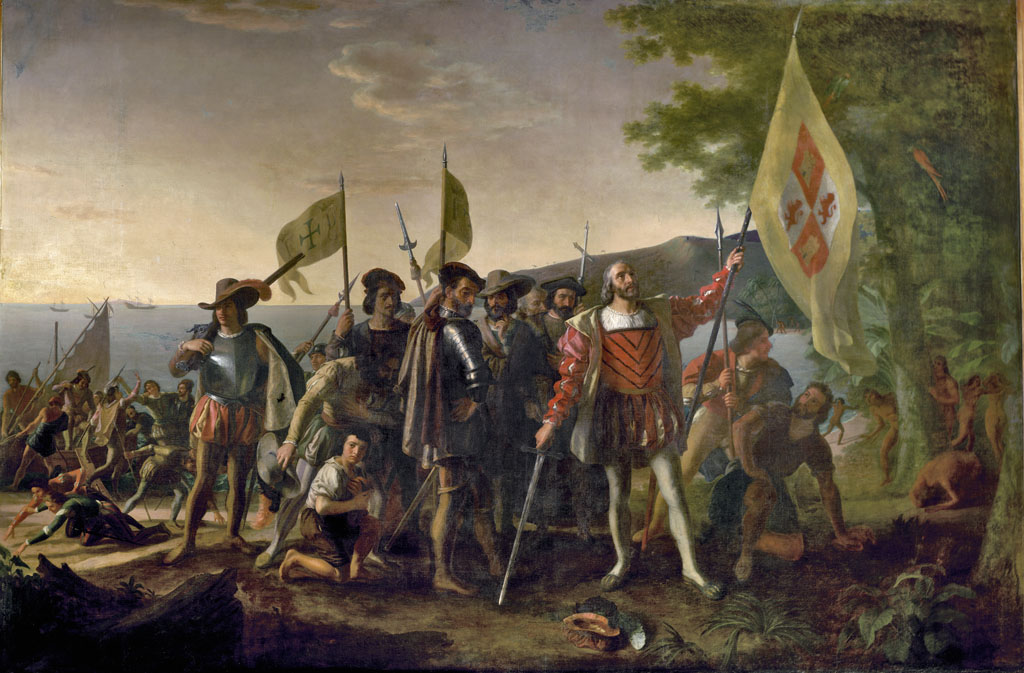
Property acquisition in the Americas begins.

Back to the critique of Ron Paul’s libertarian principles that I began with this post. We’re onto principle number 3:

3. Justly acquired property is privately owned by individuals and voluntary groups, and this ownership cannot be arbitrarily voided by governments.

–from The Ten Principles of a Free Society

[Aside: There’s that word “voluntary” with groups (associations) again! ]

As I’ve shown in my previous critiques, Paul’s principles are half-baked by-products of social contract theory. They want to assert that rights precede government (which even social contract philosophers have to take on faith) and then do away with the government that those philosophers posited as a necessary evil for preserving those rights in society with other individuals. Really? Do away with the government, you might ask? Doesn’t Paul, like Jefferson, for example, just want to keep the government to a size that isn’t able to overwhelm the individual with its potentially arbitrary and despotic power? I would argue that the way these principles are phrased–and this one in particular is a very good example–Paul seeks to postulate a society that operates according to natural rights, with or without a government. He seems to believe that rights in themselves, if we would only just respect them, are sufficient for self-government.
Continue reading

Dueling Armageddons of TeaParty Rep. Steve Pearce

How many Armageddons?

The leaders of US business in the form of the US Chamber of Commerce, the New York Times reports, spent millions of dollars last election cycle electing the extreme right-wing dynamos now holding the Chamber and the rest of us hostage for the sacred Republican principle of a balanced federal budget (well, sacred except to Reagan, the Bushes, and the Congressional Republican leaders of the last 30 years). One of these intellectual giants the Chamber was particularly generous toward displays the kind of logic these new leaders (and, by implication, the rest of us) are at the mercy of:

The chamber spent $436,953 helping to elect Steve Pearce, a New Mexico Republican, almost 20 percent of the total that he was able to raise and spend on his own.

This month, Mr. Pearce told the radio program “News New Mexico” that cutting federal spending was just as important as increasing the debt ceiling.

“We have talked a lot about Armageddon if we don’t pass the debt ceiling,” he said. “There’s an equal Armageddon on the other side if we don’t start curing the spending problems.”

Set aside that the debt-ceiling “Armageddon” is pending next Tuesday and the other has been pending since Bush and Congressional Republicans spent the Clinton-era surplus on tax breaks for the rich, Pearce evidently wants us to believe  that in order to hold off the second already held-off Armageddon, it’s necessary to bring on the first.

Hey, Chamber, thanks for sending us this leader. Thanks a lot.

Beginning of a New American Revolution? #OccupyWallStreet

The following is a public service announcement on behalf of Occupy Wall Street. To participate, go here. Of course, if you’d like to discuss it with me in the comments area right here, please do. Continue reading

The Commons and Individual Rights

I received an interesting comment from Jan C on the previous post which I’d like to respond to in part here. There’s a lot to unpack in Jan’s comment, so I may take another post to elaborate on the question of “property” vs. “possession” and “use” vs. “usury.” But here I want to address a crucial point Jan made about “the commons” and “the individual.”
Continue reading

“Anarcho”-Capitalism: The Boss’s and Landlord’s Paradise

Continuing the discussion I began here and continued here, in this installment, I present for your consideration more of the debate I participated in nearly a decade ago over the inherent contradiction in the term “anarcho”-capitalism.

I should say a little more about why this debate remains relevant. If you listen to the rhetoric of some of the “intellectuals” in the Republican party, you will hear echoes of “anarcho”-capitalism’s sacred principles: private property is a natural right; the state is an impediment to freedom; taxation is theft; freedom to associate with persons of one’s choosing is a natural right. Ron Paul‘s Ten Principles of a Free Society almost reads like a Ten Commandments for anarchos. It’s not surprising given that Paul is a Libertarian and “anarcho”-capitalism is also a product of Libertarian philosophizing, is, in fact, Libertarianism taken over the side of the slippery slope. Paul and his son Rand are far from the only Libertarianism-espousing politicians in power. One other very powerful Libertarian  in the Republican party is Wisconsin Congressman Paul Ryan, whose budget aims to dump social welfare programs from the government’s repertoire of services for the citizenry. These ideas are as close as they’ve ever been to  America’s power center. Are we all comfortable with that? Continue reading

“A democracy should never be practiced outside the limits of a town.”

"It must be acknowledged that the term 'republic' is of very vague application in every language..."

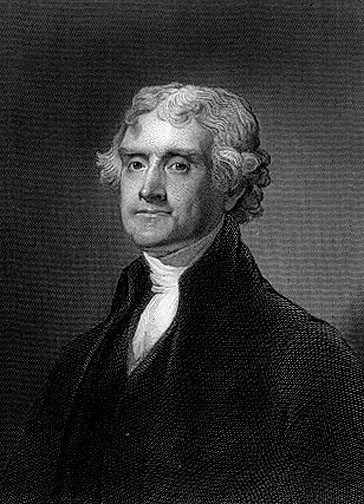
Did Jefferson really say that?

On July Fourth, an essay by Nicole Swinford titled 10 Things You Might Not Know About America’s Independence that appeared on the Fox News Web site was regurgitated in full or in part on dozens of right-wing blogs, including one I commented on in a previous post. This essay is almost certain to become one of those annoying endlessly forwarded e-mails decorated with irritating gifs of flying hummingbirds and flapping flags that will be sent around next Independence Day and every one thereafter.

One should always beware of what America’s right-wing amateur historians of the revolution claim Thomas Jefferson said. Many times, when you’re given a Jefferson “quote” from one of these sources, though it’s always intended to back up their faith that the Founders were exactly in line with their own political beliefs, you can almost certainly guarantee that Jefferson meant the opposite of what they claim he meant.

Take for example Swinford’s 6th “Thing,” which reiterates the Republican talking point about what kind of government the Founders intended. (Note that this is word for word what my right-wing friend posted on his blog in that previous post): Continue reading

“Anarcho”-Capitalism (Proprietarianism) vs. Real Libertarian Anarchism

An American’s sacred right to property being profaned.

Continuing from my last post, here reproduced are excerpts from the Usenet debates I had in the summer and fall of 2002, mostly, with self-described “anarcho”-capitalists. The original argument concerned “rights” and “freedom,” but it quickly led, as most debates with “anarchos” go, to the question of property. As I mentioned yesterday, these issues, I believe, lie at the very heart of the debates going on presently over the debt-ceiling (actually over revenues vs. spending) in Congress and the media. But you won’t hear our pundits or politicians for the most part bring it down to the very ground it all springs from. Continue reading

The “Anarcho”-Capitalist Conundrum

In the wake of September 11, 2001 and continuing through the lead-up to the Iraq War and into 2003, I was involved in an intense debate on several political Usenet groups (my involvement in political Usenet, actually, goes back to the Clinton-Lewinsky scandal of 1997-1998), in which there was a clique of rabidly right wing libertarians holding forth on what they called “anarcho-capitalism.” Many believe that the only logical conclusion to right libertarianism (and to history, actually) is capitalism completely unfettered by government. In a sense, they’re right (except for the history part): If you think government is bad for business and you think business is the best way to distribute resources, then the best government is no government at all.  Of course a lot of Libertarians believe government is necessary to provide for the defense of business interests, but the anarchos would argue that if businesses need to be defended, they should do it themselves. Abolish government, they say, abolish borders, open all the world to capitalism. Let the market determine the value of everything. Continue reading

Republicans on Financial Crisis Inquiry Commission Leaked Documents to Lobbyists

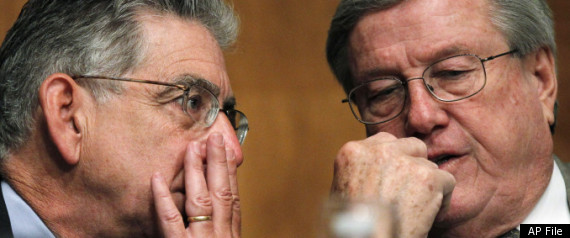
FCIC Chairman Phil Angelides (D) and VIce-Chairman Bill Thomas (R)

I wonder if ethics for some Republicans is so markedly different from everyone else’s such that, when charged with investigating the actions of Wall Street banks that might have led to that little catastrophe of 2008, they feel absolutely no moral qualms about sharing information about their inquiries with a lobbyist for those banks. Do they view that “heads up” to their supposed quarry as an act of heroism, even?  Or do they just not have a nose for what most people would probably view as corruption in the halls of power?

After the jump, a portion of a report to Ranking Member Elijah E. Cummings of the House Committee on  Oversight and Government Reform, An Examination of Attacks on the Financial Crisis Inquiry Commission. This document concerns several charges against Republicans on this Commission, which was established in 2009 to investigate the causes of the financial crisis. Some of the charges concern the Republican Commissioners’ partisanship while on the panel,  i.e., using their position to try to aid House Republicans’ efforts to kill the Dodd-Frank Act, or “parroting” an American Enterprise Institute “theory” about the role Freddie Mac and Fannie Mae played in causing the crisis, which became a major right-wing talking point in Congress and the media. But perhaps the most damning charges concern Vice-Chairman Bill Thomas, who the report alleges, shared information about the ongoing investigation with a friend and colleague who happened to be chief lobbyist for Citibank among other financial players: Continue reading

NYT: Americans’ Long National Free Lunch Daydream Is About to End

David Leonhardt very helpfully explains why Republicans are so single-mindedly pursuing what turns out to be a very popular idea, to keep the debt ceiling right where it is and force the government, come hell or high water (or both and worse), to get its financial house in order: Continue reading