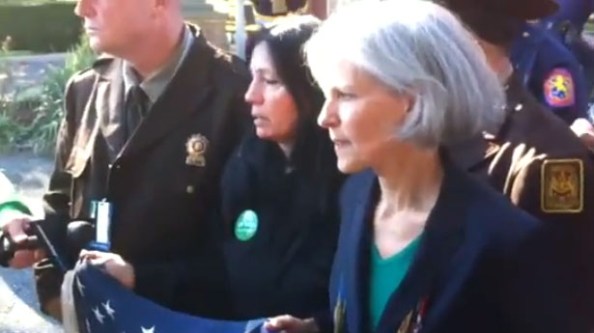
This Was a Foreign Policy Debate?

I made a comment to Washington Post Associate Editor Robert Kaiser in an online chat this afternoon about the debate last night:

It’s likely that Romney’s limitations [in last night’s debate], which kept him trying to drag the subject back to domestic politics, owe to real limitations and inexperience. I don’t know why Obama was so ready to oblige Romney’s fallback to safety and follow him there. Nor do I understand why Bob Schieffer restricted most of the discussion to the Middle East and the military, as though that’s all the foreign policy worthy of being discussed or that Americans are capable of caring about. What about climate change, energy and geopolitics, immigration, drug war policy, the Eurozone and currency wars? This was the least informative debate in memory, except it did tell us almost too much about how vacant the discourse in the US has become, especially among the political class.

Kaiser replied:

Good comments, thanks. But I think both candidates are convinced that domestic issues will be much more important in voters’ final decisions than any concerns about foreign affairs.

The discussion is over, but here is how I respond to Kaiser:  Why have a foreign policy debate at all if it’s understood that the candidates and their campaigns don’t think it’s important to the voters and the media are willing to go along with them on that? Who was this debate for? Who are any of these debates for?

If you want to hear candidates actually talk about the stuff of foreign policy–how politics and economics in the US relates to politics and economics in other countries around the world–you have to watch democracynow.org’s Expanding the Debates, in which Democracy Now! host Amy Goodman allowed the Green Party’s Jill Stein and the Justice Party’s  Rocky Anderson to respond to questions Bob Schieffer put to the president and Mitt Romney. (Libertarian Party candidate Gary Johnson declined Democracy Now’s invitation. )  It’s doubtful, if you watched the official debate only, that you’ll have learned very much at all, given the extremely limited subjects discussed and the frequent derailments with domestic politics. But it’s almost guaranteed you will learn something watching the expanded format.

Mystic or Manic?: Religion on the Brain (or Your Brain on Religion)?

Last night I was having a twittersation with someone named Simon Albert, a nonconforming, conservative Ron Paul supporter who refuses to go along with the Romney Republicans, about something entirely unrelated (at least in obvious ways) to politics: the nature of cosmic reality and what human minds can know about it. It’s not easy to have conversations of such weight in so ephemeral a format, but, of course, that rarely stops “tweeple” from trying.

It began when Albert tweeted, “God is real. #jesus #atheism.” Clearly, Albert was trolling for an argument with an atheist and he put a great big juicy worm on his hook. I bit. Continue reading

A Sufi View on the Proper Islamic Response to “Innocence of Muslims”

Sheik Imran Hosein is an Islamic scholar of the Sufi tradition, born in Trinidad and educated in Pakistan and Europe. He’s been a diplomat in his native Trinidad and Tobago and imam at a Long Island masjid, among many other accomplishments.  His academic specialty is Islamic eschatology, which, like Christian eschatology, concerns the end times. He gives a hint of the flavor of his scholarship at the end of the video posted above, the final segment of a three-part interview with a British vlogger who calls himself 108Morris108.

I’m posting the video here because, in a sense, Sheik Hosein answers a comment from Sreenivas on a previous post marveling at the audacity of Islamic protests against the film Innocence of Muslims in Libya and Pakistan. I have to say I think  Sreenivas’s main point about the irrationality of the attacks is hard to argue against. And in fact, Hosein expresses a similar disdain for what he suggests is a non-Islamic reaction that, without reflection and in pure reflex, lashes out violently at the wrong targets. He suggests the protestors behave like puppets on a string being yanked by their enemies. Protestors should peacefully target their own governments, he says, as the Tunisians and Egyptians did in the spring of 2011. Why? Because their governments are enabling the enemies of Islam.

Oddly, he criticizes governments in the Arab world (namely Saudi Arabia) that are lending moral and other forms of aid to the Syrian rebels. Is it because he thinks the Syrian rebellion is essentially violent and “un-Islamic?” Actually, he implies that it’s because the Syrian government, whatever evils it has done in the past, is a steadfast bulwark against Israel. And here is where the Sheik’s eschatology comes in. Just like George W. Bush, the imam believes end times are nigh.

What a mad world we live in!

Underdog Democratic Opponent to Entrenched CA Reactionary Responds to Homophobia Charge

David Secor, who is running as a Democrat in California’s 50th Congressional District based in San Diego against Republican stalwart Duncan Hunter, has replied at length to my previous post. I’ve decided to highlight it as a blog post unto itself rather than hope it will be read in the comments section. I recommend reading the previous post  first to get a sense of what exactly the candidate is responding to.  I won’t comment on Secor’s response here but will, rather, yield the floor to him and respond later.

Before I turn the blog over to Secor, I want to thank him for taking the time to explain himself. I also want to say a word about why I think this dialogue is important. This conflict interests me because it points to some of the less visible strains running through progressive discourse in the US. Here are two “opponents” (I refer to Secor and Mike Flynn) who inhabit more common ground than this personal antagonism between them would suggest, notably on the National Defense Authorization Act of 2012 (NDAA) that Secor refers to here. But beyond the personal disagreement is a political one, over the notion that the system as it stands is capable of change or whether a new counter-system is required to effect real, meaningful change.  This is a conflict that has raged on the left for a long time–and on the right, as well–but only recently has it come to be a vital, relevant debate beyond the merely academic.

So thank you, again,  to David Secor for his contribution to this dialogue. It follows in full after the jump: Continue reading

Homophobia in CA District 50

I’m shocked and a little shaken by something going on in a Congressional district far, far away from my own, here on on the Upper West Side of Manhattan. I wouldn’t have noticed if I hadn’t decided a couple of weeks ago to follow @MikeFlynn14. I don’t remember why I chose to follow Mike, or how our paths crossed, but it was clear to me his politics were sympatico to mine, in the #occupyWallStreet domain of the spectrum. A couple of nights ago, this Tweet from Mike caught my eye:

https://twitter.com/MikeFlynn14/status/253368650462031873

That certainly looked like a slur to me from this David Secor, whoever he was. I clicked through to Secor’s Twitter page expecting to find a Tea Party member and was surprised to find a Congressional candidate instead. For some reason, Secor doesn’t make his party affiliation terribly clear in his self-description (“House Candidate CA D-50.” You can easily miss the D there, as I did) but the politics he promotes there (“End Gridlock, Xtremist Control. GetMoneyOut! I take NO $ over $100! JOBS, ProtectRights4ALL,Women+,Vets+,PubEd+,Build USA RTs a +”) were confusingly left of center for someone who seemed to have just sent a homophobic taunt over Twitter.

I tweeted to Secor:

@davidsecor2012 @mikeflynn14 You’re really running for Congress? From CA? With an attitude [like] that? So you even have a chance?

Continue reading

#TeaParty Does the Devil’s Work in Ohio

Looks Like they do what they’re told.

Along the lines of my last post, the LA Times reports today on an effort by Tea Party groups to purge 2,100 names from Ohio voter rolls: Continue reading

Tax Increases or Books: A Library Fights Back

This video tells the tale of how Troy, Michigan’s public library cleverly and successfully fought back (with the help of an ad agency) against a Tea Party effort to shut it down in lieu of authorizing a 0.7% tax increase to keep it open. This story is probably a common one in the age of austerity. Although the election was almost two months ago, this is the first I heard of the campaign.

I’d like to believe that the Tea Partiers are sincere in their chagrin over the sense that they’ve lost control of their government. We on the left certainly can understand that. But they repeatedly show poor value judgment, as in this instance in Michigan. They can often seem to embody Oscar Wilde’s quip about a cynic knowing the price of everything and the value of nothing. But they’re witless cynics if they don’t know that 0.7% added to a yearly tax bill is a very small price to pay for a library.

Jill Stein on Change: Not Just Something to Believe In

If Pres. Obama and the Democrats talked this talk and walked this walk, they would be giving me something to vote for. Come to think of it, that’s exactly what Jill Stein of the Green Party is giving me.

Who’s the Status Quo Candidate?

Since David Corn and Mother Jones (with the help of James E. Carter IV and an an0nymous videographer) have exposed Mitt Romney as a major spoiled preppy ass, the Republican presidential nominee and his cheerleaders on the right are valiantly trying to make lemonade with the explanation that Romney’s rant against the 47% who pay no income tax was actually a eulogy for personal responsibility. He has even said that most Americans “would like to be paying taxes” (unlike himself?). On the other hand, Romney is also using this “teachable moment”  to criticize the notion of what he and his Republican parrots (or puppeteers?) disparagingly refer to as “redistribution,” which they claim Obama once professed to “believe in”   during a speech at Loyola University in 1998.  (“[T]he trick is figuring out how do we structure government systems that pool resources and hence facilitate some redistribution because I actually believe in redistribution, at least at a certain level to make sure everybody’s got a shot,”  they say Obama said.) Continue reading

Not So Innocent: How “Desert Warriors” Became “Innocence of Muslims”

Curious about how the infamous “Innocence of Muslims” was ever made? The writer Neil Gaiman has one take on the story from a Georgia (former USSR)-born actress and friend of Gaiman’s named Anna Gurji. Here’s a little taste:

My character Hilary was a young girl who is sold (against her own free will) by her parents to a tribe leader known as GEORGE. She is one of his (most likely, the youngest) brides in the movie.
The film was about a comet falling into a desert and different tribes in ancient Egypt fighting to acquire it for they deemed that the comet possessed some supernatural powers.
The movie that we were doing in Duarte was called “Desert Warrior” and it was a fictional adventure drama. The character GEORGE was a leader of one of those tribes fighting for the comet.
There was no mention EVER by anyone of MUHAMMAD and no mention of religion during the entire time I was on the set. I am hundred percent certain nobody in the cast and nobody in the US artistic side of the crew knew what was really planned for this “Desert Warrior”. Continue reading